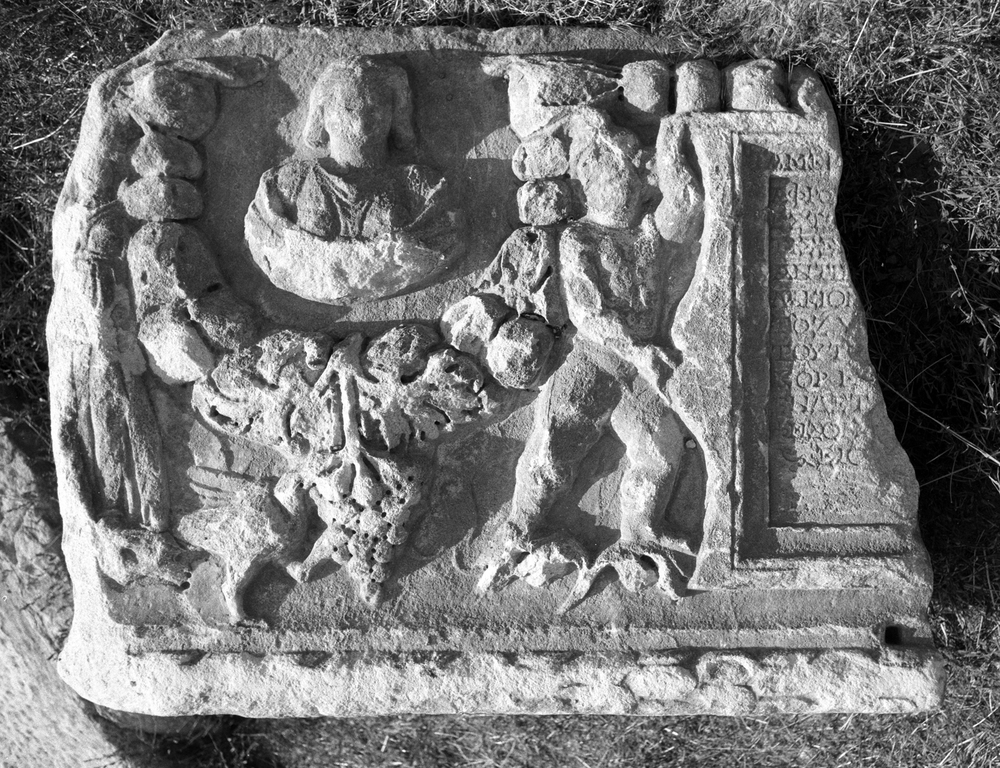
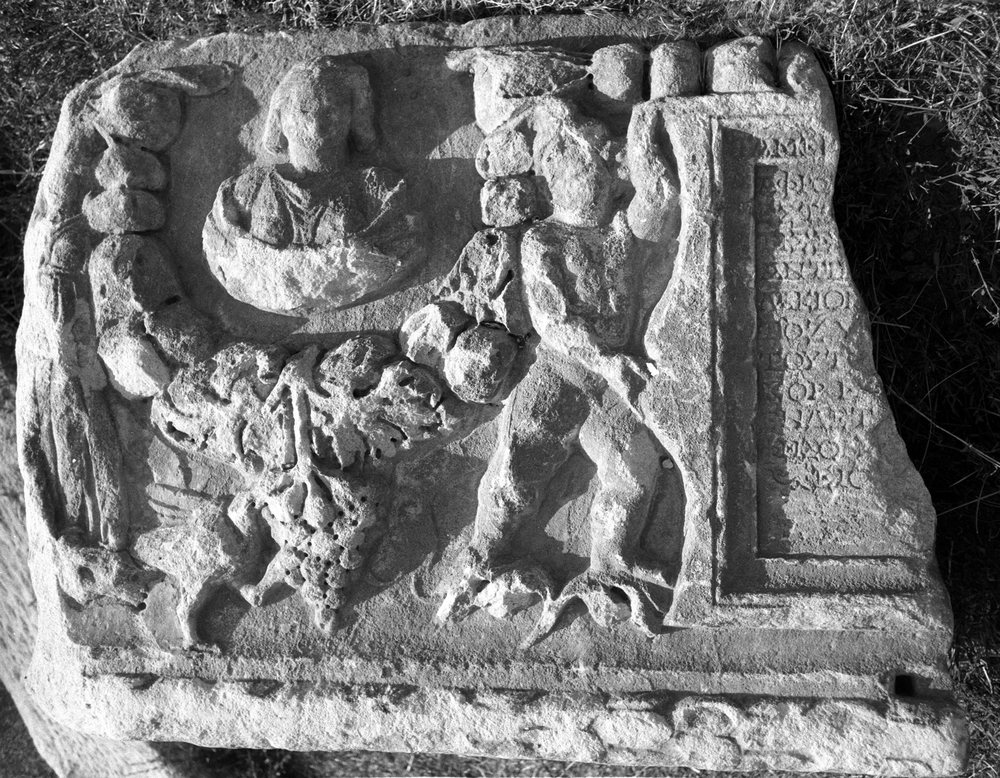
Description: Left side of a white marble
garland
sarcophagus; for full description see Işık 104.
Text:
Inscribed on the upper moulding (line 1) and within the tabula of which only the left side survives (0.15 x 0.39). The text
must have begun on the lid.
Letters: Quite well-designed, cut and aligned in the second-to-fourth-century style, 0.02. Ligatured ΤΗ (l.4); small slanting stroke above the figure in line 7.
Date: Probably first half of the third century CE (lettering, stephanephoros)
Findspot: Aphrodisias:
Necropolis, North-east, near chamber tomb
Original location: Unknown
Last recorded location: Museum.
Interpretive
[... ἀποτείσει? εἰς τὸ ἱερώτατον]
ταμεῖ[ῳ (δηνάρια) καὶ? τῇ θεᾷ]
Ἀφροδ[είτῃ (δηνάρια) ὧν? τὸ τρίτον]
ἔστα[ι τοῦ ἐκδικήσαντος]
τῆς ἐ[πιγραφῆς ἀπετέθη ἀντίγραφον εἰς τὸ χρεοφυ-]
5λάκιον [ἐπὶ στεφανηφόρου]
τὸ ζ Ὑ̣[ψικλέους Ἀδράσ-]
τοῦ τ[ο ...]
ΚΟΡ ((stop)) Μ[..]
ἐν δὲ τ[... τα?-]
10φήσον[ται ...]
((scroll)) ΕΙΟ
( vac. 3)
τὸ ζ Ὑ̣[ψικλέους Ἀδράσ-]
του τ[οῦ Ἀδράστου μη(νὸς)?]
ΚΟΡ ((stop)) Μ[..]
15 ἐν δὲ τ[αῖς εἰσώσταις τα-]
φήσον[ται οὓς ἂν ὁ c. 5]-
((scroll)) ειο[ς βουλήθη]
( vac. 3)
Diplomatic
[···.......................]
ΤΑΜΕΙ[.][........]
ΑΦΡΟΔ[....][..........]
ΕΣΤΑ[................]
ΤΗΣΕ[....................................-]
5ΛΑΚΙΟΝ[...............]
ΤΟΖ.[.............-]
ΤΟΥΤ[.···]
ΚΟΡ • Μ[··]
ΕΝΔΕΤ[···..-]
10ΦΗΣΟΝ[...···]
ΕΙΟ
ΤΟΖ.[.............-]
ΤΟΥΤ[.............]
ΚΟΡ • Μ[··]
15ΕΝΔΕΤ[..............-]
ΦΗΣΟΝ[.........·····]
ΕΙΟ[........]
Apparatus
1-6,.10-12: are supplemented exempli gratia by versions of the standard formula; the sense must be correct (even if the exact wording
is not always so), and only the owner's name (lines 11-12) remains uncertain
6-9: Could be supplemented ἐπὶ στεφανηφόρου]τὸ ζ´ Ὑ[ψικλέους Ἀδράσ] | του τ[οῦ Ἀδράστου Ἱέρα] | κος((stop)) μ[ήνος?]
English translation
Translation source: Reynolds, 2007
... whover contravenes these provisions will pay to the most sacred] treasury [.. ? .. denarii and to the goddess ] Aphrodite
[ .. ? .. denarii, of which one third] shall belong [ to the prosecutor] A copy of the inscribed text [was deposited in the
Property]-archive in the seventh stephanephorate of ?Hy[psikles son of Adras]tos son of [Adrastos ? in the month] KOR M [
.. ? .. ] And in the other burial places shall be buried whomsoever [ .....]eius (sc. the owner) wishes.
Bibliography
Recorded: New York University expedition in 1994, Sarcophagus 433
Publication: Reynolds, 2007 104 , whence SEG 57.1018; IAph2007 13.149.