Description:
White marble
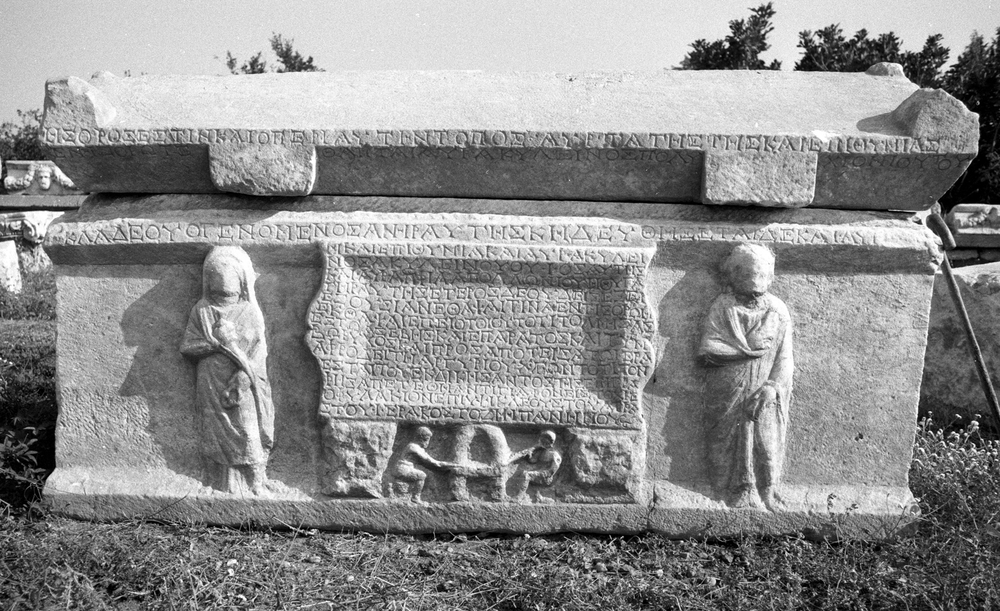
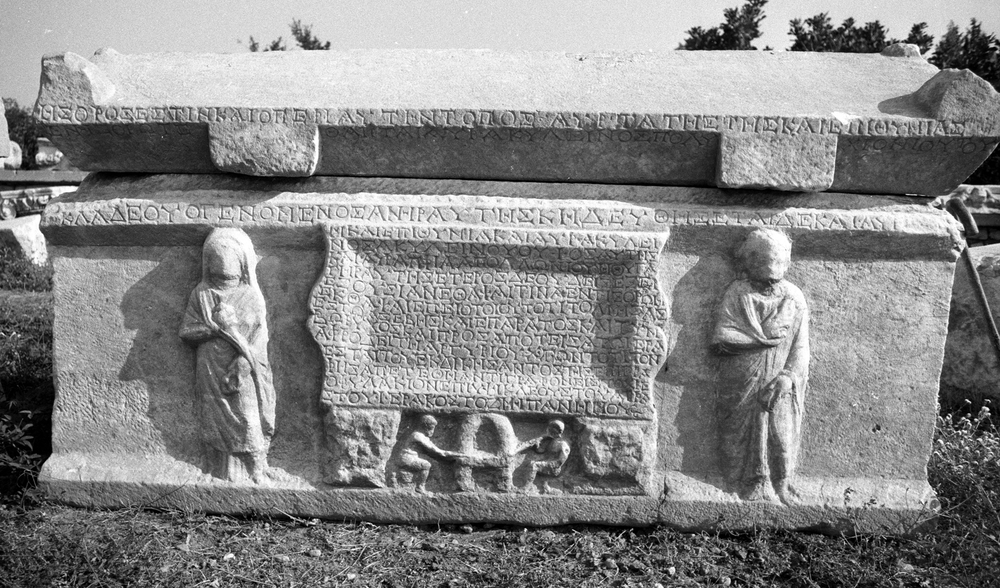
sarcophagus, with lid, ( w: 2.13). On either side of the central
tabula (w: 0.80-0.73 × h: 0.41)
are standing draped figures of a woman (left) and a man. Below the tabula are two roughish downward projections
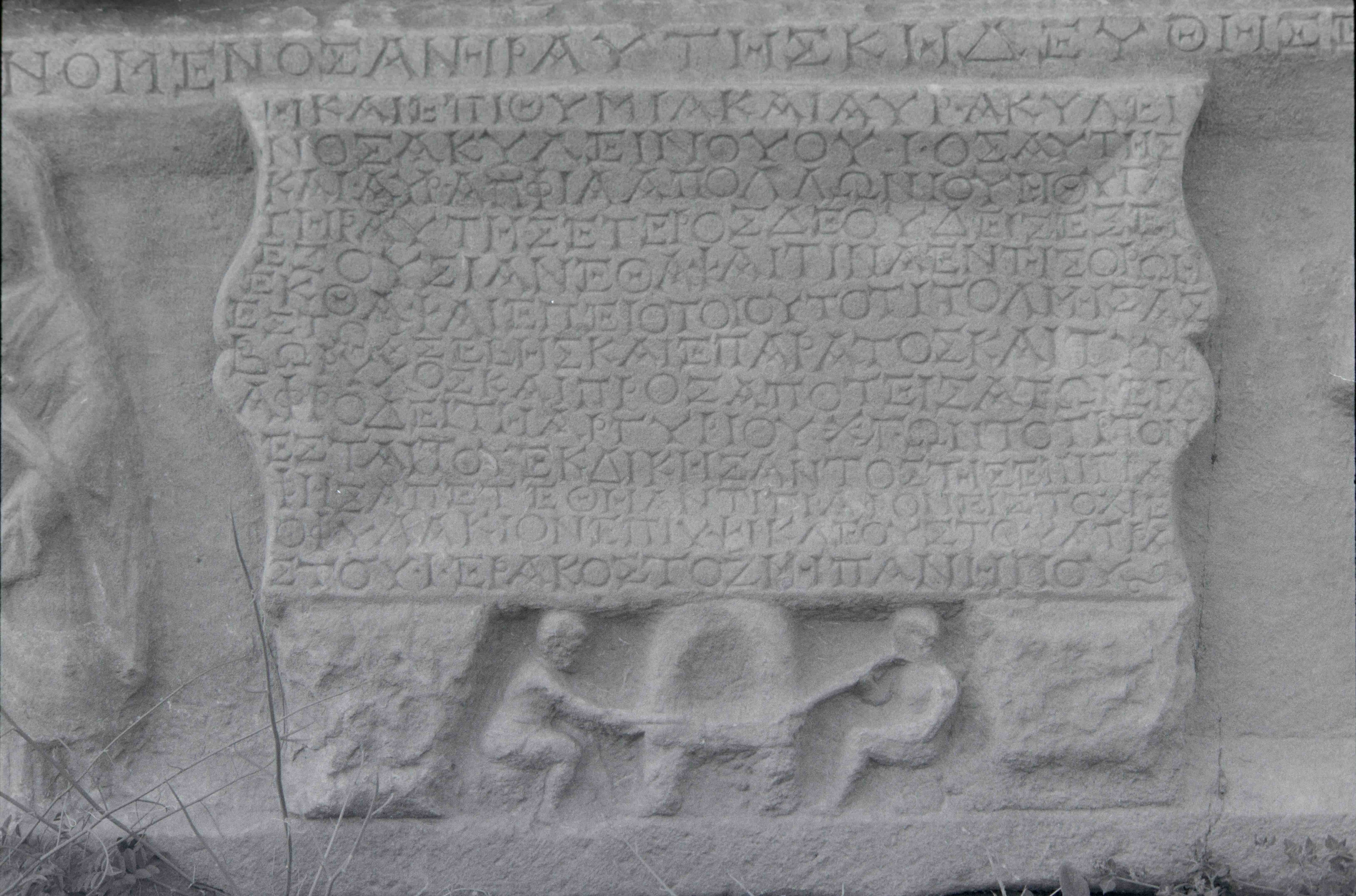
at either side and, between them, a relief scene in which two men sit on either side of what appears to be an
oven. The left-hand man holds something rectangular and flat which appears to be fed into the 'oven';
the right-hand one holds a tubular object up to his face and down to the 'oven' perhaps a glass-blower's tube
(? or a bellows).
Text:
Inscribed on the lid (lines 1-2), on the upper rim (l. 3), on the tabula including its upper and lower mouldings
(lines 4 ff). An erased area beside the relief of the woman could have contained an additional short text (perhaps ζῇ,
which might have been erased when she died).
Letters: Standard forms; line 1-3, ave. 0.03; lines 4 ff., very poorly aligned and well below the standard of the sculpture. Line 2
is interrupted by the vertical projections on the lid. . Diairesis in lines 5, 11, 16
Date: Second to third centuries CE (lettering)
Findspot: Aphrodisias:
Necropolis, North-east: chamber tomb, with
13.111, 13.108, 13.109,
13.110.
Original location: Necropolis, North-east: chamber tomb
Last recorded location: Museum (1994)
Interpretive
ἡ σορός ἐστιν καὶ ἡ περὶ αὐτὴν τόπος ( vac. 1) Αὐρ(ηλίας) Τάτης τῆς καὶ Ἐπιθυμίας
( vac. 3) ἐν ᾗ σορῷ τέ(projection)θαπται Αὐρ(ήλιος) Ἀκυλεινὸς Πολυ(projection)χρονίου τοῦ
Κλαδέου ὁ γενόμενος ἀνὴρ αὐτῆς κηδευθήσεται δὲ καὶ Αὐρ̣(ηλία) [Τά]τ̣η
ἣ̣ καὶ Ἐπιθυμία καὶ Αὐρ(ήλιος) Ἀκυλει-
5νος Ἀκυλεινοῦ ὁ υἱὸς αὐτῆς
καὶ Αὐρ(ηλία) Ἀπφία Ἀπολλωνίου ἡ θυγά-
τηρ αὐτῆς ἕτερος δὲ οὐδεὶς ἕξει
ἐξουσίαν ἐ<ν>θάψαι τινα ἐν τῇ σορῷ ἢ
ἐκθάψαι ἐπεὶ ὁ τοιοῦτό τι τολμήσας
10 ἔστω ἀσεβὴς καὶ ἐπάρατος καὶ τυμ-
βωρύχος καὶ προσαποτεισάτω ἱερὰ
Ἀφροδείτῃ ἀργυρίου (δηνάρια) ͵γ ὧν τὸ τρίτον
ἔσται τοῦ ἐκδικήσαντος τῆς ἐπιγρα-
φῆς ἀπετέθη ἀντίγραφον εἰς τὸ χρε
15 οφυλάκιον ἐπί Ὑψικλέους τοῦ Ἀδρά-
στου Ἱέρακος τὸ ζ μη(νὸς) Πανημου ((scroll))
Diplomatic
ΗΣΟΡΟΣΕΣΤΙΝΚΑΙΗΠΕΡΙΑΥΤΗΝΤΟΠΟΣ ΑΥΡΤΑΤΗΣΤΗΣΚΑΙΕΠΙΘΥΜΙΑΣ
ΕΝΗΣΟΡΩΤΕ(projection)ΘΑΠΤΑΙΑΥΡΑΚΥΛΕΙΝΟΣΠΟΛΥ(projection)ΧΡΟΝΙΟΥΤΟΥ
ΚΛΑΔΕΟΥΟΓΕΝΟΜΕΝΟΣΑΝΗΡΑΥΤΗΣΚΗΔΕΥΘΗΣΕΤΑΙΔΕΚΑΙΑΥ.[..].Η
.ΚΑΙΕΠΙΘΥΜΙΑΚΑΙΑΥΡΑΚΥΛΕΙ
5ΝΟΣΑΚΥΛΕΙΝΟΥΟΥΙΟΣΑΥΤΗΣ
ΚΑΙΑΥΡΑΠΦΙΑΑΠΟΛΛΩΝΙΟΥΗΘΥΓΑ
ΤΗΡΑΥΤΗΣΕΤΕΡΟΣΔΕΟΥΔΕΙΣΕΞΕΙ
ΕΞΟΥΣΙΑΝΕΘΑΨΑΙΤΙΝΑΕΝΤΗΣΟΡΩΗ
ΕΚΘΑΨΑΙΕΠΕΙΟΤΟΙΟΥΤΟΤΙΤΟΛΜΗΣΑΣ
10ΕΣΤΩΑΣΕΒΗΣΚΑΙΕΠΑΡΑΤΟΣΚΑΙΤΥΜ
ΒΩΡΥΧΟΣΚΑΙΠΡΟΣΑΠΟΤΕΙΣΑΤΩΙΕΡΑ
ΑΦΡΟΔΕΙΤΗΑΡΓΥΡΙΟΥ 𐆖 ͵ΓΩΝΤΟΤΡΙΤΟΝ
ΕΣΤΑΙΤΟΥΕΚΔΙΚΗΣΑΝΤΟΣΤΗΣΕΠΙΓΡΑ
ΦΗΣΑΠΕΤΕΘΗΑΝΤΙΓΡΑΦΟΝΕΙΣΤΟΧΡΕ
15ΟΦΥΛΑΚΙΟΝΕΠΙΥΨΙΚΛΕΟΥΣΤΟΥΑΔΡΑ
ΣΤΟΥΙΕΡΑΚΟΣΤΟΖΜΗΠΑΝΗΜΟΥ
Translation
The sarcophagus and the area around it is the property of Aurelia Tate, also called Epithymia, in which sarcophagus Aurelius
Aquilinos son of Polychronios and grandson of Kladaios who was her husband has been buried, and there shall be buried Aurelia
Tate, also called Epithymia and Aurelius Aquilinos son of Aquilinos, her son and Aurelia Apphia daughter of Apollonios, her
daughter. No-one else shall have the right to bury anyone in the sarcophagus or to take anyone out of it, since whoever dares
to do such a thing is to be sacrilegious, accursed and a tomb-breaker, and in addition to pay as moneys sacred to Aphrodite
3000 denarii, of which the third part will belong to the prosecutor. A copy of the inscription was placed in the Record office
in the seventh year of Hypsikles, son of Adrastos Hierax, month of Panemos.
Bibliography
Recorded: New York University expedition in 1994, Sarcophagus 415
Publication: Smith and Ratté, 1996 fig. 23 (photograph only), whence SEG 46.1557 ; IAph2007 13.101; Smith, 2006 Sarcophagus 6 (mention).