Description:
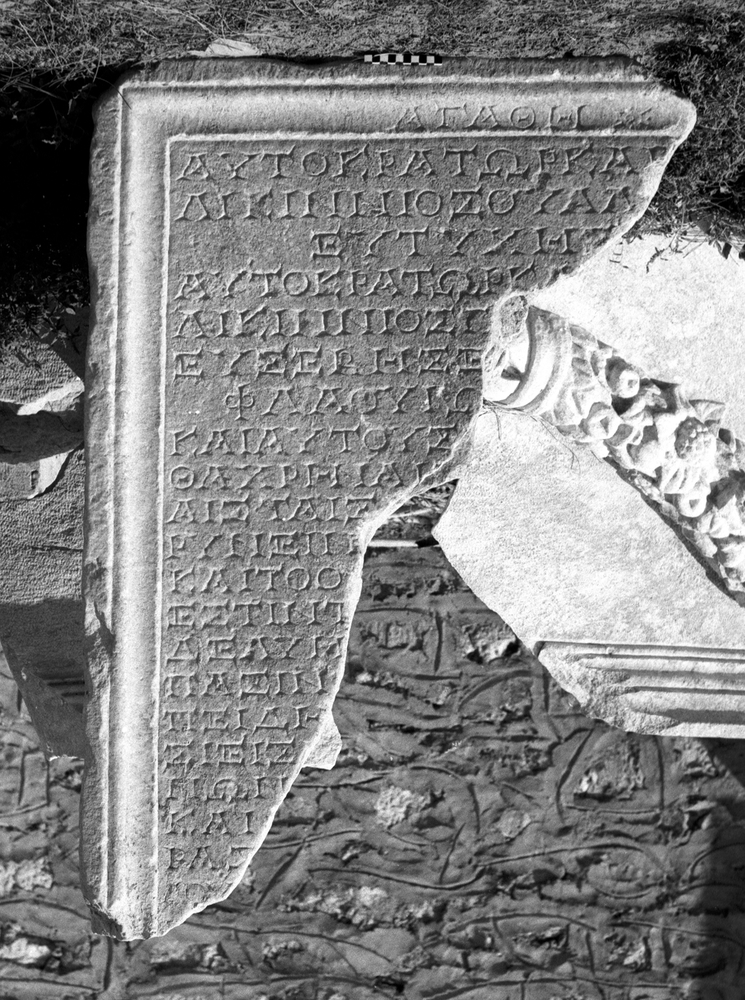
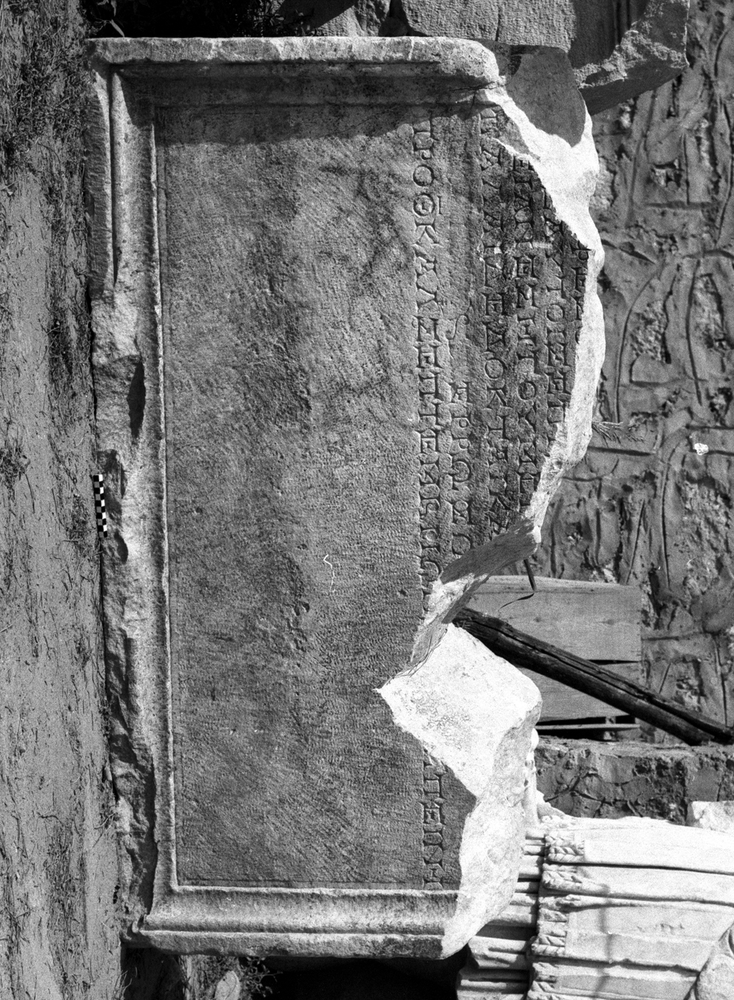
Two adjoining pieces (a: w: 0.76 × h: 1.15 × d: 0.285;
b: w: 1.44 × h: 0.78 × d: 0.285) constituting the upper left corner, the left hand edge, and the lower part of a white marble
panel with moulding at all edges. At the top back of the panel an area had been hollowed out to fit over a moulding on the
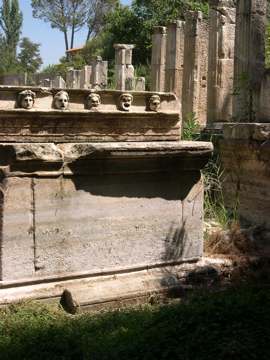
Propylon in the easily identifiable position in which it was originally fixed. .
Text:
Inscribed on the face, within the moulding.
Letters: Characteristic of Aphrodisian public inscriptions of the mid third century CE; average height 0.03
Date: 257 CE
Findspot: Aphrodisias:
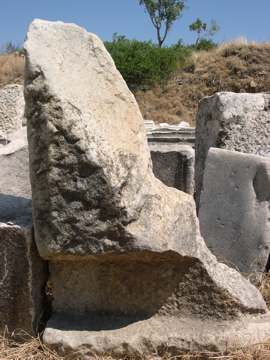
Sebasteion: fallen from the west façade of the Propylon onto the street surface in front of it.
Original location: Sebasteion, Propylon
Last recorded location: Museum.
Interpretive
i
( vac. 6) Ἀγαθῇ ((star)) [Τύχῃ ( vac. 6)]
Αὐτοκράτωρ Καῖσ̣[αρ Πούβλιος]
Λικίννιος Οὐαλ[ηριανὸς Εὐσεβὴς]
( vac. 4)Εὐτυχὴς [Σεβαστὸς ( vac. 4) καὶ]
5Αὐτοκράτωρ Κα̣ῖ̣[σαρ Πούβλιος]
Λικίννιος Γα̣[λλιῆνος ( vac. 2)]
Εὐσεβὴς Ε[ὐτυχὴς Σεβαστὸς]
( vac. 1) Φλαουίῳ [c. 9χαίρειν]
καὶ αὐτοὺς τ̣[οὺς c. 16με-]
10θα χρῆναι Τ[c. 22]-
αις ((stop)) ταῖς [c. 24]-
ρύνειν [c. 25]
καὶ τὸ ΟΤ[c. 25]
ἐστιν τ̣[c. 25]
15ΔΕΛΥΜ[c. 26]
πᾶσιν [c. 25ἐ-]
πειδὴ [c. 20 Ἀφροδι-]
σιεῖς Υ̣[c. 25]
ΝΩΝ[c. 28]
20καὶ [c. 28]
ΡΑΣ[c. 28]
ΛΟΥ[c. 28]
Τ̣[c. 30]
[------] ii
[------]
[c. 4]ΦΕΞΟΙ̣[c. 22]
[---]ς αὐτοῖς ἐπισ̣[c. 28]
[..]είαν ἐξηγουμεν̣[c. 16]
πάλαι δέδοκται κα[c. 15]
5«( vac. 7) ((scroll)) ἔρρωσο» [((scroll))] ( vac. 6)
πρὸ θ καλ(άνδων) Σεπτεμβρίων ἐ̣[ν Ἀγρι]π̣πείνῃ
Diplomatic
i
ΑΓΑΘΗ * [..........]
ΑΥΤΟΚΡΑΤΩΡΚΑΙ.[..........]
ΛΙΚΙΝΝΙΟΣΟΥΑΛ[..............]
ΕΥΤΥΧΗΣ[...............]
5ΑΥΤΟΚΡΑΤΩΡΚ..[...........]
ΛΙΚΙΝΝΙΟΣΓ.[.........]
ΕΥΣΕΒΗΣΕ[..............]
ΦΛΑΟΥΙΩ[·········.......]
ΚΑΙΑΥΤΟΥΣ.[...················..-]
10ΘΑΧΡΗΝΑΙΤ[······················]
ΑΙΣ • ΤΑΙΣ[························]
ΡΥΝΕΙΝ[·························]
ΚΑΙΤΟΟΤ[·························]
ΕΣΤΙΝ.[·························]
15ΔΕΛΥΜ[··························]
ΠΑΣΙΝ[·························.-]
ΠΕΙΔΗ[····················......-]
ΣΙΕΙΣ.[·························]
ΝΩΝ[····························]
20ΚΑΙ[····························]
ΡΑΣ[····························]
ΛΟΥ[····························]
.[······························]
[------] ii
[------]
[····]ΦΕΞΟ.[······················]
[---]ΣΑΥΤΟΙΣΕΠΙ.[····························]
[··]ΕΙΑΝΕΞΗΓΟΥΜΕ.[················]
ΠΑΛΑΙΔΕΔΟΚΤΑΙΚΑ[···············]
5« ΕΡΡΩΣΟ»[.]
ΠΡΟΘΚΑΛΣΕΠΤΕΜΒΡΙΩΝ.[.....].ΠΕΙΝΗ
Apparatus
a.15: The first letter is, I believe, a delta, but it may be a cutter's error for lambda, since λελυμ- is so obvious a possibility, as many colleagues have remarked to me. (J. M. Reynolds)
a.9,.10,.14: What survives of the last letter before the break is consonant with Γ, Ε, Ζ, Ξ, Π, Σ, Τ, and the letter in the same position in line 18 may be so too. (J. M. Reynolds)
b.1: The base of an upright is visible at the point of the break; Γ, Η, Κ, Μ, Ν, Π, Ρ, Τ are possible. (J. M. Reynolds)
b.2: What survives before the break is consonant with Ε, Ζ, Ξ, Σ; ἐπὶ σ[---] , or ἐπισ[τολ-] are both possible. (J. M. Reynolds)
b.3: The lower part of an upright survives at the point of the break, but the word can only be from the middle participle of ἐξηγεῖσθαι. (J. M. Reynolds)
b.4: It would be possible to fit κα[ὶ ἡμεῖς φυλάττομεν] into the space; cf. 8.36, line 12; 8.114, line 12. (J. M. Reynolds)
b.5: The letters ΠΡΟΚΑΛΣΕΠΤ have been erased here but can still be read in a cross light—presumably the designer realized belatedly that the space was
needed for the valediction. (J. M. Reynolds)
b.6: Of the last letter before the break only a lower serif survives, but it shows conclusively that the letter was Δ, Ε, Ζ, Ξ or Σ, and in the context Ε alone is possible; between this serif and the end of the break there is no room for more than 5-6 letters. (J. M. Reynolds)
English translation
Translation source: ALA 2004
a. With good [fortune]. Imperator Caes[ar Publius] Licinius Val[erianus Pius] Felix [Augustus and] Imperator Cae[sar Publius]
Licinius Ga[llienus] Pius F[elix Augustus] to Flavius [---], [greetings]. We [think that?] the [Aphrodisians?] themselves too ought [to ---] and to the [---] is [---] to all [---] since [--- the Aphrodi?]sians [---] and [---]
b. [---] to them a le[tter? ---] explaining(?) [---] it was decided in the past [---]. Farewell Given on twenty-third August in Cologne.
Bibliography
Recorded: New York University expedition, a: 82.195, b: 82.103
Publication: Roueché, ALA 1 (edited by J. M. Reynolds), whence AE 1990.950, McCabe, PHI, 1996 62, ALA 2004 1, IAph2007 9.43.