Description:
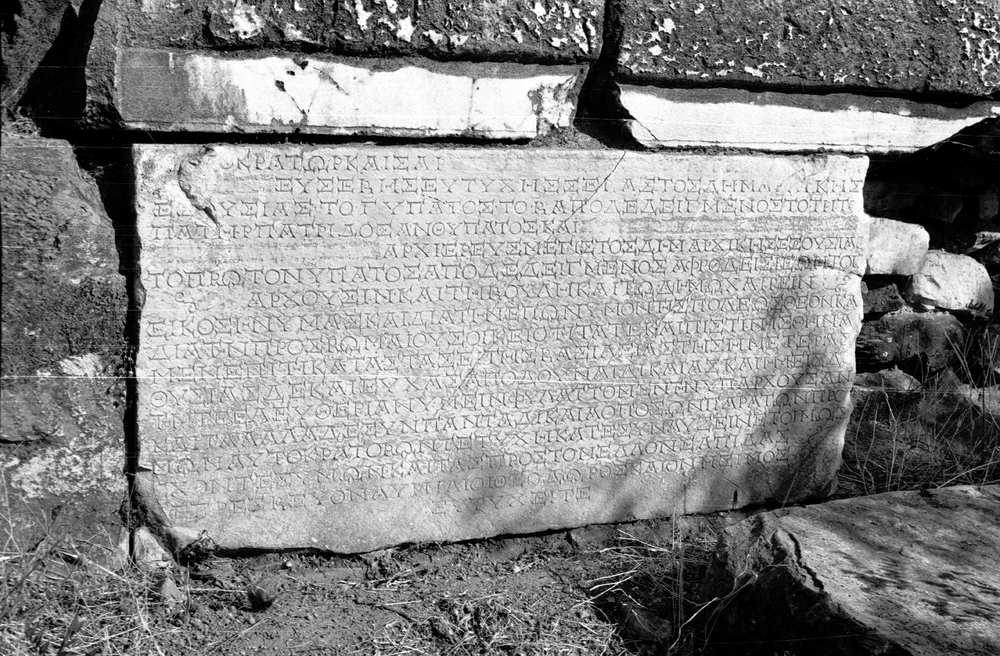
White marble
block (w: 1.61 × h: 0.78 × d: 0.33)
Text:
Inscribed on the face.
Letters: Third century, ave 0.025
Date: December 250 - January 251 CE (reign, titulature, lettering)
Findspot: Aphrodisias:
Walls, South (west part).
Original location:
Theatre: north parodos
Last recorded location: Findspot
Interpretive
αὐτοκράτωρ Καῖσαρ ⟦Γάϊος̣ Μέσ̣σ̣ι̣ο̣ς̣ Κόϊν̣τ̣ος̣ Τ̣[ραϊα]ν̣ὸς̣
Δ̣[έκ]ι̣ος̣⟧ Εὐσεβὴς Εὐτυχὴς Σεβαστός δημαρχικῆς
ἐξο̣υσίας τὸ γ ὕπατος τὸ β ἀποδεδειγμένος τὸ τρίτον
πατὴρ πατρίδος ἀνθύπατος ((stop)) καὶ ⟦Κόϊν̣τ̣ος̣ Ἑ̣ρ̣έν̣ν̣ι̣ος̣ Ἐ̣τ̣ρ̣οῦσ̣κ̣ο[ς]
5Μέσ̣σ̣ι̣ος̣ Δ̣έκ̣ι̣ος̣⟧ ἀρχιερεὺς μέγιστος δημαρχικῆς ἐξουσίας
τὸ πρῶτον ὕπατος ἀποδεδειγμένος Ἀφροδεισιέων τοῖς
((scroll)) ἄρχουσιν ((stop)) καὶ τῇ βουλῇ καὶ τῷ δήμῳ χαίρειν ((scroll))
εἰκὸς ἦν ὑμᾶς καὶ διὰ τὴν ἐπώνυμον τῆς πόλεως θεὸν καὶ
διὰ τὴν πρὸς Ῥωμαίους οἰκειότητά τε καὶ πίστιν ἡσθῆναι
10 μὲν ἐπὶ τῇ καταστάσει τῆς βασιλείας τῆς ἡμετέρας
θυσίας δὲ καὶ εὐχὰς ἀποδοῦναι δικαίας καὶ ἡμεῖς δὲ
τήν τε ἐλευθερίαν ὑμεῖν φυλάττομεν τὴν ὑπάρχουσαν
καὶ τὰ ἄλλα δὲ σύνπαντα δίκαια ὁπόσων παρὰ τῶν πρὸ ἡ
μῶν Αὐτοκρατόρων τετυχήκατε συναύξειν ἑτοίμως
15 ἔχοντες ὑμῶν ((stop)) καὶ τὰς πρὸς τὸ μέλλον ἐλπίδας ((scroll))
( vac. 1) ἐπρέσβευον Αὐρήλιοι Θεόδωρος καὶ Ὀνήσιμος
( vac. 12) εὐτυχεῖτε ( vac. 12)
Diplomatic
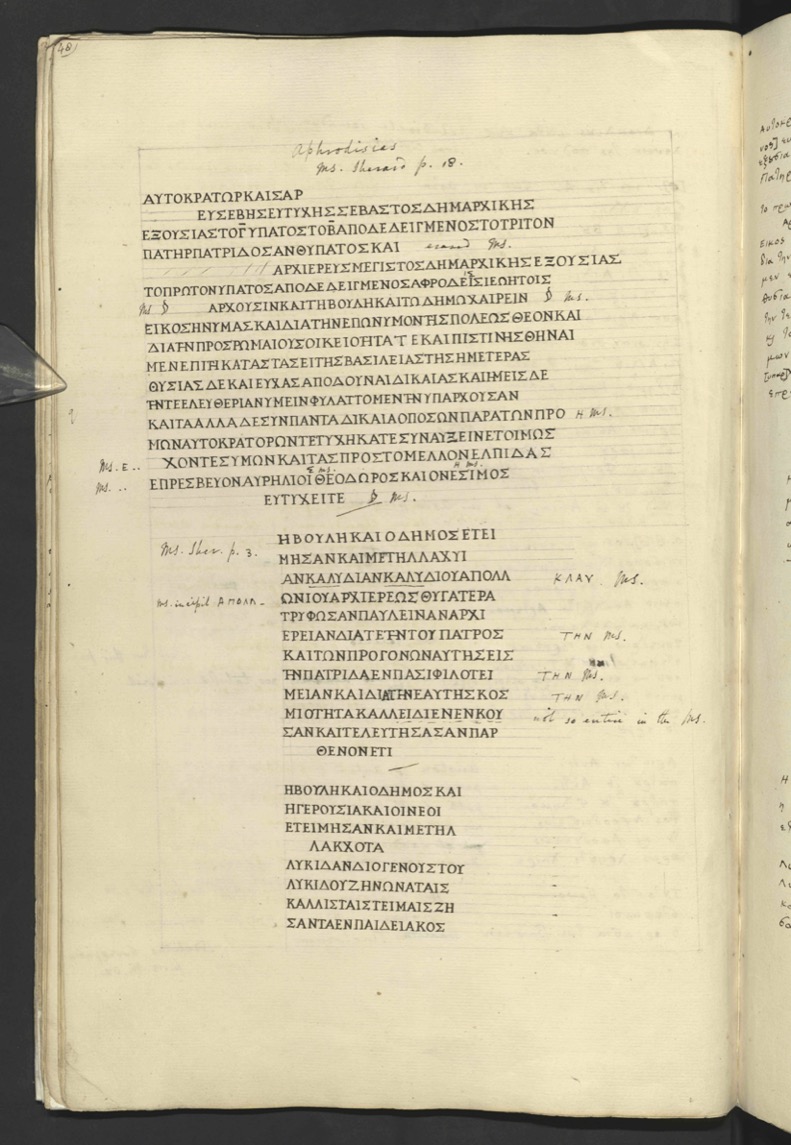
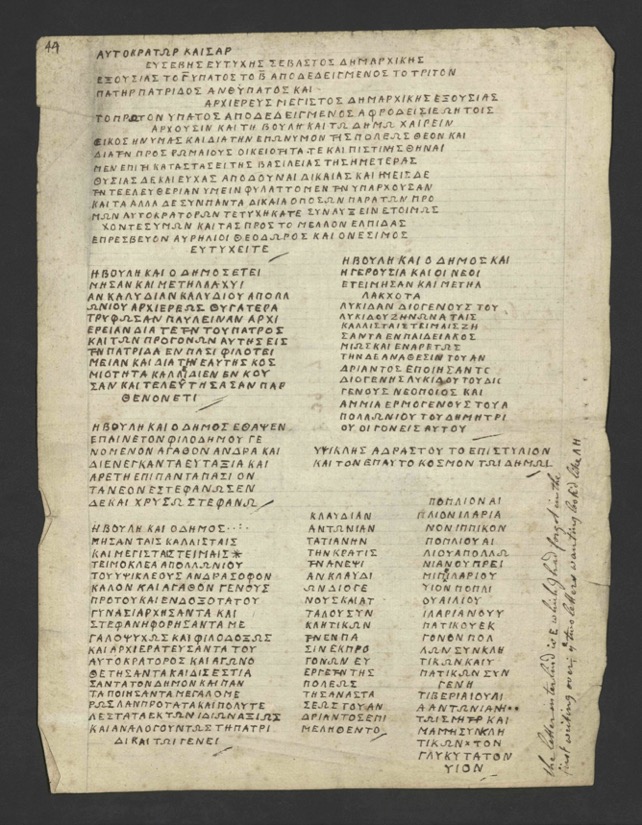
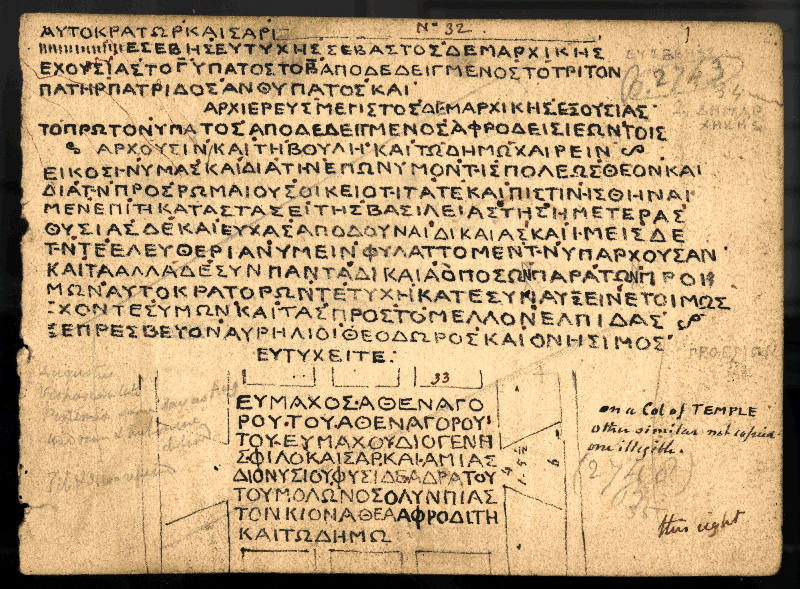
ΑΥΤΟΚΡΑΤΩΡΚΑΙΣΑΡ⟦ΓΑΙΟ.ΜΕ.....ΚΟΙ..Ο..[....].Ο.
.[..].Ο.⟧ΕΥΣΕΒΗΣΕΥΤΥΧΗΣΣΕΒΑΣΤΟΣΔΗΜΑΡΧΙΚΗΣ
ΕΞ.ΥΣΙΑΣΤΟΓΥΠΑΤΟΣΤΟΒΑΠΟΔΕΔΕΙΓΜΕΝΟΣΤΟΤΡΙΤΟΝ
ΠΑΤΗΡΠΑΤΡΙΔΟΣΑΝΘΥΠΑΤΟΣ • ΚΑΙ⟦ΚΟΙ..Ο...Ε...Ο....ΟΥ..Ο[.]
5ΜΕ...Ο..Ε..Ο.⟧ΑΡΧΙΕΡΕΥΣΜΕΓΙΣΤΟΣΔΗΜΑΡΧΙΚΗΣΕΞΟΥΣΙΑΣ
ΤΟΠΡΩΤΟΝΥΠΑΤΟΣΑΠΟΔΕΔΕΙΓΜΕΝΟΣΑΦΡΟΔΕΙΣΙΕΩΝΤΟΙΣ
ΑΡΧΟΥΣΙΝ • ΚΑΙΤΗΒΟΥΛΗΚΑΙΤΩΔΗΜΩΧΑΙΡΕΙΝ
ΕΙΚΟΣΗΝΥΜΑΣΚΑΙΔΙΑΤΗΝΕΠΩΝΥΜΟΝΤΗΣΠΟΛΕΩΣΘΕΟΝΚΑΙ
ΔΙΑΤΗΝΠΡΟΣΡΩΜΑΙΟΥΣΟΙΚΕΙΟΤΗΤΑΤΕΚΑΙΠΙΣΤΙΝΗΣΘΗΝΑΙ
10ΜΕΝΕΠΙΤΗΚΑΤΑΣΤΑΣΕΙΤΗΣΒΑΣΙΛΕΙΑΣΤΗΣΗΜΕΤΕΡΑΣ
ΘΥΣΙΑΣΔΕΚΑΙΕΥΧΑΣΑΠΟΔΟΥΝΑΙΔΙΚΑΙΑΣΚΑΙΗΜΕΙΣΔΕ
ΤΗΝΤΕΕΛΕΥΘΕΡΙΑΝΥΜΕΙΝΦΥΛΑΤΤΟΜΕΝΤΗΝΥΠΑΡΧΟΥΣΑΝ
ΚΑΙΤΑΑΛΛΑΔΕΣΥΝΠΑΝΤΑΔΙΚΑΙΑΟΠΟΣΩΝΠΑΡΑΤΩΝΠΡΟΗ
ΜΩΝΑΥΤΟΚΡΑΤΟΡΩΝΤΕΤΥΧΗΚΑΤΕΣΥΝΑΥΞΕΙΝΕΤΟΙΜΩΣ
15ΕΧΟΝΤΕΣΥΜΩΝ • ΚΑΙΤΑΣΠΡΟΣΤΟΜΕΛΛΟΝΕΛΠΙΔΑΣ
ΕΠΡΕΣΒΕΥΟΝΑΥΡΗΛΙΟΙΘΕΟΔΩΡΟΣΚΑΙΟΝΗΣΙΜΟΣ
ΕΥΤΥΧΕΙΤΕ
Apparatus
1: The first two letters seen in the eighteenth century (Sherard, Wood) but not later.
1-2: The erased imperial name was supplied by Waddington where Boeckh and all others after him had restored the name of Diocletian.
2: Fellows failed to see ΡΧΙ.
3: ΤΡΙΤΟΝ seen by all copyists up to and including Waddington; ΤΡΙΤΟ Calder, 1934
4: εὐεργέτης after καί in the copy transmitted by Raoul-Rochette was rightly omitted in CIG.
4-5: The erased prince's name supplied by Waddίngton (but in the form Ἑρρέννιος Τραιανὸς Δέκιος Καίσαρ), where Boeckh had restored
the name of Maximian.
8: ΚΑΙ seen by all copyists up to and including Waddington; ΚΑ[Ι] Calder, 1934
10: Waddingtom omitted the initial διὰ || ΤΗΙ Abbott and Johnson, 1926
13: σύνπαντα; σύμπαντα Le Bas and Waddington, 1870 Final Η recorded by all copyists except Wood and Calder - it is very cramped; ΧΟΝΤΕΣ Wood, 1750, Fellows, 1840 ΕΧΟΝΤΕΣ all other copyists
16: ΑΥΡΗΛΙΟΣ Sherard, 1705
English translation
Translation source: Reynolds, 1982
Imperator Caesar [[C. Messius Q. Traianus Decius]], Pius, Felix, Augustus, holding tribunician power for the third time, consul
for the second time, designated for the third, father of his country, proconsul, and [[Q. Herennius Etruscus Messius Decius]],
Pontifex Maximus, holding the tribunician power for the first time, consul designate to the Magistrates, Council and People
of the Aphrodisians, greetings.
It was to be expected, both because of the goddess for whom your city is named and because of your relationship with the Romans
and loyalty to them, that you rejoiced at the establishment of our kingship and made the proper sacrifice and prayers. We
preserve your existing freedom and all the other rights which you have received from the emperors who preceded us, being willing
also to give fulfilment to your hopes for the future.
Aurelius Theodoros and Aurelius Onesimos carried out the duties of ambassadors. Farewell
English translation
Translation source: Millar, 1977
(Lines 8-15): It was natural for you in view of the goddess after whom your city is named and of your friendship and good faith to the
Romans, to rejoice at the establishment of our kingship, and to offer the proper sacrifices and prayers. We preserve your
existing freedom and all the other privileges which you have gained from the emperors before us, being willing to reward your
hopes in the future also./
English translation
Translation source: Fellows, 1841
. . . . . Emperor Caesar [names erased], the Pious and Happy, Augustus, in the third year of his tribunitial power and in
his second Consulship, Consul Elect for the third time, the Father of his country, Proconsul, and . . . . . . [name erased]
Supreme Pontiff, in the first year of his tribunitial power. Consul Elect: To the Magistrates and the Senate, and the People
of the Aphrodisians, greeting. It was meet for you, on account as well of the Goddess that gave your city its name, as your
relations with the Romans and your good faith, to rejoice at the establishment of our reign, and to offer the due sacrifices
and prayers. And likewise we protect your liberty, which now is, and all other things [that are] right, which you have obtained
of the Emperors before us, being willing to unite with you in advancing your hopes for the future also. Ambassadors were Aurelius
[?], Theodorus and Onesimus. Farewell
Bibliography
Recorded: Picenini, 1705 30v, whence Sherard, 1705 41; Wood, 1750 14, 48, 14, loose page 44; Deering, 1812 8, no.32; Texier, 1835; Fellows, 1840; a visitor who provided a copy to Raoul-Rochette; Bailie, 1842; Loew, 1841; Waddington, 1850; Gaudin, 1904 142; Calder, 1934; New York University expedition in 1965
Publication: CIG II.2, 1835 2743 ; Fellows, 1841 16 , whence CIG II.3, 1843 p. 1109; Texier, 1839 154; Bailie, 1846 44 ; Franz, 1847 from Loew, a.9 ; Le Bas and Waddington, 1870 1624 ; Reinach, 1906 2 (comments), whence Abbott and Johnson, 1926 145; MAMA 8 424 whence Millar, 1977 417; Reynolds, 1982 25 , whence SEG 32.1097 , Robert, Bulletin Épigraphique 1983.384 , AE 1984.877 , McCabe, PHI, 1996 61 ; IAph2007 8.114.