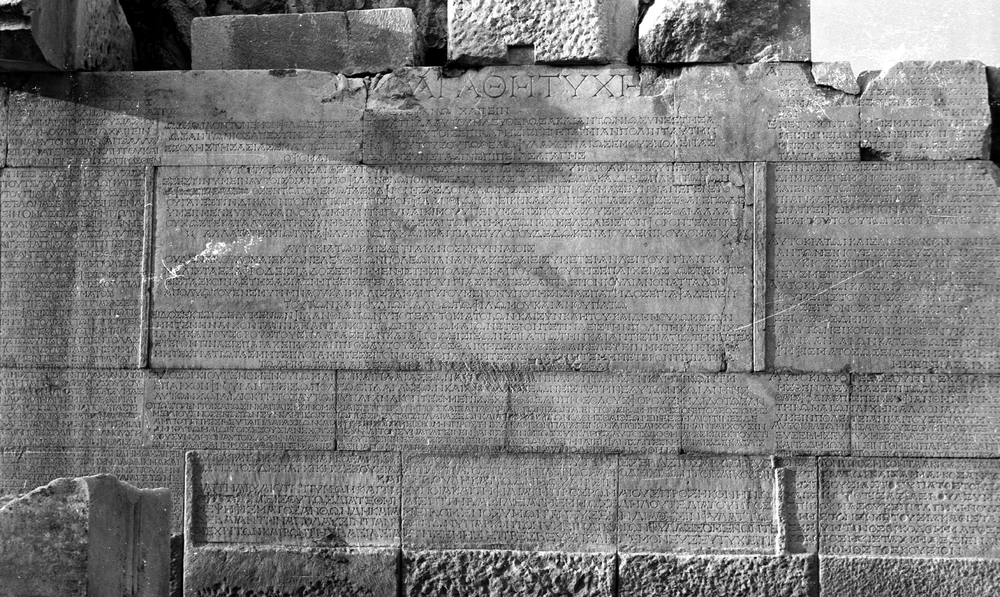
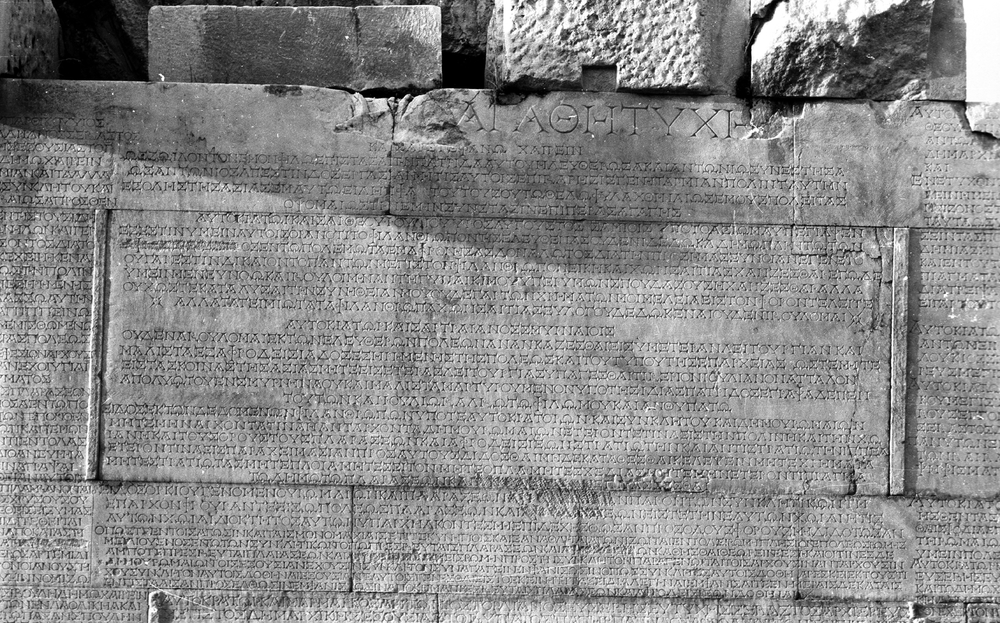
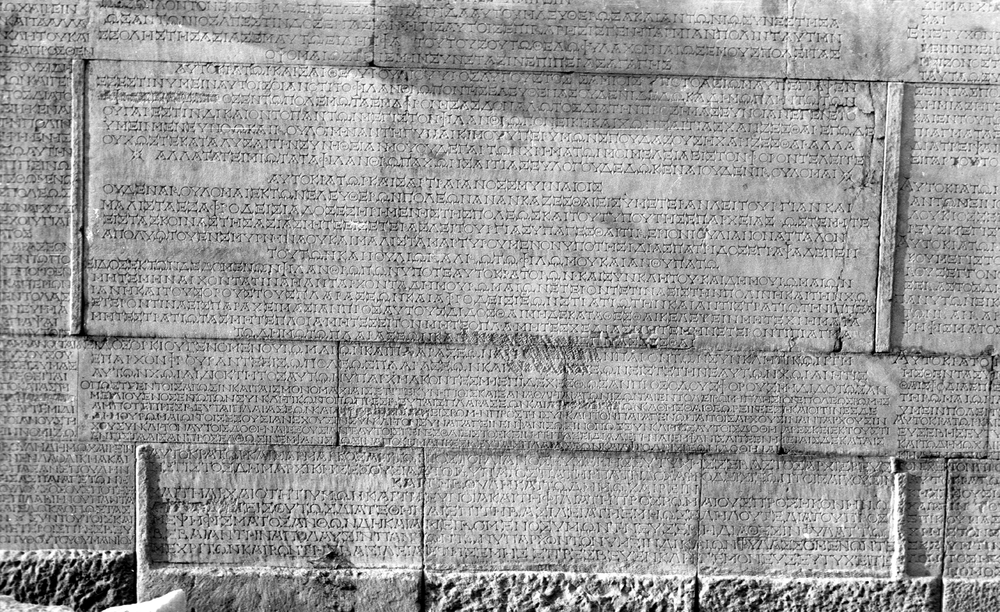
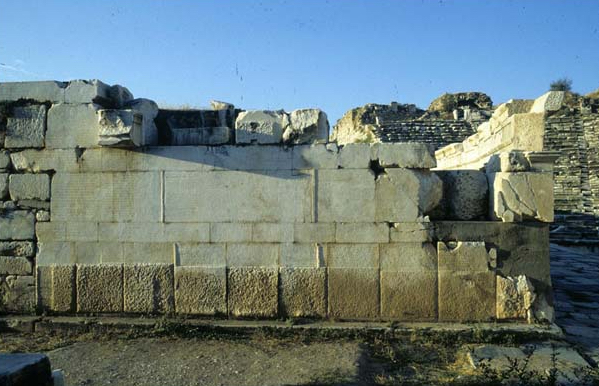
Description: Archive wall, column 4, second course
Text:
Inscribed area, w: 2.03 × h: 0.295.
In line l, the letters ΕΓΡΑ are cut on an inset piece of stone, presumably replacing a piece on which the cutter had made
an error.
Letters: Second to third century A.D.: ave. 0.02; three apices in line 5; diaeretic dots in line 1; star-shaped stops at each end of
line 7.
Date: Inscription: second to third centuries C.E. Document: early 38 BCE (lettering, context, content)
Findspot: Aphrodisias:
Theatre: north parodos wall
Original location: Theatre, north parodos
Last recorded location: Findspot
Interpretive
( vac. 8) Αὐτοκράτωρ Καῖσαρ θεοῦ Ἰουλίου υἱὸς Αὔγουστος Σαμίοις ὑπὸ τὸ ἀξίωμα ὑπέγραψεν
ἔξεστιν ὑμεῖν αὐτοῖς ὁρᾶν ὅτι τὸ φιλάνθρωπον τῆς ἐλευθερίας οὐδενὶ δέδωκα δήμῳ πλὴν τῷ τῶν
⟦[Ἀφροδεισιέων]⟧ ὃς ἐν τῷ πολέμῳ τὰ ἐμὰ φρονήσας δοριάλωτος διὰ τὴν πρὸς ἡμᾶς εὔνοιαν ἐγένετο
οὐ γάρ ἐστιν δίκαιον τὸ πάντων μέγιστον φιλάνθρωπον εἰκῇ καὶ χωρὶς αἰτίας χαρίζεσθαι ((stop)) ἐγὼ δὲ
5 ὑμεῖν μὲν εὐνοῶ καὶ βουλοίμην ἂν τῇ γυναικί μου ὑπὲρ ὑμῶν σπουδαζούσῃ χαρίζεσθαι ((stop))ἀλλὰ
οὐχ ὥστε καταλῦσαι τὴν συνήθειάν μου οὐδὲ γὰρ τῶν χρημάτων μοι μέλει ἃ εἰς τὸν φόρον τελεῖτε
( vac. 3) ((star))ἀλλὰ τὰ τειμιώτατα φιλάνθρωπα χωρὶς αἰτίας εὐλόγου δεδωκέναι οὐδενὶ βούλομαι ((star))
Diplomatic
ΑΥΤΟΚΡΑΤΩΡΚΑΙΣΑΡΘΕΟΥΙΟΥΛΙΟΥΥΙΟΣΑΥΓΟΥΣΤΟΣΣΑΜΙΟΙΣΥΠΟΤΟΑΞΙΩΜΑΥΠΕΓΡΑΨΕΝ
ΕΞΕΣΤΙΝΥΜΕΙΝΑΥΤΟΙΣΟΡΑΝΟΤΙΤΟΦΙΛΑΝΘΡΩΠΟΝΤΗΣΕΛΕΥΘΕΡΙΑΣΟΥΔΕΝΙΔΕΔΩΚΑΔΗΜΩΠΛΗΝΤΩΤΩΝ
⟦[............]⟧ΟΣΕΝΤΩΠΟΛΕΜΩΤΑΕΜΑΦΡΟΝΗΣΑΣΔΟΡΙΑΛΩΤΟΣΔΙΑΤΗΝΠΡΟΣΗΜΑΣΕΥΝΟΙΑΝΕΓΕΝΕΤΟ
ΟΥΓΑΡΕΣΤΙΝΔΙΚΑΙΟΝΤΟΠΑΝΤΩΝΜΕΓΙΣΤΟΝΦΙΛΑΝΘΡΩΠΟΝΕΙΚΗΚΑΙΧΩΡΙΣΑΙΤΙΑΣΧΑΡΙΖΕΣΘΑΙ • ΕΓΩΔΕ
5ΥΜΕΙΝΜΕΝΕΥΝΟΩΚΑΙΒΟΥΛΟΙΜΗΝΑΝΤΗΓΥΝΑΙΚΙΜΟΥΥΠΕΡΥΜΩΝΣΠΟΥΔΑΖΟΥΣΗΧΑΡΙΖΕΣΘΑΙ • ΑΛΛΑ
ΟΥΧΩΣΤΕΚΑΤΑΛΥΣΑΙΤΗΝΣΥΝΗΘΕΙΑΝΜΟΥΟΥΔΕΓΑΡΤΩΝΧΡΗΜΑΤΩΝΜΟΙΜΕΛΕΙΑΕΙΣΤΟΝΦΟΡΟΝΤΕΛΕΙΤΕ
* ΑΛΛΑΤΑΤΕΙΜΙΩΤΑΤΑΦΙΛΑΝΘΡΩΠΑΧΩΡΙΣΑΙΤΙΑΣΕΥΛΟΓΟΥΔΕΔΩΚΕΝΑΙΟΥΔΕΝΙΒΟΥΛΟΜΑΙ *
English translation
Translation source: Reynolds, 1982
Imperator Caesar Augustus, son of divus Julius, wrote to the Samians underneath their petition:
You yourselves can see that I have given the privilege of freedom to no people except the Aphrodisians, who took my side in
the war and were captured by storm because of their devotion to us. For it is not right to give the favour of the greatest
privilege of all at random and without cause. I am well-disposed to you and should like to do a favour to my wife who is active
in your behalf, but not to the point of breaking my custom. For I am not concerned for the money which you pay towards the
tribute, but I am not willing to give the most highly prized privileges to anyone without good cause.
English translation
Translation source: Millar, 1977
(Lines 2-7): You can see for yourselves that I have given the privilege (philanthropon) of freedom to no people except the Aphrodisians, who took my side in the war and suffered capture through their loyalty to
us. For it is not appropriate for the greatest privilege of all to be granted at random and without cause. I am well disposed
towards you and would like to grant this favour to my wife, who is eager on your behalf, but not to the extent of breaking
my established rule. It is not that I am concerned about the money which you pay in tribute, but that I would not wish the
most valued privileges to be granted to anyone without good cause.
Bibliography
Recorded: New York University expedition in 1967
Publication: Millar, 1977 431-2 description and partial translation; Reynolds, 1982 13 whence SEG 32.833 , Robert, Bulletin Épigraphique 1983.374 ; AE 1984.867 ; SEG 34.1044 , SEG 35.1081 , McCabe, PHI, 199637 ; IAph2007 8.32.