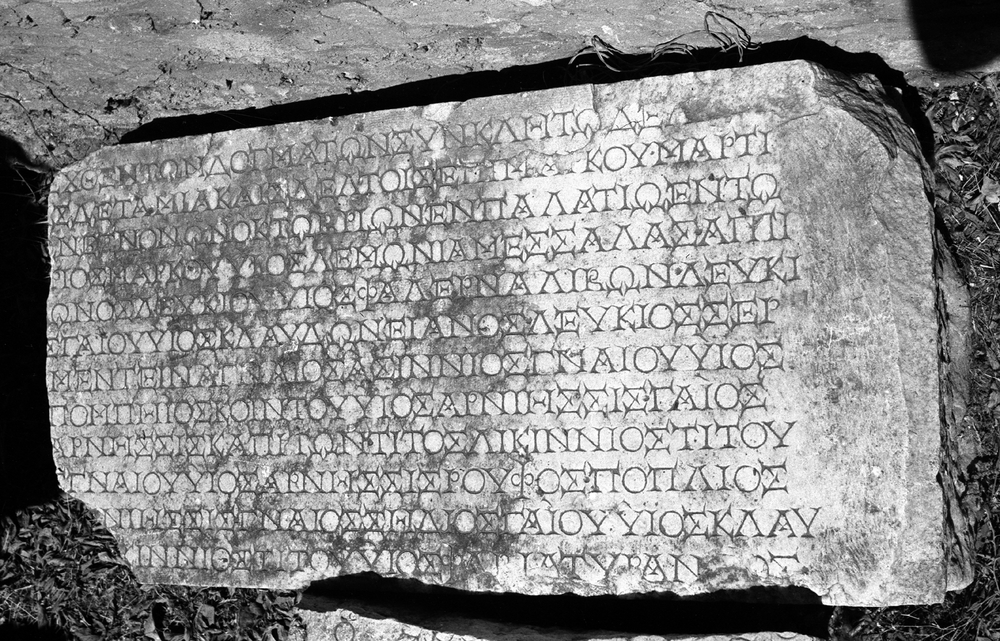
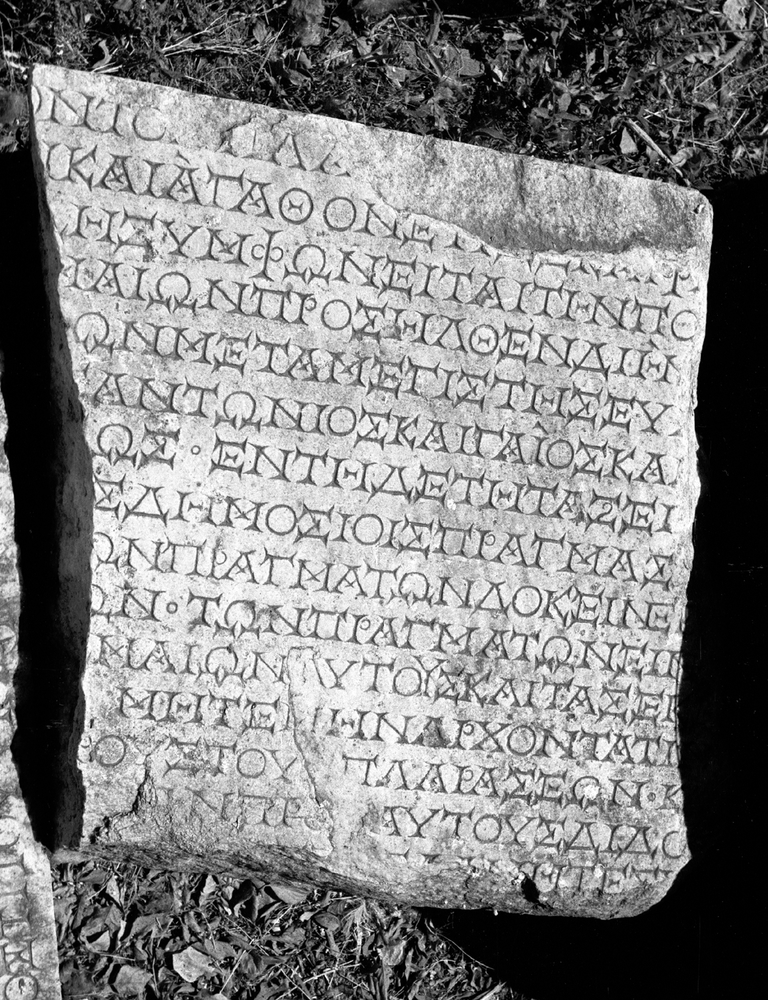
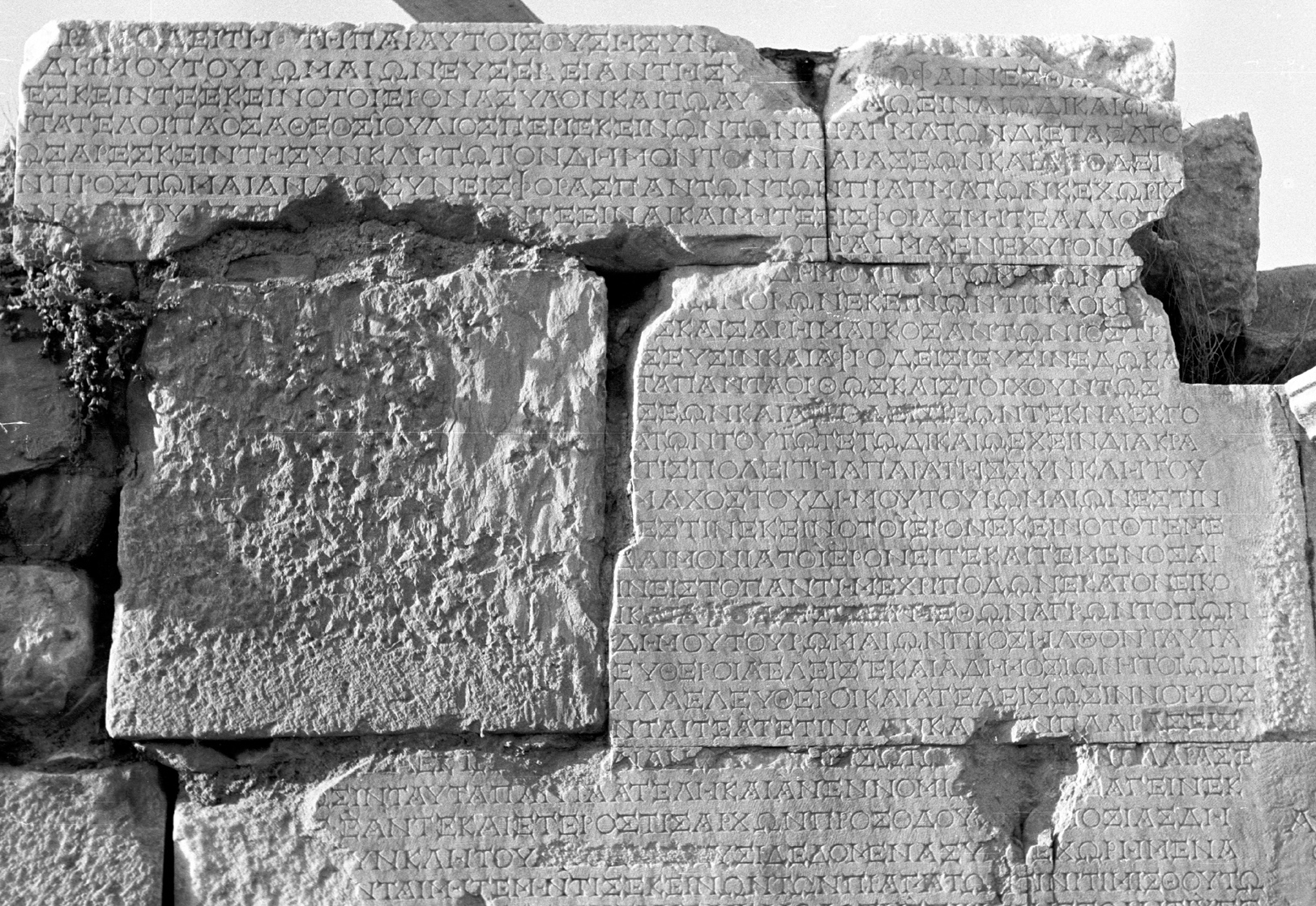
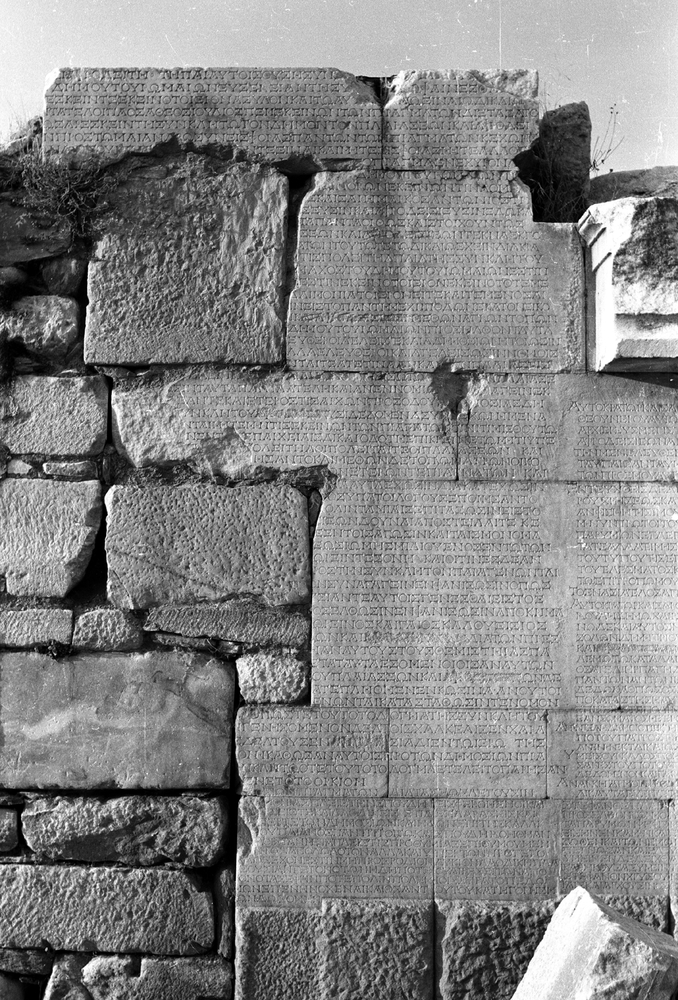
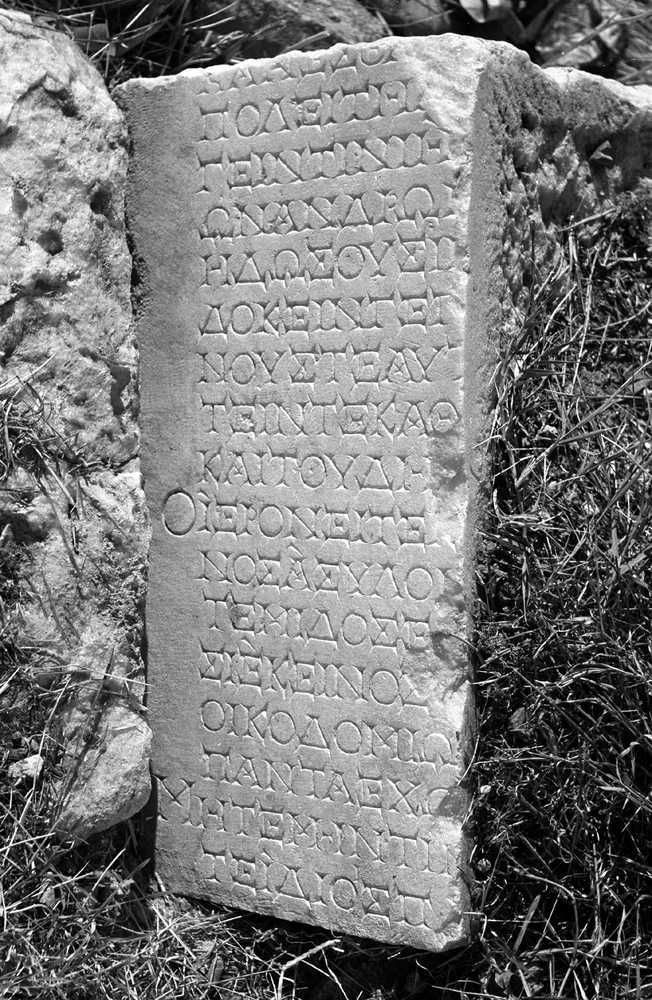
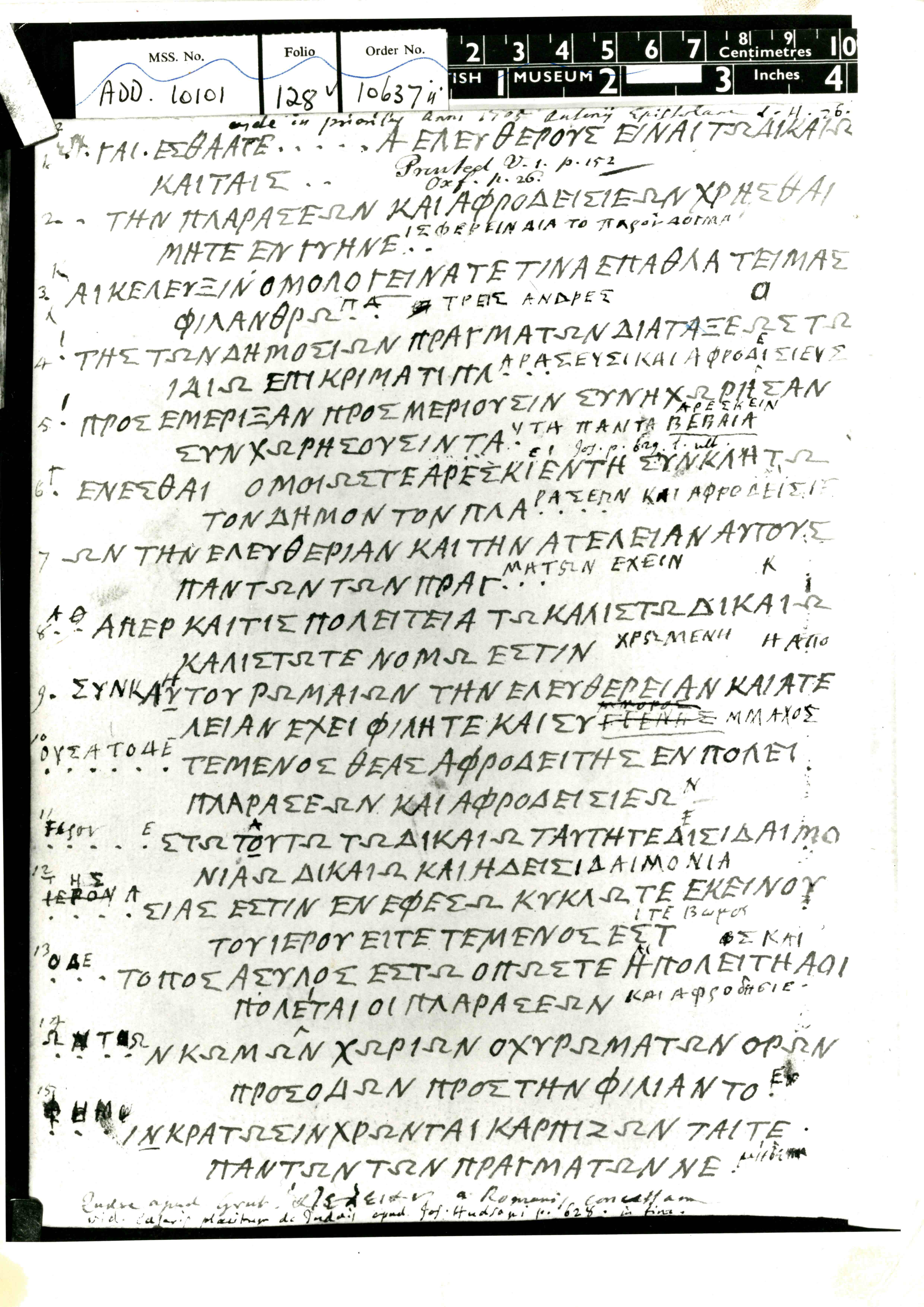
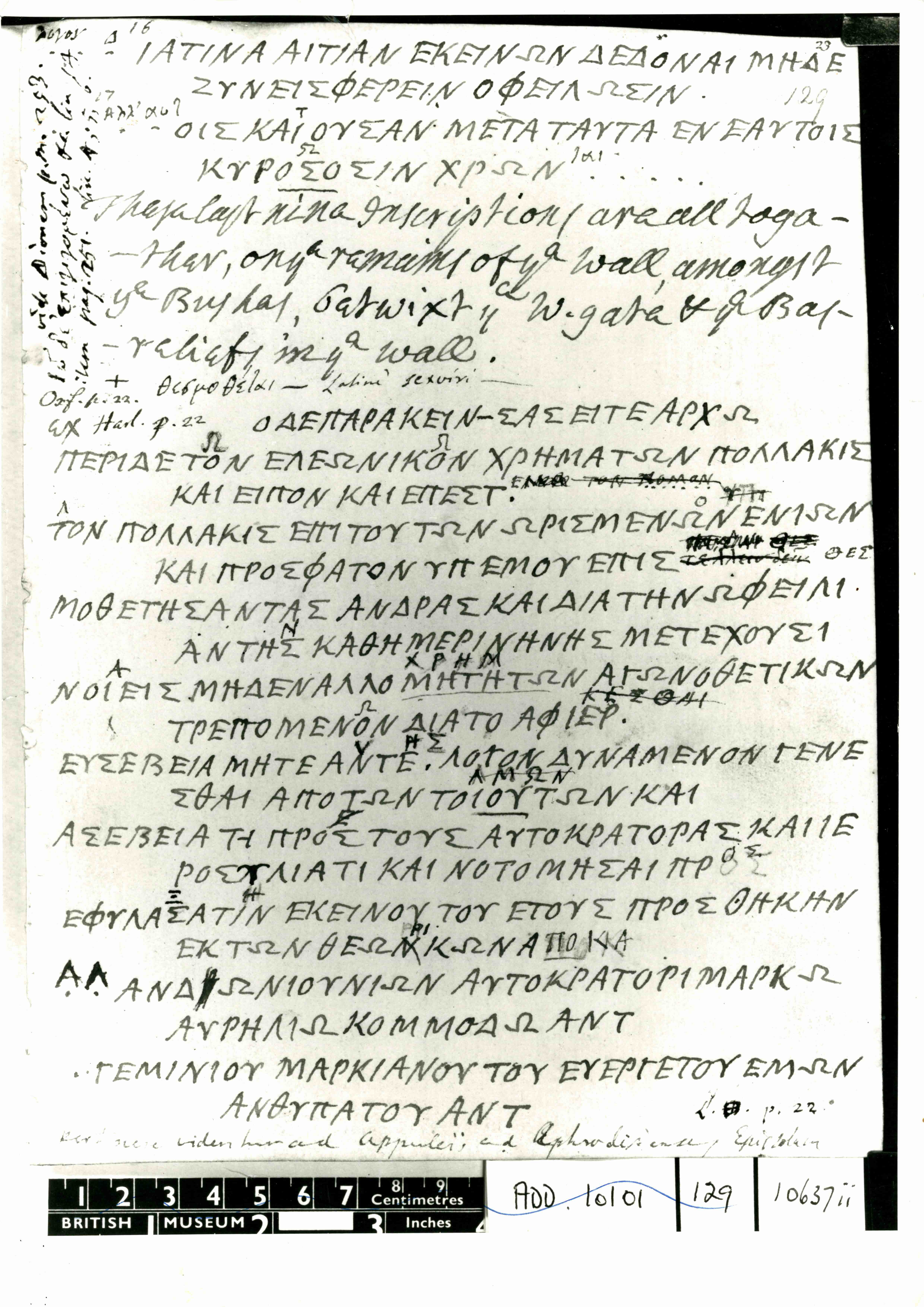
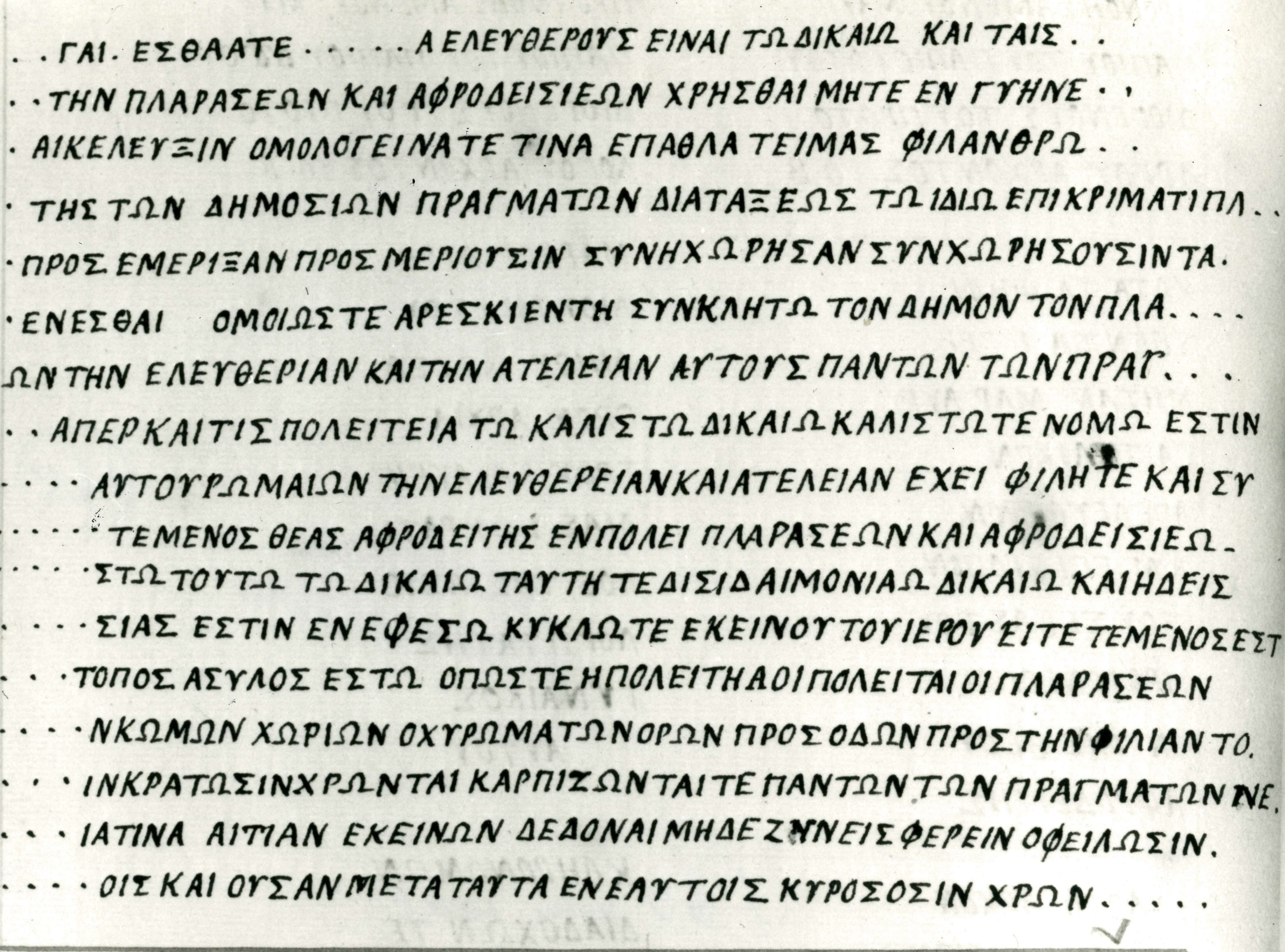
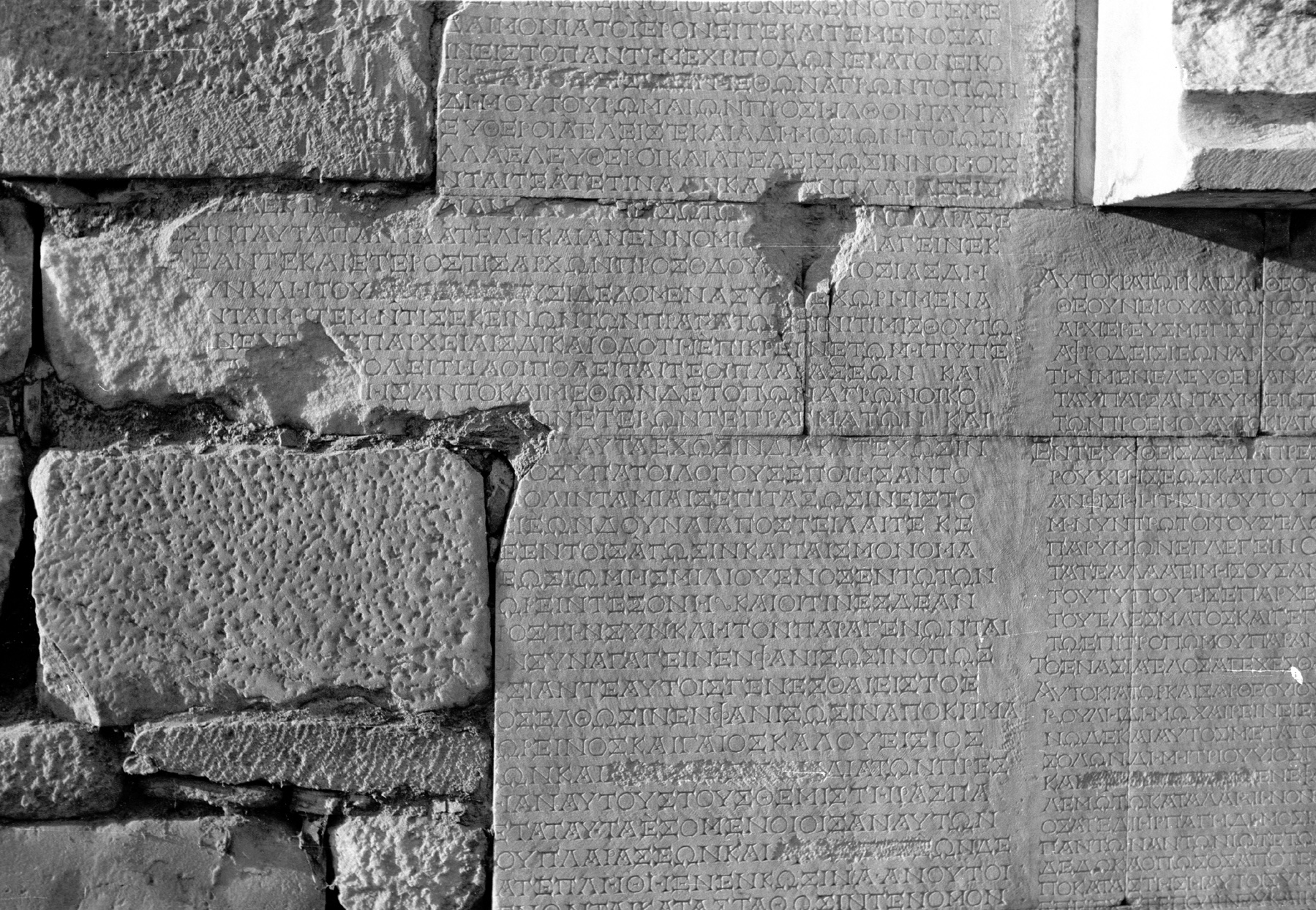
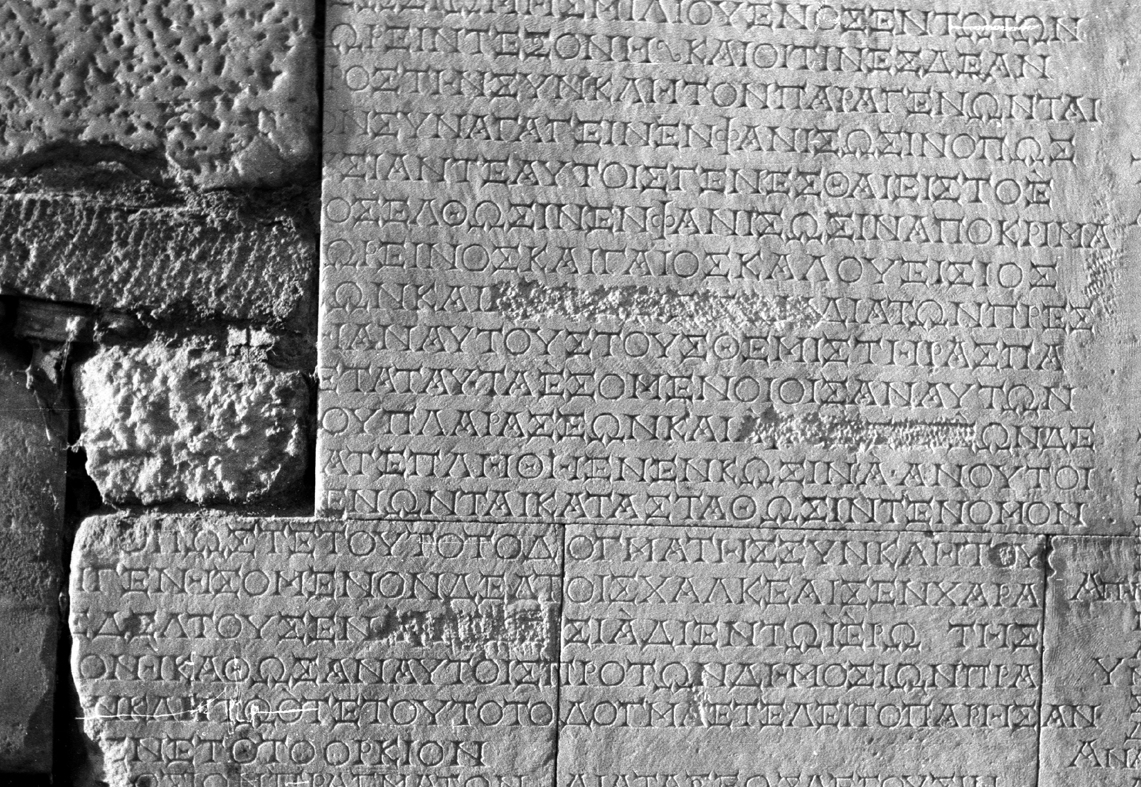
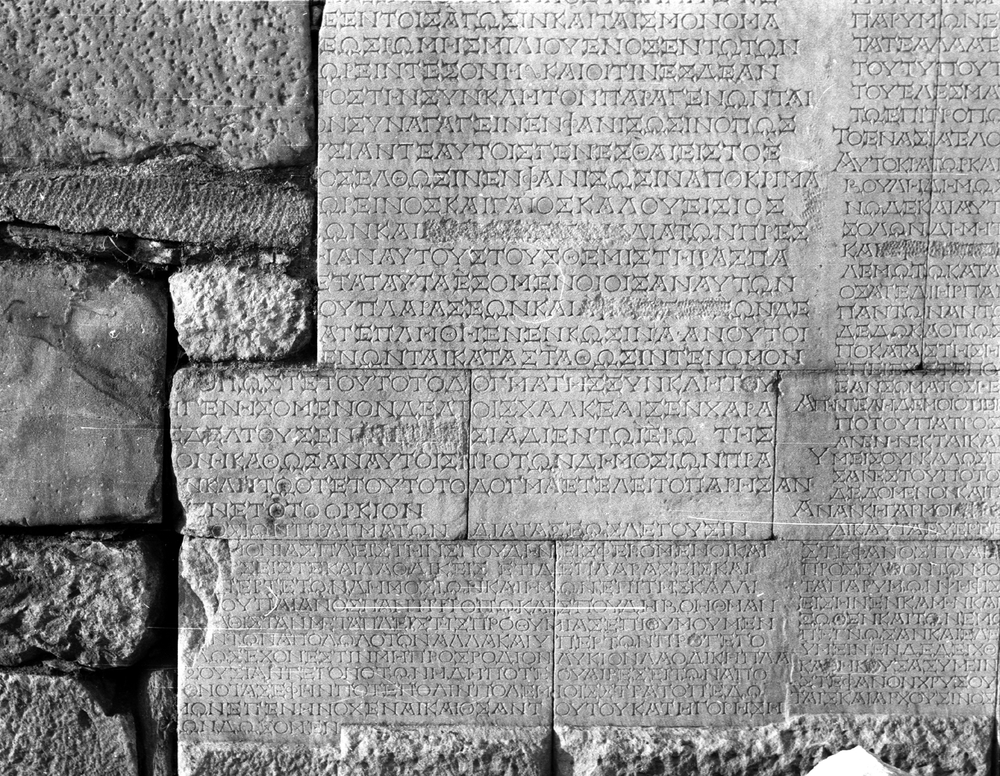
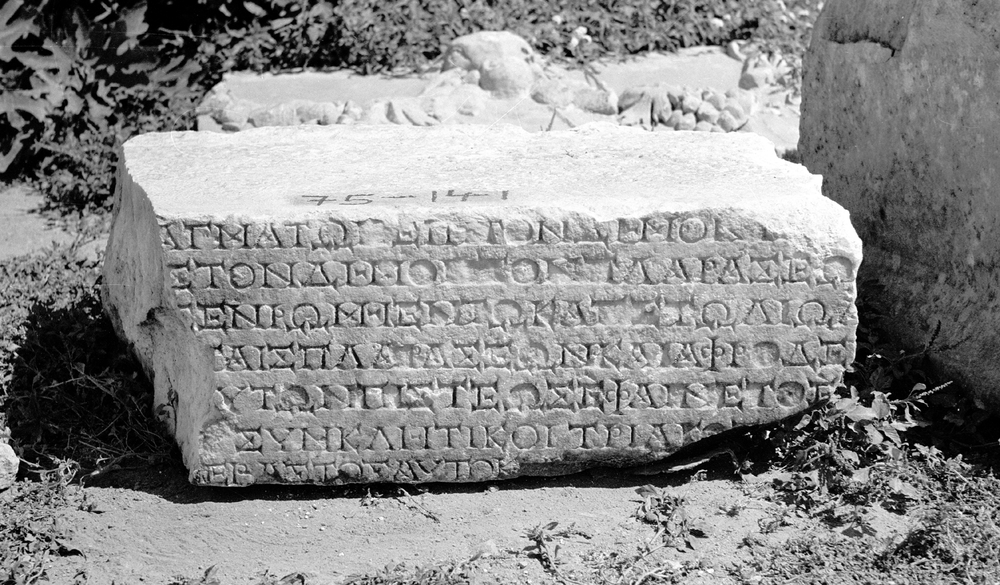
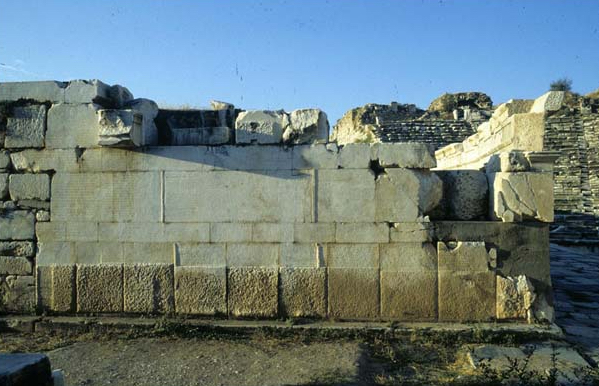
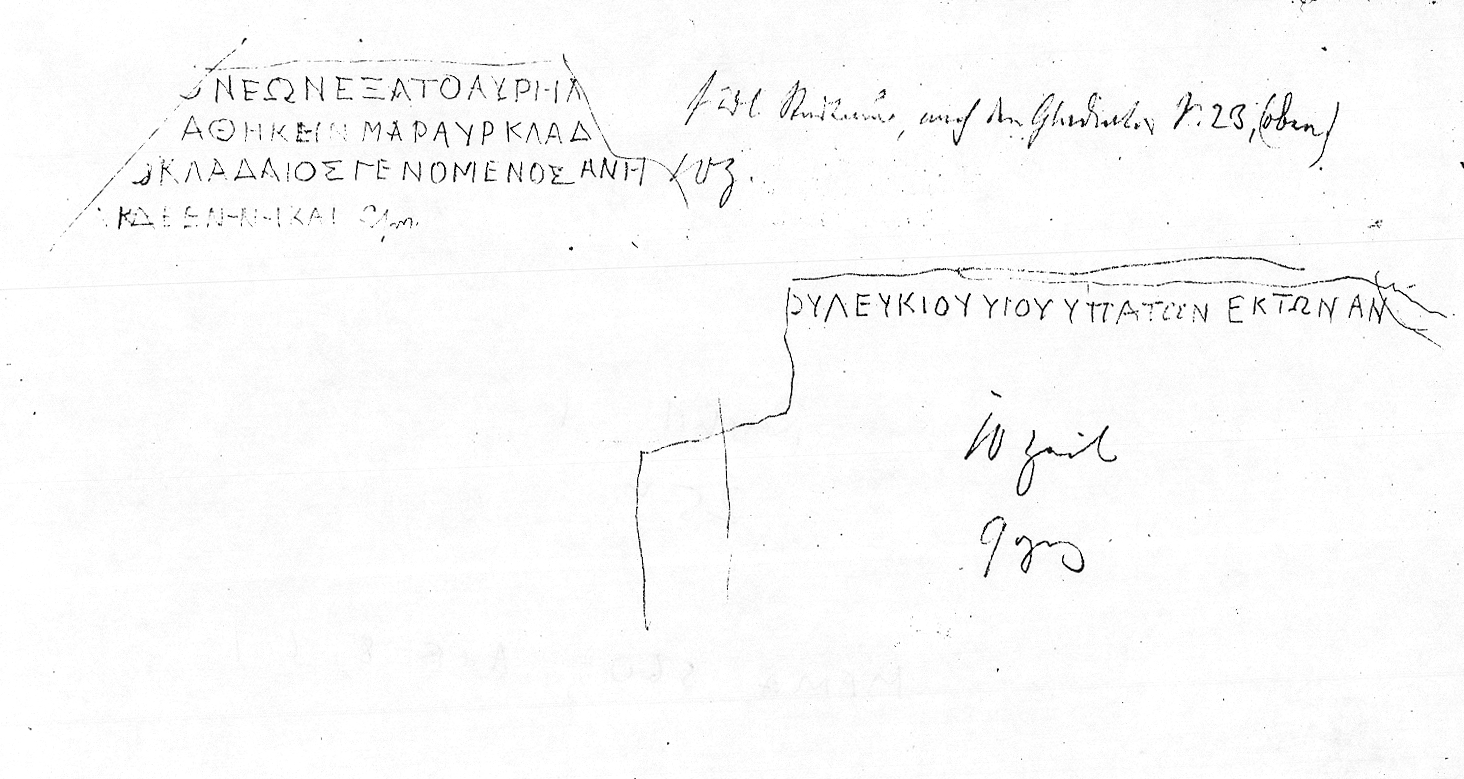
[ἐπὶ Γαΐου Καλουεισίου Γαΐου υἱοῦ Λευκίου Μαρκί]ου Λευκίου υἱοῦ ὑπάτων ἐκ τῶν ἀνε̣[ν]εχθέντων δογμάτων συνκλήτῳ δέλτῳ
[πρώτῃ? κηρώμασι τετάρτῳ π]ε̣μπτῳ ἕκτῳ ἑβδόμῳ ὀγδόῳ ἐνάτῳ ταῖς δὲ ταμιακαῖς δέλτοις ἐπὶ Μάρκου · Μαρτι-
[c. 18] [c. 18 ταμι]ῶν κατὰ πόλιν δέλτῳ πρώτῃ πρὸ ἡμερῶν ἓξ Νόνων Ὀκτωβρίων ἐν Παλατίῳ ἐν τῷ
[ναῷ? c. 15] γραφομένων παρῆσαν Μᾶρκος Οὐα̣[λέ]ριος Μάρκου υἱὸς Λεμωνία Μεσσάλας · Ἄππι-
5[ος Κλαύδιος? Λευκίου? υἱὸ]ς Οὐελ̣λ̣είνα Ἀσπ̣ρήνας Λεύκιος Σκριβών<ι>ος Λευκίου υἱὸς Φαλέρνα Λίβων · Λεύκι-
[ος c. 10 Λε]υκίου υἱὸς Ὠφεντείνα Βάλβ̣ο̣ς̣ [c. 12]ς Γαΐου υἱὸς Κλαυδωνειανός · Λεύκιος Σέρ-
[γιος Λευκίου? υἱὸς] Φαλέρνα Πλαῦτος Γάϊος Μ[c. 7 υἱὸς .]μεντείνα Γναῖος Ἀσίννιος Γναίου υἱὸς
[Ἀρνιήσσις? c. 7] Πόπλιος Σήστιος Λευκίου̣ [υἱὸς Κολλείνα Γναῖ]ο̣ς̣ Πομπήϊος Κοΐντου υἱὸς Ἀρνιήσσις · Γάϊος
[Ἥδιος Γαΐου υἱ]ὸς Κλαυδ̣ία Θῶ̣ρ̣ο̣ς Λεύκι[ος? c. 9 υἱ]ὸς Ἀρν<ι>ήσσις Καπίτων · Τίτος Λικίννιος Τίτου
10[υἱὸς c. 18]η̣νος Γ[c. 26]νιος Γναίου υἱὸς Ἀρν<ι>ήσσις Ῥοῦφος · Πόπλιος
[c. 48] υἱὸ[ς Ἀρ?]νιήσσις Γναῖος Σήδιος Γαΐου υἱὸς Κλαυ-
[δία c. 45]ν̣ Τιτ[ος Λι]κ̣ίννιος Τίτου υἱὸς Φαβία Τύραννος
[---]Ι̣Ι̣ΤΟΣ
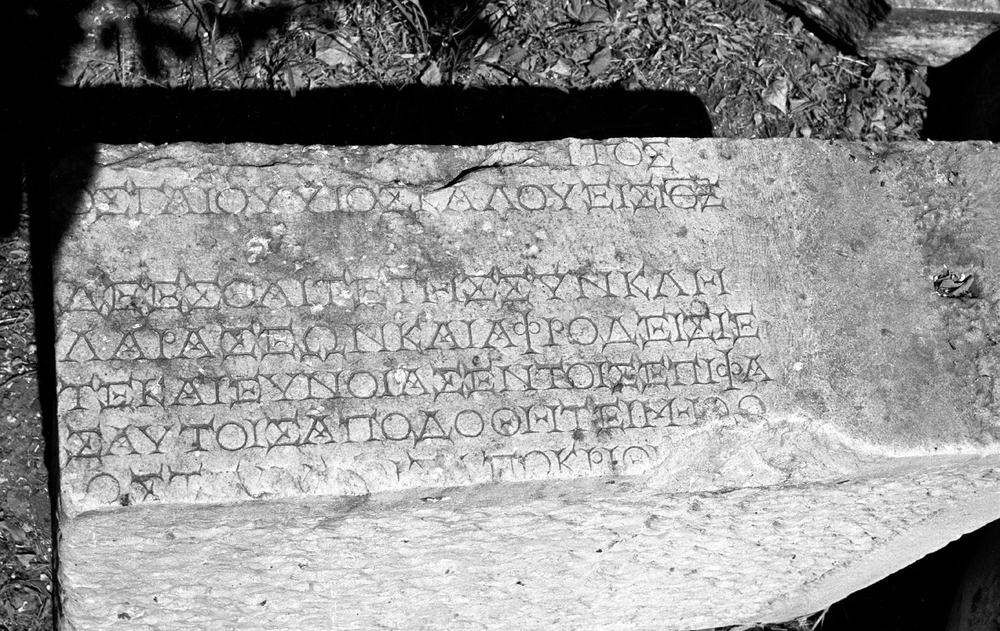
[c. 49 - 53 περὶ? ὧν Γάϊος Καλουείσι]ος Γαΐου υἱὸς Καλουείσιος
15[Λεύκιος Μάρκιος Λευκίου υἱὸς Κηνσωρεῖνος ὕπατοι λόγους ἐποιήσαντο ] ( vac. 25)
[Σόλωνα? Δημητρίου πρεσβευτὴν Ἀφροδεισιέων χάριτα φιλίαν συμμαχίαν ἀνανεοῦσθαι] δέεσθαί τε τῆς συνκλή-
[του ὅπως c. 61 - 66 Π]λαρασέων καὶ Ἀφροδεισιέ-
[ων c. 42 φιλίας? ἕνεκεν πρὸς τοὺς Ῥωμαίους] τε καὶ εὐνοίας ἐν τοῖς ἐπιφα-
[νεστάτοις c. 52 - 57 ταῦτα ὅπω]ς α̣ὐτ̣ο̣ῖς ἀποδοθῇ τειμηθῶ-
20[σι τε οἱ ἀγροὶ? διεφθαρμένοι ὅπως? τε c. 29 - 36 φιλανθρώπ]ως τε α̣ὐτ̣ο̣ῖ̣ς ἀποκριθῇ [( vac. 3)?]
[ἔδοξεν τ]ῇ σ[υν]κ̣λήτῳ πρὸ[ς τὸν δ]ῆ̣μον τὸν Πλα[ρασέων καὶ Ἀφροδεισιέων χάριτα φιλίαν συμμαχίαν ἀνα-]
[νεώσασθ]α̣ι̣ πρεσβευτὴν ἄνδρ̣α̣ κ̣αλὸν καὶ ἀγαθόν ἔτι δ̣ὲ̣ καὶ φί[λον παρὰ δήμου καλοῦ καὶ ἀγαθοῦ ἔτι? δὲ καὶ φί-]
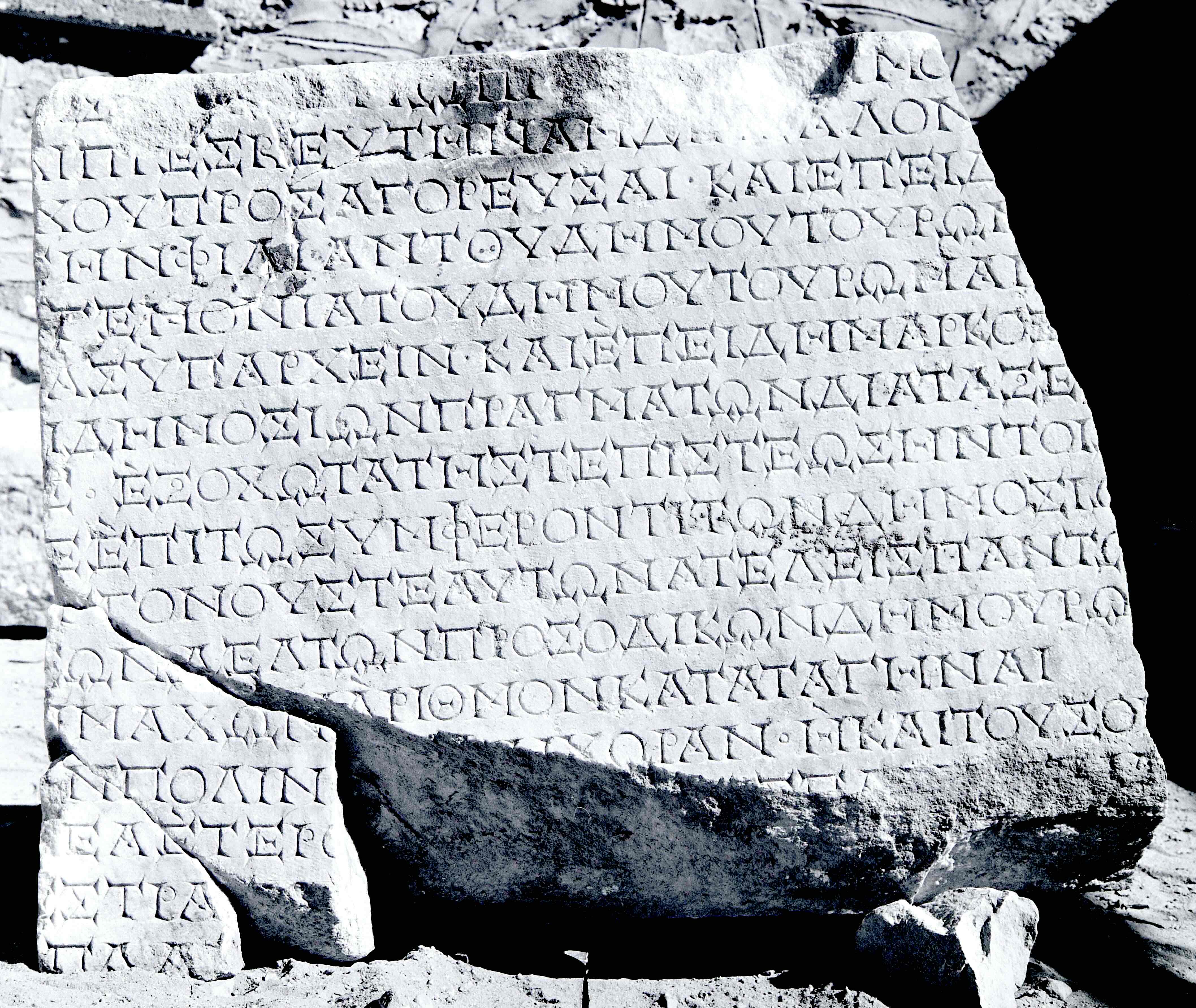
[λου συμμά]χου προσαγορεῦσαι ((stop)) καὶ ἐπειδὴ συμφωνεῖται τὴν πο[λειτήαν τὴν τῶν Πλαρασέων καὶ Ἀφροδεισιέων]
[ἀφ’ οὗ πρὸς] τ̣ὴν φιλίαν τοῦ δήμου τοῦ Ῥωμαίων προσῆλθεν διην[εκ c. 36]
25 [c. 6 τῇ ἡ]γεμονίᾳ τοῦ δήμου τοῦ Ῥωμαίων μετὰ μεγίστης εὐν̣[οίας c. 33]
[c. 9]ας ὑπάρχειν ((stop)) καὶ ἐπειδὴ Μᾶρκος Ἀντώνιος καὶ Γάϊος Καῖ[σαρ αὐτοκράτορες? ( vac. 3)? τριῶν ἀνδρῶν]
[τῆς ( vac. 3)? τῶ]ν̣ δημοσίων πραγμάτων διατάξεως ((stop)) ἐν τῇδε τῇ τάξει [λόγους? ἐποιήσαντο περὶ τῆς καλλίστης? προ-]
[αιρέσεω?]ς ((stop)) ἐξοχωτάτης τε πίστεως ἣν τοῖς δημοσίοις πράγμασι̣[ν ὁ δῆμος ὁ Πλαρασέων καὶ Ἀφροδεισιέων]
[παρέσχηκ?]ε ἐπὶ τῷ συμφέροντι τῶν δημοσίων πραγμάτων δοκεῖν εἶν̣[αι Πλαρασεῖς καὶ Ἀφροδεισιεῖς αὐτοὺς]
30[καὶ τέκνα ἐ]γ̣γόνους τε αὐτῶν ἀτελεῖς πάντων ((stop)) τῶν πραγμάτων εἶν[αι c. 17 ὑπεξειρημένους]
[εἶναι πάν]τ̣ων δέλτων προσοδικῶν δήμου Ῥωμαίων αὐτοὺς καὶ τὰς ἐκε[ίνων γυναῖκας τέκνα ἐγγόνους τε αὐτῶν καὶ]
[εἰς τὸν συ]μ̣μάχων ἀριθμὸν καταταγῆναι ( vac. 3) μήτε μὴν ἄρχοντά τιν[α ἢ ἀντάρχοντα δήμου Ῥωμαίων ἕτερόν τέ]
[τινα εἰς τὴ]ν πόλιν ἢ̣ [τ]ὴ̣ν̣ χώραν ((stop)) ἢ καὶ τοὺς ὅρους τοὺ[ς] Πλαρασέων κα̣[ὶ Ἀφροδεισιέων στρατιώτην καὶ ἀντιστρα]-
[τιώτην ἱππ]έα ἕτερό̣[ν τινα εἰ]ς παρα̣[χει]μ̣α̣σ̣[ί]α̣ν πρὸς αὐτοὺς δίδο[σθαι μηδὲ καταθέσθαι κελεύειν μήτε χρή-]
35[ματα ((stop))? μήτ]ε̣ στρα[τιώτας ((stop))? μήτε πλοῖα ((stop))? μήτε σεῖτον ((stop))? μή]τε ὅπλα ((stop)) μήτε σχ[εδίας ((stop))? μήτε μὴν ἕτερόν τι πρᾶγμα]
[τῷ δήμῳ τῷ] Πλα̣ρ̣[ασέων καὶ Ἀφροδεισιέων ἐπιτάσσεσθαι ---]
[---]Φ[---]
[ἥν? τέ τινα ἀσυλίαν? ---άτ]ω̣ρ Ἀφ̣ρ̣οδείτῃ ( vac. 1) τῇ παρ’αὐτοῖς οὔσῃ συνε̣[χώρησεν] τ̣α̣ύ̣τ̣η̣ν̣ δ̣[ικαίως?]
[συνκεχωρῆσθαι? c. 10 καὶ κατὰ? τὴν το]ῦ̣ δήμου τοῦ Ῥωμαίων εὐσέβειαν τῇ συ[νκλήτ]ῳ φαίνεσθαι̣ [εἶναι?]
40[c. 32 ἀρ]έσκειν τε ἐκεῖνο τὸ ἱερὸν ἄσυλον καὶ τῷ αὐτῷ δ̣[ι]κ̣αίῳ εἶναι ᾧ δ̣ικαίῳ
[τὸ ἱερὸν Ἀρτέμιδος Ἐφεσίας ἐν Ἐφέσῳ ἐστὶ]ν̣ τά τε λοιπὰ ὅσα θεὸςἸούλιος περὶ ἐκείνων τῶν πραγμάτων διετάξατο
[πάντα? κύρια διαμένειν c. 15 ὁμοί]ως ἀρέσκειν τῇ συνκλήτῳ τὸν δῆμον τὸν Πλαρασέων καὶ Ἀφροδει-
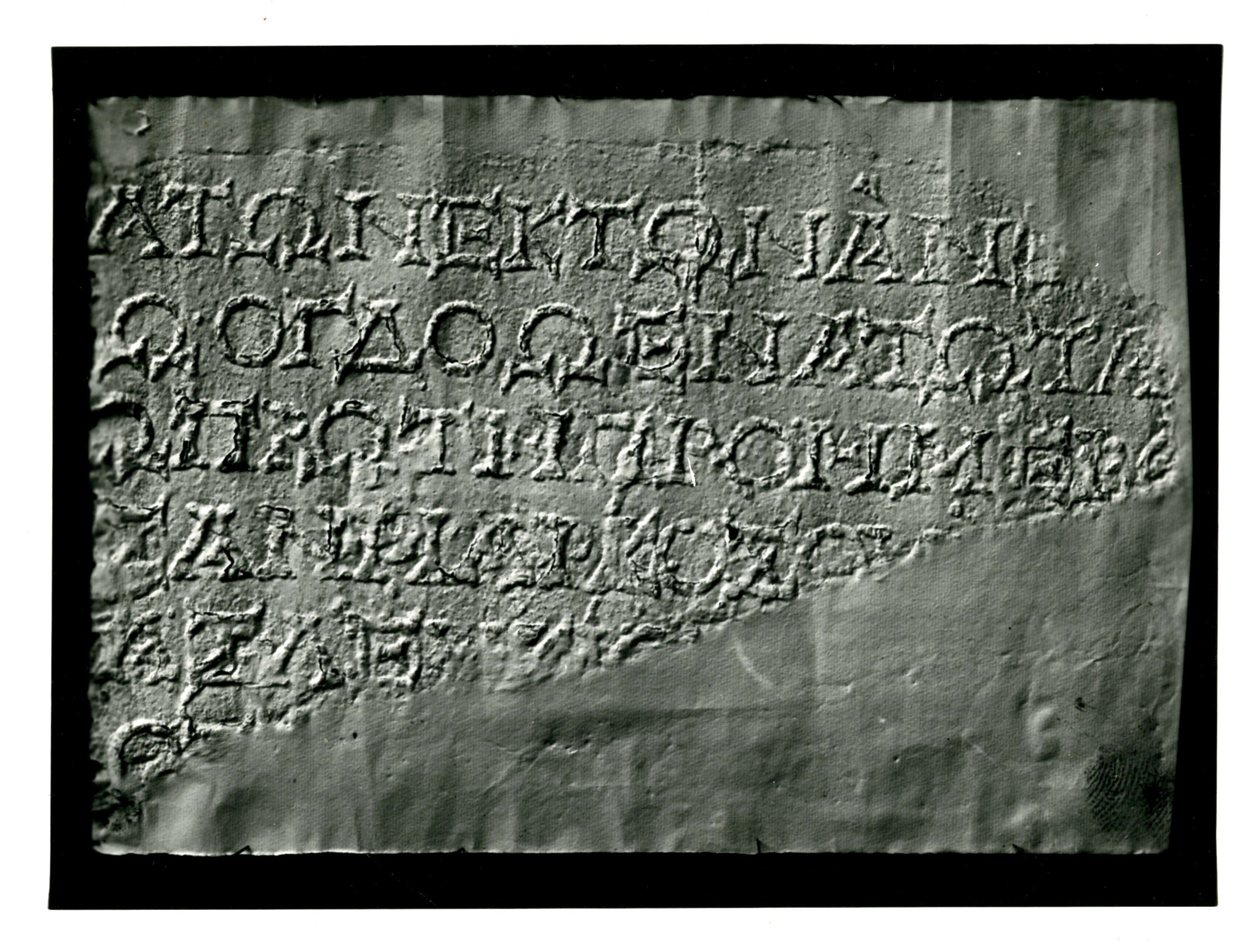
[σιέων c. 31 ω]ν πρὸς τῷ Μαιάνδρῳ συνεισφορὰς πάντων τῶν πραγμάτων κεχωρισ-
[c. 25 πάντ?]ω̣ν ἀλ̣[ι]τ̣ούρ̣γ̣η̣τ[ον ἀνείσφορ?]ό̣ν τε εἶναι καὶ μήτε εἰσφορὰς μήτε ἄλλο τι
45[---]ΝΙ̣[..]Τ̣[...] τὸ πρᾶγμα ἐνέχυρον λ[αμ-]
βάνεσθα[ι ἀ]π̣άγεσθαι ΑΤΕ [c. 2 ἀλλ?]ὰ ἐλευθέρους εἶναι τῷ <τε> δικαίῳ καὶ ταῖς [ἰδίαις κρίσεσιν ἕνεκεν τοῦ] δήμου τοῦ Ῥωμαίων τὴ̣[ν]
πολειτήαν̣ τὴν Πλαρασέων καὶ Ἀφροδεισιέων χρῆσθαι μήτε ἐνγύην ε[ἰς Ῥώμην ἐντὸς τ]ῶν ὅρων ἐκείνων τινὰ ὁμολ[ο-]
γεῖν τινι ἢ [κ]αὶ κελεύειν ὁμολογεῖν ἅ τέ τινα ἔπαθλα τειμάς φιλάνθρω[πα Γάϊ]ος Καῖσαρ ἢ Μᾶρκος Ἀντώνιος τρι-
ῶν ἀνδρῶν τῆς τῶν δημοσίων πραγμάτων διατάξεως τῷ ἰδίῳ ἐπικρίματι Πλ[αρα]σεῦσιν καὶ Ἀφροδεισιεῦσιν ἔδωκα[ν]
50ἢ δώσουσιν προσεμέρισαν προσμεριοῦσιν συνεχώρησαν συνχωρήσουσιν τα[ῦ]τα πάντα ὀρθῶς καὶ στοιχούντως
δοκεῖν γεγενῆ̣σθαι ( vac. 1) ὁμοίως τε ἀρέσκ<ει>ν τῇ συνκλήτῳ τὸν δῆμον τὸν Πλα[ρα]σέων καὶ ⟦Ἀφροδεισ⟧ιέων τέκνα ἐκγό-
νους τε αὐτῶν τὴν ἐλευθερίαν καὶ τὴν ἀτέλειαν αὐτοὺς πάντων πραγ[μ]άτων τούτῳ τε τῷ δικαίῳ ἔχειν διακρα-
τεῖν τε καθάπερ καί τις πολειτεία τῷ καλίστῳ δικαίῳ καλίστῳ τε νόμῳ ἐστίν ἥτις πολειτήα παρὰ τῆς συνκλήτου
καὶ τοῦ δή[μο]υ τοῦ Ῥωμαίων τὴν ἐλευθερίαν καὶ ἀτέλειαν ἔχει φίλη τε καὶ σύ[μ]μαχος τοῦ δήμου τοῦ Ῥωμαίων ἐστίν.
55 Ὃ ἱερὸν εἴτε κ̣[αὶ] τέμενος θεᾶς Ἀφροδείτης ἐν πόλει Πλαρασέων καὶ Ἀφροδεισιέω[ν] ἐστίν ἐκεῖνο τὸ ἱερόν ἐκεῖνο τὸ τέμε-
νος ἄσυλον [ἔ]στω τούτῳ τῷ δικαίῳ ταύτῃ τε δ<ε>ισιδαιμονίᾳ ᾧ δικαίῳ καὶ ᾗ δεισιδαιμονίᾳ τὸ ἱερὸν εἴτε καὶ τέμενος Ἀρ-
τέμιδος Ἐ[φε]σίας ἐστὶν ἐν Ἐφέσῳ κύκλῳ τε ἐκείνου τοῦ ἱεροῦ εἴτε τέμενός ἐστιν εἰς τὸ πάντῃ μέχρι ποδῶν ἑκατὸν εἴκο-
σι ἐκεῖνος ὁ τόπος ἄσυλος ἔστω ὅπως τε ἡ πολειτήα οἱ πολεῖται οἱ Πλαρασέων κ⟦αὶ Ἀφροδεισιέων⟧ ⟦με⟧θ’ὧν ἀγρῶν τόπων
οἰκοδομιῶν κωμῶν χωρίων ὀχυρωμάτων ὀρῶν προσόδων πρὸς τὴν φιλίαν το[ῦ] δήμου τοῦ Ῥωμαίων προσῆλθον ταῦτα
60 πάντα ἔχω[σ]ιν κρατῶσιν χρῶνται καρπίζωνταί τε πάντων τῶν πραγμάτων Ν ἐ[λ]εύθεροι ἀτελεῖς τε καὶ ἀδημοσιώνητοι ὦσιν
Μήτε μήν τιν̣[ες δ]ιά τινα αἰτίαν ἐκείνων δι̣δόναι <τι?> μηδὲ σ̣υνεισφέρειν ὀφείλωσιν [ἀ]λλὰ ἐλεύθεροι καὶ ἀτελεῖς ὦσιν νόμοις
τε ἰδίοις π[ατρί]οις καὶ οὓς ἂν μετὰ ταῦτα ἐν ἑαυτοῖς κυρώ̣σω̣ιν χρῶν[ται c. 3]νται τε ἅτε τινὰ ἂν καὶ [οἷ’ ἂ]ν Πλαρασεῖς
[καὶ Ἀφροδεισιεῖς c. 38]Α̣ ἐκ τῶν̣ [Τραλ]λ̣ιανῶν̣ ὅ̣ρ̣ων ε̣ἴσω τῶν [ὅρων τῶ]ν Πλαρασέ-
[ων καὶ Ἀφροδεισιέων c. 31 άγ]ῶσιν ταῦτα πάντα ἀτελῆ καὶ ἀννενομίω[τα ἐ]ξάγειν ἐκ
65[τῶν ὅρων τῶν Τραλλιανῶν? ἐάν? τε στρατηγός ἀντιστράτηγος ὕπατός τ]ε ( vac. 1)ἐάν τε καὶ ἕτερός τις ἄρχων προσόδους̣ [δη]μ̣οσίας δή-
[μου Ῥωμαίων αὐτοῖς? ἐπιτάσσῃ παρὰ? τὰ φιλάνθρωπα τὰ ὑπὸ τῆς σ]υνκλήτου ⟦Ἀ̣φ̣ρ̣ο̣δ̣ε̣ι̣σ̣ι̣ε̣⟧ῦσι δεδομένα συν̣κεχωρημένα
[c. 45]νται μήτε μήν τις ἐκείνων τῶν πραγμάτων̣ τινί τι μισθούτω
[c. 25 ἄρχων ἀντάρχων τε ὃς ἂν περὶ τῶ]ν ἐν τα̣[ῖ]ς̣ ἐπαρχείαις δικαιοδότῃ ἐπικρεινέτω μή τι ὑπε-
[ναντίον τούτῳ τῷ δόγματι τῆς συνκλήτου γένηται ὅπως τε κ]α̣ὶ [ἡ] πολειτήα οἱ πολεῖταί τε οἱ Πλαρασέων ( vac. 1) καὶ
70[Ἀφροδεισιέων οἷστισι? νόμοις ἰδίοις πατρίοις τε καὶ ἐθισμοῖς ἐχρ?]ήσαντο καὶ μεθ’ ὧν δὲ τόπων ἀγρῶν οἰκο-
[δομιῶν κωμῶν χωρίων ὀχυρωμάτων ὀρῶν προσόδων c. 24] τ̣οι̣[---]ων ἑτέρων τε πραγμάτων ( vac. 1) καὶ
[χρημάτων? c. 17 πρὸς τὴν φιλίαν τοῦ δήμου τοῦ Ῥωμαίων προσῆλθον πάν]τα αὐτὰ ἔχωσιν διακατέχωσιν
[ἔδοξεν ( vac. 3)? περὶ δὲ ὧν Γάϊος Καλουείσιος Λεύκιος Μάρκιος Κηνσωρεῖ]ν̣ος ὕπατοι λόγους ἐποιήσαντο
[ὅπως? Λεύκιος Μάρκιος Κηνωρεῖνος καὶ Γάϊος Καλουείσιος ὕπατοι τοῖς κατὰ] π̣όλιν ταμίαις ἐπιτάξωσιν εἰς τὸ
75[αἰράριον ἀναφέρειν? ὄνομα καὶ ξένια τῷ πρεσβευτῇ τῶν Πλαρασέων καὶ Ἀφροδει]σιέων δοῦναι ἀποστεῖλαί τε κε-
[λεύσωσιν ἀπὸ? σηστερτίων νόμων c. 34 ὅπως τ]ε ἐν τοῖς ἀγῶσί τε καὶ ταῖς μονομα-
[χίαις ἔτι τε κυνηγίοις καὶ ἐὰν ἀθληταὶ ἀγωνίζωνται ἐν πόλει Ῥώμῃ πλησίον τε πόλ]εως Ῥώμης μιλίου ἑνός ἐν τῷ τῶν
[συνκλητικῶν τόπῳ τῷ? πρεσβευτῇ Πλαρασέων καὶ Ἀφροδεισιέων καθῆσθαι θε]ωρεῖν τ' ἐξὸν ᾖ ((scroll)) καὶ οἵτινες δὲ ἄν
[ποτε πρεσβευταὶ τοῦ? δήμου τοῦ Πλαρασέων καὶ Ἀφροδεισιέων εἰς Ῥώμην π]ρὸς τὴν σύνκλητον παραγένωνται
80[τοῖς ἄρχουσιν ἀντάρχουσιν δήμου Ῥωμαίων τοῖς ἐξουσίαν ἔχουσιν σύνκλητ]ον συναγαγεῖν ἐνφανίσωσιν ὅπως
[σύνκλητος αὐτοῖς δοθῇ ἀρέσκειν δὲ ἐκ τοῦ στίχου σύνκλητον αὐτοῖς δοθῆναι ἐξο]υσίαν τε αὐτοῖς γενέσθαι εἰς τὸ ἐ-
[κείνῃ τῇ τάξει διαλεγῆναι ἐμφανίσαι τε ἐν ἡμέραις δέκα ταῖς ἔνγιστα αἷς ἂν πρ]οσέλθωσιν ἐνφανίσωσιν ἀπόκριμα
[πρεσβευταῖς Πλαρασέων καὶ Ἀφροδεισιέων δοθῆναι ὅπως τε Λεύκιος Μάρκιος Κηνσ]ωρεῖνος καὶ Γάϊος Καλουείσιος
[ὕπατοι τὸ ὅρκιον? τοῦ δήμου τοῦ Ῥωμαίων γενέσθαι φροντίσωσι τόν τε δῆμον τὸν Πλαρασ]έων καὶ ⟦Ἀφροδ̣ε̣ι̣σ̣ι̣έ̣ω̣ν̣⟧ διὰ τῶν πρεσ-
85[βευτῶν ὀμόσαι? c. 55]ΗΑΝ αὐτοὺς τοὺς θεμιστῆρας πα-
[c. 65 μ]ετὰ ταῦτα ἐσόμενοι οἷς ἂν αὐτῶν
[c. 55 τοῦ δήμου τ]οῦ Πλαρασέων καὶ ⟦Ἀ̣φροδεισιέ⟧ων δὲ-
[c. 65 τ]ά τε πλήθη ἐνένκωσιν ἃ ἂν οὗτοι
[c. 45 φροντίσωσιν ὅπως ἐπειδὴ? ---γ]ένωνται κατασταθῶσίν τε νόμον
90[περὶ τούτων τῶν πρ]αγμάτων ἐπὶ τὸν δῆμον [ἐπιφέρωσιν? c. 10] ὅπως τε τοῦτο τὸ δόγμα τῆς συνκλήτου
[καὶ τὸ ὅρκιον τὸ πρὸ]ς τὸν δῆμον τὸν Πλαρασέω[ν καὶ Ἀφροδεισιέων ἐπ]ιγενησόμενον δέλτοις χαλκείαις ἐνχαρα-
[χθέντα ἐν ἱερῷ Διὸ]ς ἐν Ῥώμῃ ἐν τῷ Καπετωλίῳ ἀ[νατιθῶσι ὁμοίως δὲ καὶ ἄλλα]ς δέλτους ἐν ⟦[Ἀφροδει]⟧σιάδι ἐν τῷ ἱερῷ ( vac. 1) τῆς
[Ἀφροδείτης καὶ ἐν] τ̣αῖς Πλαρασέων καὶ Ἀφροδει[σιέων ἀγοραῖς? ἐξ? οὗ ἂν δῆλ]ον ᾖ καθὼς ἂν αὐτοῖς πρὸ τῶν δημοσίων πρα-
[γμάτων καὶ ἰδίας] α̣ὐτῶν πίστεως ἐφαίνετο ε[ἶναι ( vac. 3) ἔδοξεν ( vac. 3) ἐν τῇ συ]νκλήτῳ ὅτε τοῦτο τὸ δόγμα ἐτελεῖτο παρῆσαν
95[c. 11 καὶ] ( vac. 1) συνκλητικοὶ τριακό̣σ̣[ιοι τεσσαράκοντα ὅτε ἐγ]ένετο τὸ ὅρκιον ( vac. )
[πρώτῃ? κηρώμασι τετάρτῳ π]ε̣μπτῳ ἕκτῳ ἑβδόμῳ ὀγδόῳ ἐνάτῳ ταῖς δὲ ταμιακαῖς δέλτοις ἐπὶ Μάρκου · Μαρτι-
[c. 18] [c. 18 ταμι]ῶν κατὰ πόλιν δέλτῳ πρώτῃ πρὸ ἡμερῶν ἓξ Νόνων Ὀκτωβρίων ἐν Παλατίῳ ἐν τῷ
[ναῷ? c. 15] γραφομένων παρῆσαν Μᾶρκος Οὐα̣[λέ]ριος Μάρκου υἱὸς Λεμωνία Μεσσάλας · Ἄππι-
5[ος Κλαύδιος? Λευκίου? υἱὸ]ς Οὐελ̣λ̣είνα Ἀσπ̣ρήνας Λεύκιος Σκριβών<ι>ος Λευκίου υἱὸς Φαλέρνα Λίβων · Λεύκι-
[ος c. 10 Λε]υκίου υἱὸς Ὠφεντείνα Βάλβ̣ο̣ς̣ [c. 12]ς Γαΐου υἱὸς Κλαυδωνειανός · Λεύκιος Σέρ-
[γιος Λευκίου? υἱὸς] Φαλέρνα Πλαῦτος Γάϊος Μ[c. 7 υἱὸς .]μεντείνα Γναῖος Ἀσίννιος Γναίου υἱὸς
[Ἀρνιήσσις? c. 7] Πόπλιος Σήστιος Λευκίου̣ [υἱὸς Κολλείνα Γναῖ]ο̣ς̣ Πομπήϊος Κοΐντου υἱὸς Ἀρνιήσσις · Γάϊος
[Ἥδιος Γαΐου υἱ]ὸς Κλαυδ̣ία Θῶ̣ρ̣ο̣ς Λεύκι[ος? c. 9 υἱ]ὸς Ἀρν<ι>ήσσις Καπίτων · Τίτος Λικίννιος Τίτου
10[υἱὸς c. 18]η̣νος Γ[c. 26]νιος Γναίου υἱὸς Ἀρν<ι>ήσσις Ῥοῦφος · Πόπλιος
[c. 48] υἱὸ[ς Ἀρ?]νιήσσις Γναῖος Σήδιος Γαΐου υἱὸς Κλαυ-
[δία c. 45]ν̣ Τιτ[ος Λι]κ̣ίννιος Τίτου υἱὸς Φαβία Τύραννος
[---]Ι̣Ι̣ΤΟΣ
[c. 49 - 53 περὶ? ὧν Γάϊος Καλουείσι]ος Γαΐου υἱὸς Καλουείσιος
15[Λεύκιος Μάρκιος Λευκίου υἱὸς Κηνσωρεῖνος ὕπατοι λόγους ἐποιήσαντο ] ( vac. 25)
[Σόλωνα? Δημητρίου πρεσβευτὴν Ἀφροδεισιέων χάριτα φιλίαν συμμαχίαν ἀνανεοῦσθαι] δέεσθαί τε τῆς συνκλή-
[του ὅπως c. 61 - 66 Π]λαρασέων καὶ Ἀφροδεισιέ-
[ων c. 42 φιλίας? ἕνεκεν πρὸς τοὺς Ῥωμαίους] τε καὶ εὐνοίας ἐν τοῖς ἐπιφα-
[νεστάτοις c. 52 - 57 ταῦτα ὅπω]ς α̣ὐτ̣ο̣ῖς ἀποδοθῇ τειμηθῶ-
20[σι τε οἱ ἀγροὶ? διεφθαρμένοι ὅπως? τε c. 29 - 36 φιλανθρώπ]ως τε α̣ὐτ̣ο̣ῖ̣ς ἀποκριθῇ [( vac. 3)?]
[ἔδοξεν τ]ῇ σ[υν]κ̣λήτῳ πρὸ[ς τὸν δ]ῆ̣μον τὸν Πλα[ρασέων καὶ Ἀφροδεισιέων χάριτα φιλίαν συμμαχίαν ἀνα-]
[νεώσασθ]α̣ι̣ πρεσβευτὴν ἄνδρ̣α̣ κ̣αλὸν καὶ ἀγαθόν ἔτι δ̣ὲ̣ καὶ φί[λον παρὰ δήμου καλοῦ καὶ ἀγαθοῦ ἔτι? δὲ καὶ φί-]
[λου συμμά]χου προσαγορεῦσαι ((stop)) καὶ ἐπειδὴ συμφωνεῖται τὴν πο[λειτήαν τὴν τῶν Πλαρασέων καὶ Ἀφροδεισιέων]
[ἀφ’ οὗ πρὸς] τ̣ὴν φιλίαν τοῦ δήμου τοῦ Ῥωμαίων προσῆλθεν διην[εκ c. 36]
25 [c. 6 τῇ ἡ]γεμονίᾳ τοῦ δήμου τοῦ Ῥωμαίων μετὰ μεγίστης εὐν̣[οίας c. 33]
[c. 9]ας ὑπάρχειν ((stop)) καὶ ἐπειδὴ Μᾶρκος Ἀντώνιος καὶ Γάϊος Καῖ[σαρ αὐτοκράτορες? ( vac. 3)? τριῶν ἀνδρῶν]
[τῆς ( vac. 3)? τῶ]ν̣ δημοσίων πραγμάτων διατάξεως ((stop)) ἐν τῇδε τῇ τάξει [λόγους? ἐποιήσαντο περὶ τῆς καλλίστης? προ-]
[αιρέσεω?]ς ((stop)) ἐξοχωτάτης τε πίστεως ἣν τοῖς δημοσίοις πράγμασι̣[ν ὁ δῆμος ὁ Πλαρασέων καὶ Ἀφροδεισιέων]
[παρέσχηκ?]ε ἐπὶ τῷ συμφέροντι τῶν δημοσίων πραγμάτων δοκεῖν εἶν̣[αι Πλαρασεῖς καὶ Ἀφροδεισιεῖς αὐτοὺς]
30[καὶ τέκνα ἐ]γ̣γόνους τε αὐτῶν ἀτελεῖς πάντων ((stop)) τῶν πραγμάτων εἶν[αι c. 17 ὑπεξειρημένους]
[εἶναι πάν]τ̣ων δέλτων προσοδικῶν δήμου Ῥωμαίων αὐτοὺς καὶ τὰς ἐκε[ίνων γυναῖκας τέκνα ἐγγόνους τε αὐτῶν καὶ]
[εἰς τὸν συ]μ̣μάχων ἀριθμὸν καταταγῆναι ( vac. 3) μήτε μὴν ἄρχοντά τιν[α ἢ ἀντάρχοντα δήμου Ῥωμαίων ἕτερόν τέ]
[τινα εἰς τὴ]ν πόλιν ἢ̣ [τ]ὴ̣ν̣ χώραν ((stop)) ἢ καὶ τοὺς ὅρους τοὺ[ς] Πλαρασέων κα̣[ὶ Ἀφροδεισιέων στρατιώτην καὶ ἀντιστρα]-
[τιώτην ἱππ]έα ἕτερό̣[ν τινα εἰ]ς παρα̣[χει]μ̣α̣σ̣[ί]α̣ν πρὸς αὐτοὺς δίδο[σθαι μηδὲ καταθέσθαι κελεύειν μήτε χρή-]
35[ματα ((stop))? μήτ]ε̣ στρα[τιώτας ((stop))? μήτε πλοῖα ((stop))? μήτε σεῖτον ((stop))? μή]τε ὅπλα ((stop)) μήτε σχ[εδίας ((stop))? μήτε μὴν ἕτερόν τι πρᾶγμα]
[τῷ δήμῳ τῷ] Πλα̣ρ̣[ασέων καὶ Ἀφροδεισιέων ἐπιτάσσεσθαι ---]
[---]Φ[---]
[ἥν? τέ τινα ἀσυλίαν? ---άτ]ω̣ρ Ἀφ̣ρ̣οδείτῃ ( vac. 1) τῇ παρ’αὐτοῖς οὔσῃ συνε̣[χώρησεν] τ̣α̣ύ̣τ̣η̣ν̣ δ̣[ικαίως?]
[συνκεχωρῆσθαι? c. 10 καὶ κατὰ? τὴν το]ῦ̣ δήμου τοῦ Ῥωμαίων εὐσέβειαν τῇ συ[νκλήτ]ῳ φαίνεσθαι̣ [εἶναι?]
40[c. 32 ἀρ]έσκειν τε ἐκεῖνο τὸ ἱερὸν ἄσυλον καὶ τῷ αὐτῷ δ̣[ι]κ̣αίῳ εἶναι ᾧ δ̣ικαίῳ
[τὸ ἱερὸν Ἀρτέμιδος Ἐφεσίας ἐν Ἐφέσῳ ἐστὶ]ν̣ τά τε λοιπὰ ὅσα θεὸςἸούλιος περὶ ἐκείνων τῶν πραγμάτων διετάξατο
[πάντα? κύρια διαμένειν c. 15 ὁμοί]ως ἀρέσκειν τῇ συνκλήτῳ τὸν δῆμον τὸν Πλαρασέων καὶ Ἀφροδει-
[σιέων c. 31 ω]ν πρὸς τῷ Μαιάνδρῳ συνεισφορὰς πάντων τῶν πραγμάτων κεχωρισ-
[c. 25 πάντ?]ω̣ν ἀλ̣[ι]τ̣ούρ̣γ̣η̣τ[ον ἀνείσφορ?]ό̣ν τε εἶναι καὶ μήτε εἰσφορὰς μήτε ἄλλο τι
45[---]ΝΙ̣[..]Τ̣[...] τὸ πρᾶγμα ἐνέχυρον λ[αμ-]
βάνεσθα[ι ἀ]π̣άγεσθαι ΑΤΕ [c. 2 ἀλλ?]ὰ ἐλευθέρους εἶναι τῷ <τε> δικαίῳ καὶ ταῖς [ἰδίαις κρίσεσιν ἕνεκεν τοῦ] δήμου τοῦ Ῥωμαίων τὴ̣[ν]
πολειτήαν̣ τὴν Πλαρασέων καὶ Ἀφροδεισιέων χρῆσθαι μήτε ἐνγύην ε[ἰς Ῥώμην ἐντὸς τ]ῶν ὅρων ἐκείνων τινὰ ὁμολ[ο-]
γεῖν τινι ἢ [κ]αὶ κελεύειν ὁμολογεῖν ἅ τέ τινα ἔπαθλα τειμάς φιλάνθρω[πα Γάϊ]ος Καῖσαρ ἢ Μᾶρκος Ἀντώνιος τρι-
ῶν ἀνδρῶν τῆς τῶν δημοσίων πραγμάτων διατάξεως τῷ ἰδίῳ ἐπικρίματι Πλ[αρα]σεῦσιν καὶ Ἀφροδεισιεῦσιν ἔδωκα[ν]
50ἢ δώσουσιν προσεμέρισαν προσμεριοῦσιν συνεχώρησαν συνχωρήσουσιν τα[ῦ]τα πάντα ὀρθῶς καὶ στοιχούντως
δοκεῖν γεγενῆ̣σθαι ( vac. 1) ὁμοίως τε ἀρέσκ<ει>ν τῇ συνκλήτῳ τὸν δῆμον τὸν Πλα[ρα]σέων καὶ ⟦Ἀφροδεισ⟧ιέων τέκνα ἐκγό-
νους τε αὐτῶν τὴν ἐλευθερίαν καὶ τὴν ἀτέλειαν αὐτοὺς πάντων πραγ[μ]άτων τούτῳ τε τῷ δικαίῳ ἔχειν διακρα-
τεῖν τε καθάπερ καί τις πολειτεία τῷ καλίστῳ δικαίῳ καλίστῳ τε νόμῳ ἐστίν ἥτις πολειτήα παρὰ τῆς συνκλήτου
καὶ τοῦ δή[μο]υ τοῦ Ῥωμαίων τὴν ἐλευθερίαν καὶ ἀτέλειαν ἔχει φίλη τε καὶ σύ[μ]μαχος τοῦ δήμου τοῦ Ῥωμαίων ἐστίν.
55 Ὃ ἱερὸν εἴτε κ̣[αὶ] τέμενος θεᾶς Ἀφροδείτης ἐν πόλει Πλαρασέων καὶ Ἀφροδεισιέω[ν] ἐστίν ἐκεῖνο τὸ ἱερόν ἐκεῖνο τὸ τέμε-
νος ἄσυλον [ἔ]στω τούτῳ τῷ δικαίῳ ταύτῃ τε δ<ε>ισιδαιμονίᾳ ᾧ δικαίῳ καὶ ᾗ δεισιδαιμονίᾳ τὸ ἱερὸν εἴτε καὶ τέμενος Ἀρ-
τέμιδος Ἐ[φε]σίας ἐστὶν ἐν Ἐφέσῳ κύκλῳ τε ἐκείνου τοῦ ἱεροῦ εἴτε τέμενός ἐστιν εἰς τὸ πάντῃ μέχρι ποδῶν ἑκατὸν εἴκο-
σι ἐκεῖνος ὁ τόπος ἄσυλος ἔστω ὅπως τε ἡ πολειτήα οἱ πολεῖται οἱ Πλαρασέων κ⟦αὶ Ἀφροδεισιέων⟧ ⟦με⟧θ’ὧν ἀγρῶν τόπων
οἰκοδομιῶν κωμῶν χωρίων ὀχυρωμάτων ὀρῶν προσόδων πρὸς τὴν φιλίαν το[ῦ] δήμου τοῦ Ῥωμαίων προσῆλθον ταῦτα
60 πάντα ἔχω[σ]ιν κρατῶσιν χρῶνται καρπίζωνταί τε πάντων τῶν πραγμάτων Ν ἐ[λ]εύθεροι ἀτελεῖς τε καὶ ἀδημοσιώνητοι ὦσιν
Μήτε μήν τιν̣[ες δ]ιά τινα αἰτίαν ἐκείνων δι̣δόναι <τι?> μηδὲ σ̣υνεισφέρειν ὀφείλωσιν [ἀ]λλὰ ἐλεύθεροι καὶ ἀτελεῖς ὦσιν νόμοις
τε ἰδίοις π[ατρί]οις καὶ οὓς ἂν μετὰ ταῦτα ἐν ἑαυτοῖς κυρώ̣σω̣ιν χρῶν[ται c. 3]νται τε ἅτε τινὰ ἂν καὶ [οἷ’ ἂ]ν Πλαρασεῖς
[καὶ Ἀφροδεισιεῖς c. 38]Α̣ ἐκ τῶν̣ [Τραλ]λ̣ιανῶν̣ ὅ̣ρ̣ων ε̣ἴσω τῶν [ὅρων τῶ]ν Πλαρασέ-
[ων καὶ Ἀφροδεισιέων c. 31 άγ]ῶσιν ταῦτα πάντα ἀτελῆ καὶ ἀννενομίω[τα ἐ]ξάγειν ἐκ
65[τῶν ὅρων τῶν Τραλλιανῶν? ἐάν? τε στρατηγός ἀντιστράτηγος ὕπατός τ]ε ( vac. 1)ἐάν τε καὶ ἕτερός τις ἄρχων προσόδους̣ [δη]μ̣οσίας δή-
[μου Ῥωμαίων αὐτοῖς? ἐπιτάσσῃ παρὰ? τὰ φιλάνθρωπα τὰ ὑπὸ τῆς σ]υνκλήτου ⟦Ἀ̣φ̣ρ̣ο̣δ̣ε̣ι̣σ̣ι̣ε̣⟧ῦσι δεδομένα συν̣κεχωρημένα
[c. 45]νται μήτε μήν τις ἐκείνων τῶν πραγμάτων̣ τινί τι μισθούτω
[c. 25 ἄρχων ἀντάρχων τε ὃς ἂν περὶ τῶ]ν ἐν τα̣[ῖ]ς̣ ἐπαρχείαις δικαιοδότῃ ἐπικρεινέτω μή τι ὑπε-
[ναντίον τούτῳ τῷ δόγματι τῆς συνκλήτου γένηται ὅπως τε κ]α̣ὶ [ἡ] πολειτήα οἱ πολεῖταί τε οἱ Πλαρασέων ( vac. 1) καὶ
70[Ἀφροδεισιέων οἷστισι? νόμοις ἰδίοις πατρίοις τε καὶ ἐθισμοῖς ἐχρ?]ήσαντο καὶ μεθ’ ὧν δὲ τόπων ἀγρῶν οἰκο-
[δομιῶν κωμῶν χωρίων ὀχυρωμάτων ὀρῶν προσόδων c. 24] τ̣οι̣[---]ων ἑτέρων τε πραγμάτων ( vac. 1) καὶ
[χρημάτων? c. 17 πρὸς τὴν φιλίαν τοῦ δήμου τοῦ Ῥωμαίων προσῆλθον πάν]τα αὐτὰ ἔχωσιν διακατέχωσιν
[ἔδοξεν ( vac. 3)? περὶ δὲ ὧν Γάϊος Καλουείσιος Λεύκιος Μάρκιος Κηνσωρεῖ]ν̣ος ὕπατοι λόγους ἐποιήσαντο
[ὅπως? Λεύκιος Μάρκιος Κηνωρεῖνος καὶ Γάϊος Καλουείσιος ὕπατοι τοῖς κατὰ] π̣όλιν ταμίαις ἐπιτάξωσιν εἰς τὸ
75[αἰράριον ἀναφέρειν? ὄνομα καὶ ξένια τῷ πρεσβευτῇ τῶν Πλαρασέων καὶ Ἀφροδει]σιέων δοῦναι ἀποστεῖλαί τε κε-
[λεύσωσιν ἀπὸ? σηστερτίων νόμων c. 34 ὅπως τ]ε ἐν τοῖς ἀγῶσί τε καὶ ταῖς μονομα-
[χίαις ἔτι τε κυνηγίοις καὶ ἐὰν ἀθληταὶ ἀγωνίζωνται ἐν πόλει Ῥώμῃ πλησίον τε πόλ]εως Ῥώμης μιλίου ἑνός ἐν τῷ τῶν
[συνκλητικῶν τόπῳ τῷ? πρεσβευτῇ Πλαρασέων καὶ Ἀφροδεισιέων καθῆσθαι θε]ωρεῖν τ' ἐξὸν ᾖ ((scroll)) καὶ οἵτινες δὲ ἄν
[ποτε πρεσβευταὶ τοῦ? δήμου τοῦ Πλαρασέων καὶ Ἀφροδεισιέων εἰς Ῥώμην π]ρὸς τὴν σύνκλητον παραγένωνται
80[τοῖς ἄρχουσιν ἀντάρχουσιν δήμου Ῥωμαίων τοῖς ἐξουσίαν ἔχουσιν σύνκλητ]ον συναγαγεῖν ἐνφανίσωσιν ὅπως
[σύνκλητος αὐτοῖς δοθῇ ἀρέσκειν δὲ ἐκ τοῦ στίχου σύνκλητον αὐτοῖς δοθῆναι ἐξο]υσίαν τε αὐτοῖς γενέσθαι εἰς τὸ ἐ-
[κείνῃ τῇ τάξει διαλεγῆναι ἐμφανίσαι τε ἐν ἡμέραις δέκα ταῖς ἔνγιστα αἷς ἂν πρ]οσέλθωσιν ἐνφανίσωσιν ἀπόκριμα
[πρεσβευταῖς Πλαρασέων καὶ Ἀφροδεισιέων δοθῆναι ὅπως τε Λεύκιος Μάρκιος Κηνσ]ωρεῖνος καὶ Γάϊος Καλουείσιος
[ὕπατοι τὸ ὅρκιον? τοῦ δήμου τοῦ Ῥωμαίων γενέσθαι φροντίσωσι τόν τε δῆμον τὸν Πλαρασ]έων καὶ ⟦Ἀφροδ̣ε̣ι̣σ̣ι̣έ̣ω̣ν̣⟧ διὰ τῶν πρεσ-
85[βευτῶν ὀμόσαι? c. 55]ΗΑΝ αὐτοὺς τοὺς θεμιστῆρας πα-
[c. 65 μ]ετὰ ταῦτα ἐσόμενοι οἷς ἂν αὐτῶν
[c. 55 τοῦ δήμου τ]οῦ Πλαρασέων καὶ ⟦Ἀ̣φροδεισιέ⟧ων δὲ-
[c. 65 τ]ά τε πλήθη ἐνένκωσιν ἃ ἂν οὗτοι
[c. 45 φροντίσωσιν ὅπως ἐπειδὴ? ---γ]ένωνται κατασταθῶσίν τε νόμον
90[περὶ τούτων τῶν πρ]αγμάτων ἐπὶ τὸν δῆμον [ἐπιφέρωσιν? c. 10] ὅπως τε τοῦτο τὸ δόγμα τῆς συνκλήτου
[καὶ τὸ ὅρκιον τὸ πρὸ]ς τὸν δῆμον τὸν Πλαρασέω[ν καὶ Ἀφροδεισιέων ἐπ]ιγενησόμενον δέλτοις χαλκείαις ἐνχαρα-
[χθέντα ἐν ἱερῷ Διὸ]ς ἐν Ῥώμῃ ἐν τῷ Καπετωλίῳ ἀ[νατιθῶσι ὁμοίως δὲ καὶ ἄλλα]ς δέλτους ἐν ⟦[Ἀφροδει]⟧σιάδι ἐν τῷ ἱερῷ ( vac. 1) τῆς
[Ἀφροδείτης καὶ ἐν] τ̣αῖς Πλαρασέων καὶ Ἀφροδει[σιέων ἀγοραῖς? ἐξ? οὗ ἂν δῆλ]ον ᾖ καθὼς ἂν αὐτοῖς πρὸ τῶν δημοσίων πρα-
[γμάτων καὶ ἰδίας] α̣ὐτῶν πίστεως ἐφαίνετο ε[ἶναι ( vac. 3) ἔδοξεν ( vac. 3) ἐν τῇ συ]νκλήτῳ ὅτε τοῦτο τὸ δόγμα ἐτελεῖτο παρῆσαν
95[c. 11 καὶ] ( vac. 1) συνκλητικοὶ τριακό̣σ̣[ιοι τεσσαράκοντα ὅτε ἐγ]ένετο τὸ ὅρκιον ( vac. )