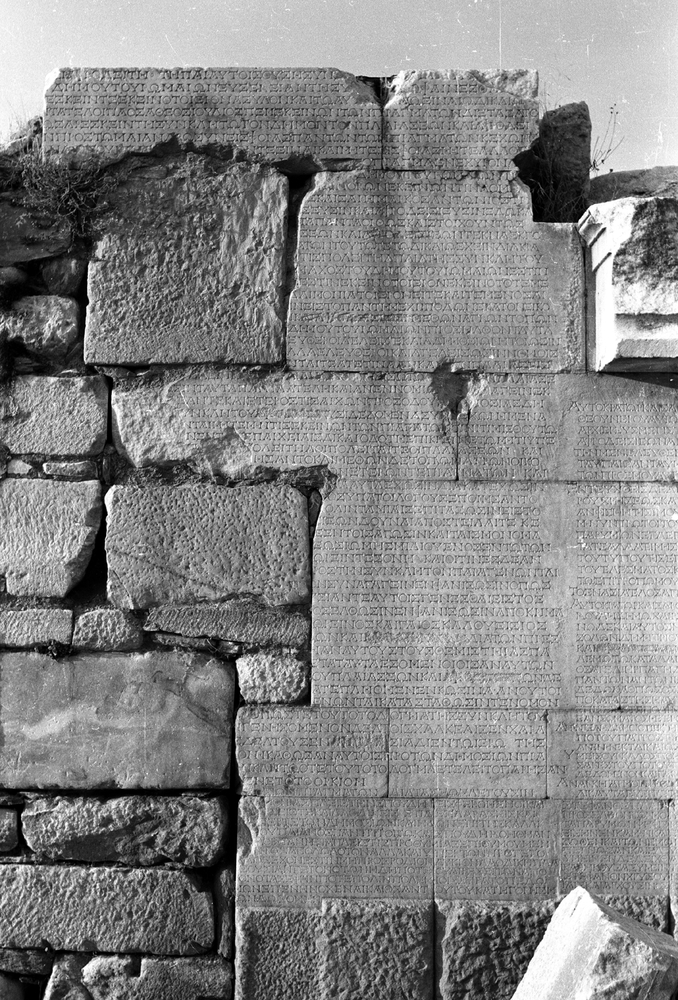
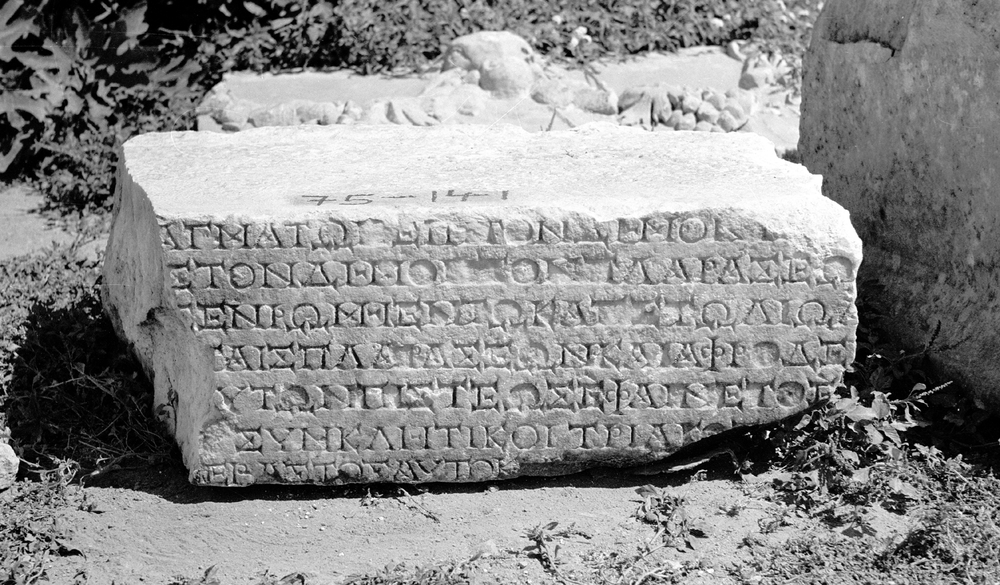
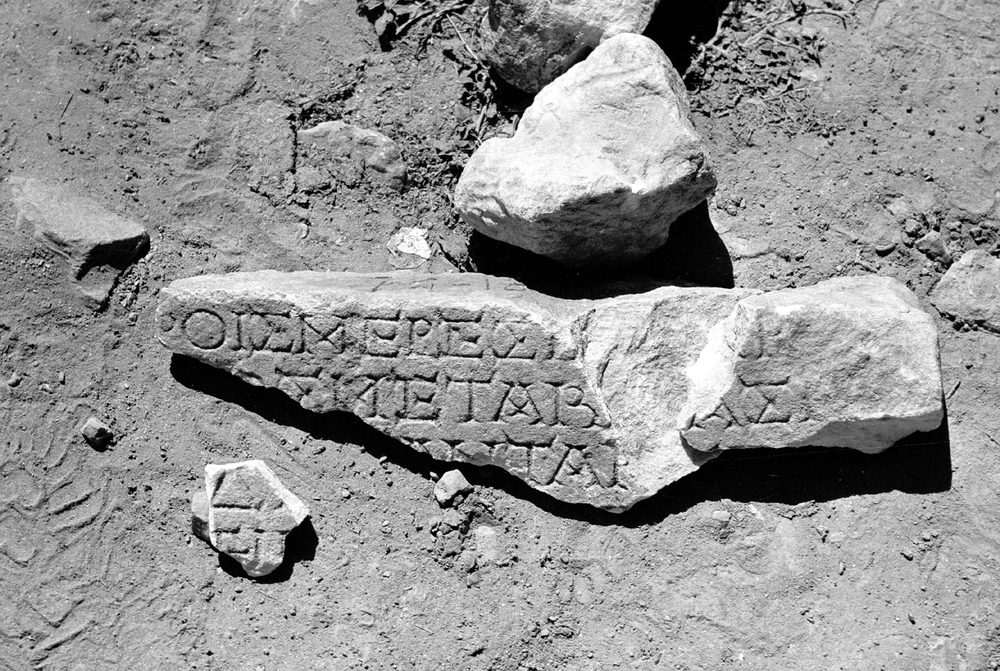
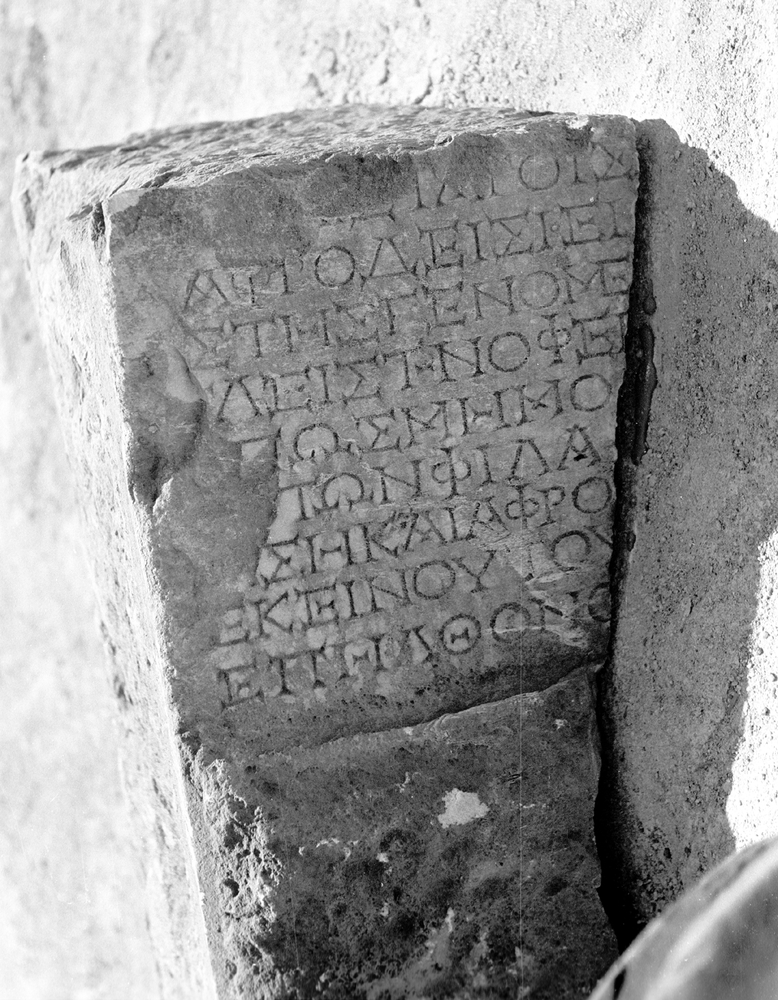
Description: Seven fragments of white marble
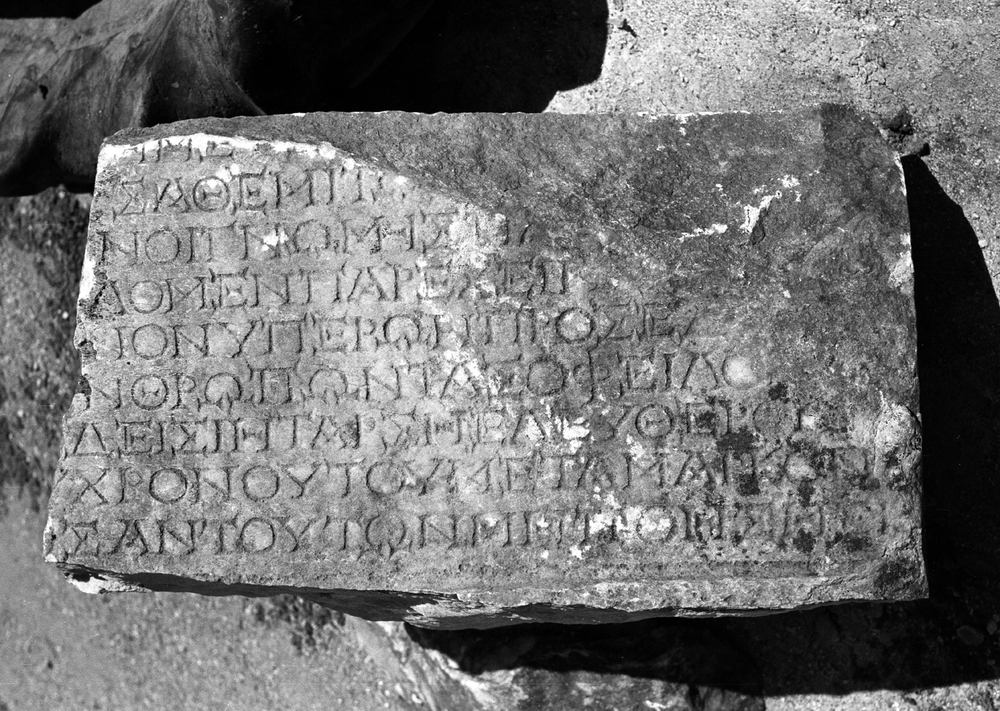
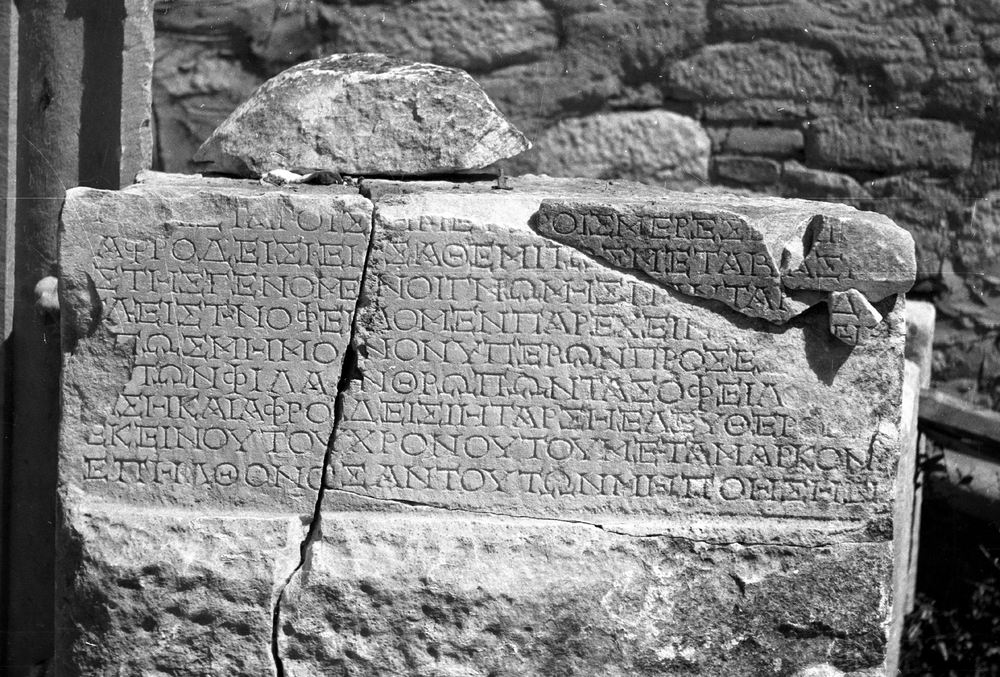
blocks from the archive wall: column 1, lowest register. a (w: 0.97 × h: 1.06 including the dado, x depth not measurable)
damaged at the left side. b, reassembled from three pieces (w: 0.81 × h: 1.06 including the dado × d: 0.40).
c two small fragments fitting onto the damaged surface of b. d. fragment of a block (w: 0.81 × h: 0.29 × d: 0.55).
Text:
Inscribed immediately above the dado. a contains the right ends of the lines. b contains the left ends of lines 3-11. c contains
parts of lines 3-11.
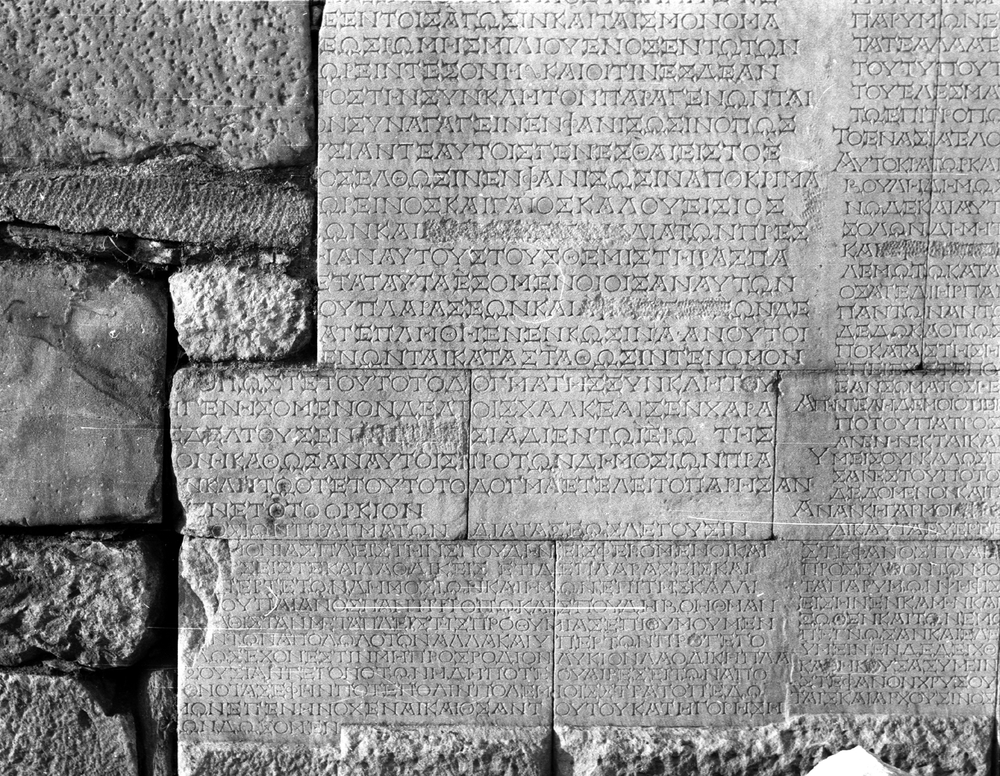
d contains part of line 1, below part of 8.27, lines 90-95.
Letters: Second to third centuries C.E.; ave 0.02, rather more lightly cut than those of document 8.27. No apices or diairesis marks.
Date: Inscription: Second to third centuries C.E. Document, 39/38 BCE (lettering, context, prosopography)
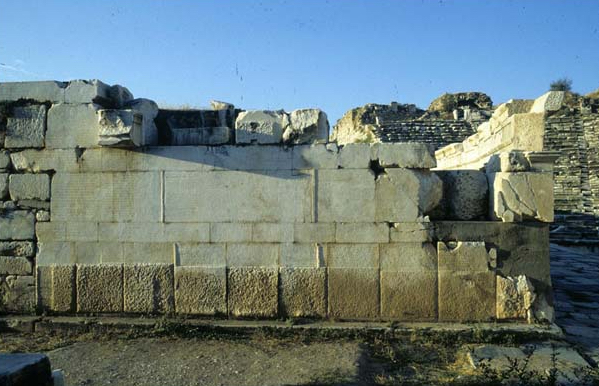
Findspot: Aphrodisias: a in the Theatre, on the
north parodos wall;
b, c and d reused in the Walls, West.
Original location:
Theatre, north parodos wall
Last recorded location: a in findspot; b, c and d in Museum
Interpretive
[Γάϊος Καῖσαρ Σ]εβαστὸς αὐτοκ[ρ]άτωρ, [Μᾶρκος Ἀντώνιος αὐτοκράτωρ? τριῶν ἀνδρῶν τῆς τῶν δημ]οσίων πραγμάτων ( vac. 1) διατάξεως
λέγουσιν ( vac. 2)
[ἐπειδὴ καὶ ἐν τοῖς ἔμπροσθεν χρόνοις ἀεὶ διετέλουν περὶ τῆς τοῦ δήμου τοῦ Ῥωμαίων ἡγε]μονίας πλείστην σπουδὴν εἰσφερόμενοι κ̣α̣ὶ
μ̣[ά]λ̣ι̣σ̣τα τοῖς ἡμετέροις μέρεσι[ν] π̣ρ̣ο̣[σγενόμενοι? c. 17 Ῥόδιοι Λύκιοι Τα]ρσεῖς τε καὶ Λαοδικεῖς ἔτι δὲ Πλαρασεῖς καὶ ( vac. 2)
Ἀφροδεισιεῖς ἀθεμίτως ΜΕΤΑΒΑΣΙ̣[c. 40 ὑ]πέρ τε τῶν δημοσίων καὶ ἡμῶν ἐπὶ τῆς καλλί-
5στης γενόμενοι γνώμης πάντα κ[ίν]δυ̣[νον ἀνεδέχοντο? δι’ ὅπερ? c. 20] ΟΥΠΑΙΑΝΟΣ παντὶ τρόπῳ καὶ σπουδῇ βοήθηαν
πλείστην ὀφείλομεν παρέχειν [---] ΤΗΙ [c. 40 κ]αθιστᾶν μετὰ πλείστης προθυμίας ἐπιθυμοῦμεν
[ὅ]πως μὴ μόνον ὑπὲρ ὧν προσεδ̣[έοντο? c. 35 χρημάτ?]ω̣ν τῶν ἀπολωλότων ἀλλὰ καὶ ὑπὲρ τῶν προγεγο-
[νό]των φιλανθρώπων τὰς ὀφειλο[μένας χάριτας? ἀνταποδίδωμεν c. 20 κα]λῶς ἔχον ἐστὶν μὴ πρὸς Ῥόδιον Λύκιον Λαοδικῆ Πλα-
[ρ]α̣σῆ καὶ Ἀφροδεισιῆ Ταρσῆ ἐλεύθερον̣ [c. 40 ἐ]ξουσίαν γεγονότων ἤδη ποτὲ ΟΥ αἱρέσει τῶν ἀπὸ
10 ἐκείνου τοῦ χρόνου τοῦ μετὰ Μᾶρκον Λ̣[c. 35 ἐπιγεγ?]ονότας ἐφ’ ἥν ποτε πόλιν πολεμίοις στρατοπέδῳ
ἐπῆλθον ὃς ἂν τούτων μὴ ποήσῃ ἐκ̣[---] [c. 40] [---]μων ἐπενηνοχέναι καὶ ὃ̣ς ἂν τούτου κατηγορήσῃ
( vac. 25) [c. 40] [---]ων δώσομεν
Diplomatic
[............]ΕΒΑΣΤΟΣΑΥΤΟΚ[.]ΑΤΩΡ[............................................]ΟΣΙΩΝΠΡΑΓΜΑΤΩΝ ΔΙΑΤΑΞΕΩΣΛΕΓΟΥΣΙΝ
[.......................................................................]ΜΟΝΙΑΣΠΛΕΙΣΤΗΝΣΠΟΥΔΗΝΕΙΣΦΕΡΟΜΕΝΟΙ..Ι
.[.]...ΤΑΤΟΙΣΗΜΕΤΕΡΟΙΣΜΕΡΕΣΙ[.]...[..........·················..............]ΡΣΕΙΣΤΕΚΑΙΛΑΟΔΙΚΕΙΣΕΤΙΔΕΠΛΑΡΑΣΕΙΣΚΑΙ
ΑΦΡΟΔΕΙΣΙΕΙΣΑΘΕΜΙΤΩΣΜΕΤΑΒΑΣ.[········································.]ΠΕΡΤΕΤΩΝΔΗΜΟΣΙΩΝΚΑΙΗΜΩΝΕΠΙΤΗΣΚΑΛΛΙ
5ΣΤΗΣΓΕΝΟΜΕΝΟΙΓΝΩΜΗΣΠΑΝΤΑΚ[..]Δ.[....................····················]ΟΥΠΑΙΑΝΟΣΠΑΝΤΙΤΡΟΠΩΚΑΙΣΠΟΥΔΗΒΟΗΘΗΑΝ
ΠΛΕΙΣΤΗΝΟΦΕΙΛΟΜΕΝΠΑΡΕΧΕΙΝ[---]ΤΗΙ[········································.]ΑΘΙΣΤΑΝΜΕΤΑΠΛΕΙΣΤΗΣΠΡΟΘΥΜΙΑΣΕΠΙΘΥΜΟΥΜΕΝ
[.]ΠΩΣΜΗΜΟΝΟΝΥΠΕΡΩΝΠΡΟΣΕ.[.....···································......].ΝΤΩΝΑΠΟΛΩΛΟΤΩΝΑΛΛΑΚΑΙΥΠΕΡΤΩΝΠΡΟΓΕΓΟ
[..]ΤΩΝΦΙΛΑΝΘΡΩΠΩΝΤΑΣΟΦΕΙΛΟ[.........................····················..]ΛΩΣΕΧΟΝΕΣΤΙΝΜΗΠΡΟΣΡΟΔΙΟΝΛΥΚΙΟΝΛΑΟΔΙΚΗΠΛΑ
[.].ΣΗΚΑΙΑΦΡΟΔΕΙΣΙΗΤΑΡΣΗΕΛΕΥΘΕΡΟ.[········································.]ΞΟΥΣΙΑΝΓΕΓΟΝΟΤΩΝΗΔΗΠΟΤΕΟΥΑΙΡΕΣΕΙΤΩΝΑΠΟ
10ΕΚΕΙΝΟΥΤΟΥΧΡΟΝΟΥΤΟΥΜΕΤΑΜΑΡΚΟΝ.[···································......]ΟΝΟΤΑΣΕΦΗΝΠΟΤΕΠΟΛΙΝΠΟΛΕΜΙΟΙΣΣΤΡΑΤΟΠΕΔΩ
ΕΠΗΛΘΟΝΟΣΑΝΤΟΥΤΩΝΜΗΠΟΗΣΗΕ.[---········································---]ΜΩΝΕΠΕΝΗΝΟΧΕΝΑΙΚΑΙ.ΣΑΝΤΟΥΤΟΥΚΑΤΗΓΟΡΗΣΗ
[········································---]ΩΝΔΩΣΟΜΕΝ
Apparatus
7: Of the last surviving letter before the break there is only a horizontal base meeting a slanting stroke to the left; the angle
seems more like that of Δ than of Σ. Of the first surviving letter after the break there is some slight trace suggesting the
serif on the right horizontal of Ω.
9: Before the break the two uprights interpreted as Ν are followed by a letter of which only a horizontal base survives, Δ, Ε,
Ζ, Ξ, or Σ. || ΟΥΑΙΡΕΣΕΙΤΩΝ Reynolds, 1982, IAph2007
10: Before the break the stone shows unmistakable signs of a triangular letter without a base-line, Α or Λ; the photograph is
less clear.
11: The cutter wrote Θ for Ο.
English translation
Translation source: Reynolds, 1982
(The translation assumes some of the controversial restorations proposed.)
[Caius Caesar] Augustus, imperator, [Marcus Antonius, imperator, triumviri] Reipublicae Constituendae, announce:
[? Since in former times too the Rhodians, Lykians, Ta]rsians and Laodikeians, and also the Plarasans and Aphrodisians, [always]
showed the greatest zeal [for the] empire [of the Roman People] and [being] especially [attached] to our party [.. ? ..] they
[have been] unlawfully [.. ? .. ? when], holding the most noble principles, [? they undertook] every risk on behalf of the
respublica and ourselves; [for which reason .. ? ..] we ought to provide the most abundant aid in every way and with all zeal
[.. ? .. ? for the sake of Apollo] Paean (Medicus), we desire, with the greatest eagerness, [? to restore them] in order that
[? we may pay the debt of gratitude] due not only for those things which [.. ? .. being things] destroyed, but also for their
former good services [to us .. ? .. it is] proper that [no one shall have] the power [to .. ? ..] against a Rhodian, Lykian,
Plarasan and Aphrodisian, Tarsian [.. ? ..] a freeborn person in respect of [.. ? ..] which have occurred already in the past
[.. ? ..] from the time when Marcus [.. ? .. those who ? assaulted] each city which they attacked ? with hostile armies. Whoever
fails to observe ? any of these injunctions [.. ? ..] ? to have brought a charge [.. ? ..] and to whomsoever informs against
him we will give [.. ? ..].
Bibliography
Recorded: New York University expedition, a in 1967; in 1975 b, c 75.187 and d 75.141
Publication: Millar, 1973 9 (description, a only); Reynolds, 1982 7 , whence Robert, Bulletin Épigraphique 1983.369 , AE 1984.861 , McCabe, PHI, 1996 74 ; IAph2007 8.26.