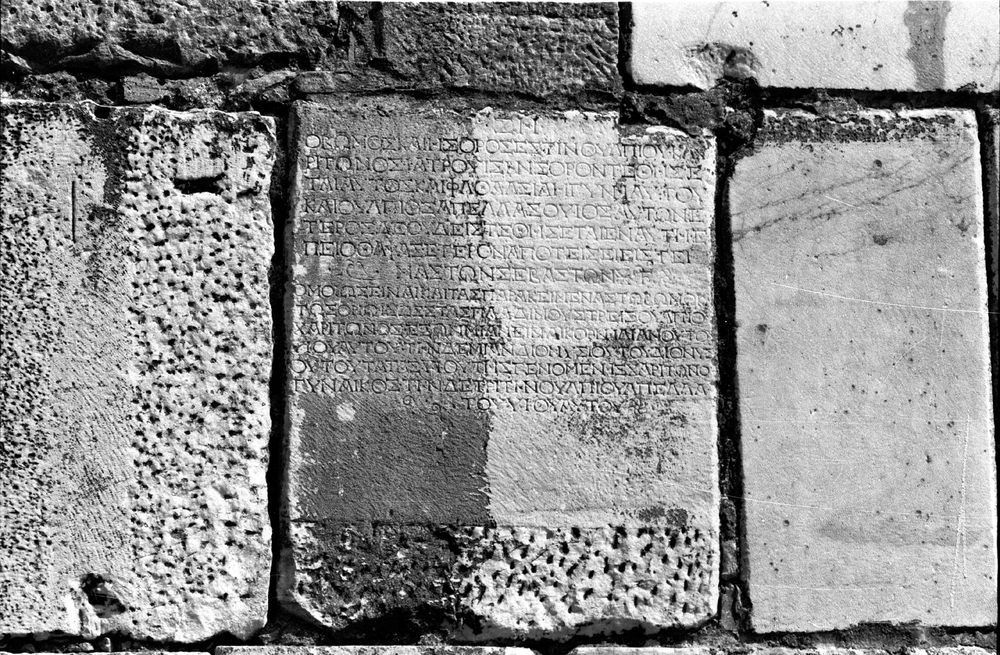
Description:
White marble
stele with traces of a moulding above (w: 0.86 × h: 1.02 x depth not measurable). Surface prepared but not highly polished
for the inscription; stele left roughly dressed towards the base.
Text:
Inscribed on the face.
Letters: 0.02-0.0225
Date: Probably late second to early third century CE (lettering)
Findspot: Aphrodisias:
Walls, North-west stretch: in the standing stretch north of west gate, with
12.1109, 12.1102
Original location: Unknown
Last recorded location: Findspot (1973)
Interpretive
( vac. 11) · ζῆ · ( vac. 11)
ὁ βωμὸς καὶ ἡ σορός ἐστιν Οὐλπίου · Κλ((stop))(αυδίου) Χα
ρίτωνος ἰατροῦ ἰς ἣν σορὸν τεθήσε-
ται αὐτὸς καὶ Φλ(αουία) Θάλε̣ια ἡ γυνὴ αὐτοῦ
5 καὶ Οὔλπιος Ἀπελλᾶς ὁ υ·ἱὸς αὐτῶν · ἕ- ((stop))
τερος δὲ οὐδεὶς τεθήσεται ἐν αὐτῇ · ἐ-
πεὶ ὁ θάψας ·ἕ·τερον ἀποτείσει εἰς τει-
( vac. )((leaf))( vac. 1)μὰς τῶν Σεβαστῶν (δηνάρια) ͵Ϛ ((#whorl)) ( vac. 2)
ὁμοίως εἶναι καὶ τὰς παρακειμένας τῷ βωμῷ κα[ὶ]
10 τῷ σορίῳ ἰσώσστας πλαδιμοὺς τρεῖς Οὐλπίου
Χαρίτωνος · ἐξ ὧν μίαν εἶναι Κορνηλιανοῦ τοῦ̣
υἱοῦ αὐτοῦ · τὴν δὲ μίαν Διονυσίου τοῦ Διονυσ[ί-]
ου τοῦ Τάτας ·υ·ἱ·οῦ τῆς γενομένης Χαρίτωνος̣
γυναικὸς · τὴν δὲ τρίτην Οὐλπίου Ἀπελλᾶ ·
15 ( vac. 8) ((scroll)) ( vac. 1) τοῦ ((stop))υ·ἱ·οῦ αὐτοῦ ((#whorl)) ( vac. 5)
Diplomatic
ΖΗ
ΟΒΩΜΟΣΚΑΙΗΣΟΡΟΣΕΣΤΙΝΟΥΛΠΙΟΥΚΛ • ΧΑ
ΡΙΤΩΝΟΣΙΑΤΡΟΥΙΣΗΝΣΟΡΟΝΤΕΘΗΣΕ
ΤΑΙΑΥΤΟΣΚΑΙΦΛΘΑΛ.ΙΑΗΓΥΝΗΑΥΤΟΥ
5ΚΑΙΟΥΛΠΙΟΣΑΠΕΛΛΑΣΟΥΙΟΣΑΥΤΩΝΕ- •
ΤΕΡΟΣΔΕΟΥΔΕΙΣΤΕΘΗΣΕΤΑΙΕΝΑΥΤΗΕ
ΠΕΙΟΘΑΨΑΣΕΤΕΡΟΝΑΠΟΤΕΙΣΕΙΕΙΣΤΕΙ
❦ ΜΑΣΤΩΝΣΕΒΑΣΤΩΝ 𐆖 ͵Ϛ #whorl
ΟΜΟΙΩΣΕΙΝΑΙΚΑΙΤΑΣΠΑΡΑΚΕΙΜΕΝΑΣΤΩΒΩΜΩΚΑ[.]
10ΤΩΣΟΡΙΩΙΣΩΣΣΤΑΣΠΛΑΔΙΜΟΥΣΤΡΕΙΣΟΥΛΠΙΟΥ
ΧΑΡΙΤΩΝΟΣΕΞΩΝΜΙΑΝΕΙΝΑΙΚΟΡΝΗΛΙΑΝΟΥΤΟ.
ΥΙΟΥΑΥΤΟΥΤΗΝΔΕΜΙΑΝΔΙΟΝΥΣΙΟΥΤΟΥΔΙΟΝΥΣ[.-]
ΟΥΤΟΥΤΑΤΑΣΥΙΟΥΤΗΣΓΕΝΟΜΕΝΗΣΧΑΡΙΤΩΝΟ.
ΓΥΝΑΙΚΟΣΤΗΝΔΕΤΡΙΤΗΝΟΥΛΠΙΟΥΑΠΕΛΛΑ
15 ΤΟΥ • ΥΙΟΥΑΥΤΟΥ #whorl
Translation
No translation yet (2007)
English translation
Translation source: Fellows, 1841
In his lifetime. The monument and the sarcophagus is [the property] of Ulpius Charito the physician. Into the sarcophagus
there shall be put himself and Flavia Thasia [?], his wife, and Ulpius Apellas, their son; but nobody else shall be put into
it, since he who buries another [there] shall pay as a fine to the augusti (i.e. Emperors) [6000] denaria. In the same way,
the three Isostae made of slabs, lying at the side of the monument and the sarcophagus, are to be the property of Ulpius Charito,
of which one is to be the property of Cornelianus, his son; one that of Dionysius, son of Dionysius [and] of Tatia, who had
been Charito's wife; and the third to be the property of Ulpius Apellas, his son
Bibliography
Recorded: Sherard, 1716 126; Walpole, ?1805; Fellows, 1840; Bailie, 1842?; Waddington, 1850; Calder, 1934; New York University expedition in 1973
Publication: Lines 1-8: Walpole, 1817 11 (part) whence, and from Sherard, CIG II.2, 1835 2846 ; Fellows, 1841 55 , whence CIG II.3, 1843 p. 1117, Bailie, 1846 83 ; Le Bas and Waddington, 1870 1640 ; MAMA 8 552 , whence McCabe, PHI, 1996 518 ; IAph2007 12.1112.