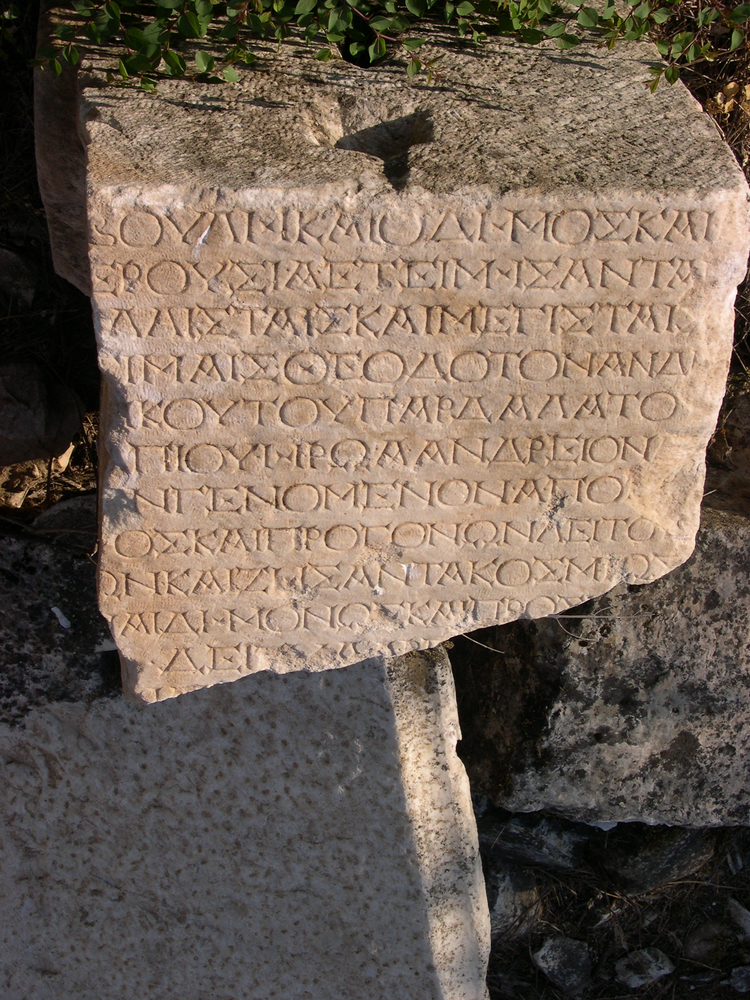
Description:
White marble
base without moulding (w: 0.55 × d: 0.77), in two fragments:
Upper part, a, lines 1-11, h: 0.55; lower part, b, lines 12-16, h: 0.80.
The lower fragment had a deep groove in it, and the part to the right of the groove was not visible in 1973.
Text:
Inscribed on the face.
Letters: 0.0275–0.035; there are dots either side of the first Α in lines 2, 6, 7, and of Η in line 6.
Date: First half of second century CE (lettering)
Findspot: Aphrodisias:
Walls North-east: fallen from the wall just inside the north-east gate.
Original location: Unknown
Last recorded location: Findspot (2004)
Interpretive
[ἡ] βουλὴ καὶ ὁ δῆμος καὶ
[ἡ γ]ερουσία ἐτείμησαν τα[ῖς]
[κα]λλίσταις καὶ μεγίσταις
[τ]ε̣ιμαῖς · Θεόδοτον Ἀνδρ̣[ο-]
5[νε]ίκου τοῦ Παρδαλᾶ τοῦ̣
[Π]α̣πίου ἥρωα ἀνδρεῖον ἀ̣[γα-]
[θ]ὸν γενόμενον ἀπὸ π̣[α-]
[τ]ρ̣ὸς καὶ προγόνων λειτου̣[ρ-]
[γ]ῶ̣ν καὶ ζήσαντα κοσμίως
10 [κα]ὶ αἰδημόνως καὶ πρὸς ὑ̣πό-
δειγμα ἀ̣ρ̣ε̣[τῆ]ς ( vac. 4)
[τὴν ἀν]άστασιν τ[ο]υ̣ ἀνδρ[ι-]
[άν]τος ποησαμέν̣[ο]υ Ἀν-
[δρ]ονείκου τοῦ Π[αρ]δ̣αλᾶ
15 [τοῦ] Παπίου τοῦ π̣[α]τ̣ρ̣ὸς
( vac. 5) αὐτοῦ ( vac. 6)
Diplomatic
[.]ΒΟΥΛΗΚΑΙΟΔΗΜΟΣΚΑΙ
[..]ΕΡΟΥΣΙΑΕΤΕΙΜΗΣΑΝΤΑ[..]
[..]ΛΛΙΣΤΑΙΣΚΑΙΜΕΓΙΣΤΑΙΣ
[.].ΙΜΑΙΣΘΕΟΔΟΤΟΝΑΝΔ.[.-]
5[..]ΙΚΟΥΤΟΥΠΑΡΔΑΛΑΤΟ.
[.].ΠΙΟΥΗΡΩΑΑΝΔΡΕΙΟΝ.[..-]
[.]ΟΝΓΕΝΟΜΕΝΟΝΑΠΟ.[.-]
[.].ΟΣΚΑΙΠΡΟΓΟΝΩΝΛΕΙΤΟ.[.-]
[.].ΝΚΑΙΖΗΣΑΝΤΑΚΟΣΜΙΩΣ
10[..]ΙΑΙΔΗΜΟΝΩΣΚΑΙΠΡΟΣ.ΠΟ
ΔΕΙΓΜΑ...[..]Σ
[.....]ΑΣΤΑΣΙΝΤ[.].ΑΝΔΡ[.-]
[..]ΤΟΣΠΟΗΣΑΜΕ.[.]ΥΑΝ
[..]ΟΝΕΙΚΟΥΤΟΥΠ[..].ΑΛΑ
15[...]ΠΑΠΙΟΥΤΟΥ.[.]..ΟΣ
ΑΥΤΟΥ
English translation
Translation source: Chaniotis, 2004
The council, the people, and the gerousia honored with the best and greatest honors Theodotos, son of Androneikos, son of
Pardalas, son of Papias, who became a manly and good hero, whose father and ancestors had undertaken liturgies, who lived
an orderly and modest life, giving an example of virtue; the statue was erected by his father, Androneikos, son of Pardalas,
son of Papias.
Bibliography
Recorded: Gaudin, 1904 95 (a only); Calder, 1934 (a and b); New York University expedition in 1973, and in 2001, I 01.029 (a and b)
Publication: Reinach, 1906 56 (upper part); MAMA 8 490 , whence McCabe, PHI, 1996 536 , Smith, 2006 H.144 (listed); IAph2007 12.104; Chaniotis, 2004 6, whence SEG 54.1030.