[ο]ὐ̣ θά|νεν οὐ|δ' Ἀχέ|ροντοϲ | (5) ἴδεν ῥό|ον, ἀλλ' ἐ|ν Ὀλύμπωι |
Ἀσκληπιόδο|τοϲ τείρε⸢ϲ⸣ι | (10) ϲυνφέρετε |
οὗτοϲ ὅτιϲ | δώμηϲε καὶ | ἀγλαὰ πολ|λὰ τιθήνηι |
[------]
Description: A white marble funerary stele, cut in one piece, in the form of a pyramid surmounting a rectangular base (w: 0.95 × h: 0.50 × d: 0.50); all four sides of the pyramid and of the base are cut as panels within moulding. The top of the pyramid is broken away, but there are traces of a hole which would have held an insertion at the apex.
Text: Line 1 is inscribed on the front panel of the pyramid, lines 2-3 within the front panel of the base.
Letters: 0.034-0.045; clear cut and irregular; apostrophes in lines 3 and 6.
Date: Late fifth century. (prosopography)
Findspot: Aphrodisias: City, Village: reused supporting a pillar of a verandah, in a house subsequently demolished.
Original location: Unknown.
Last recorded location: Museum (1994)
The monument appears to be complete below; it must be assumed that it originally stood on another feature on which the last
line of the epigram was inscribed.
9: ΤΕΙΡΕΕΙ
Translation source: ALA 2004
He did not die, nor did he see the stream of Acheron, but in Olympus Asklepiodotos is among the stars—he who also built many splendid things for his motherland [------]
Translation source: Merkelbach and Stauber, 1998
Asklepiodotos ist nicht gestorben und hat den Fluss des Acheron nicht gesehen, sondern er ist im Olymp und wird mit den Sternen im umlauf gedreht, er, der Bauten errichtet und seine Amme (der Stadt) viele (Wohltaten erwiesen) hat . . .
See also 11.68.
Recorded: Calder, 1934; New York University expedition, 79.12
Publication: MAMA 8 487 , whence Robert, Hellenica XIII 170-171, Robert, Bulletin Épigraphique 1966.399 ; Roueché, ALA 54 and plate xiii, whence McCabe, PHI, 1996 731 , Merkelbach and Stauber, 1998 02/09/06 , ALA 2004 54, IAph2007 11.69.
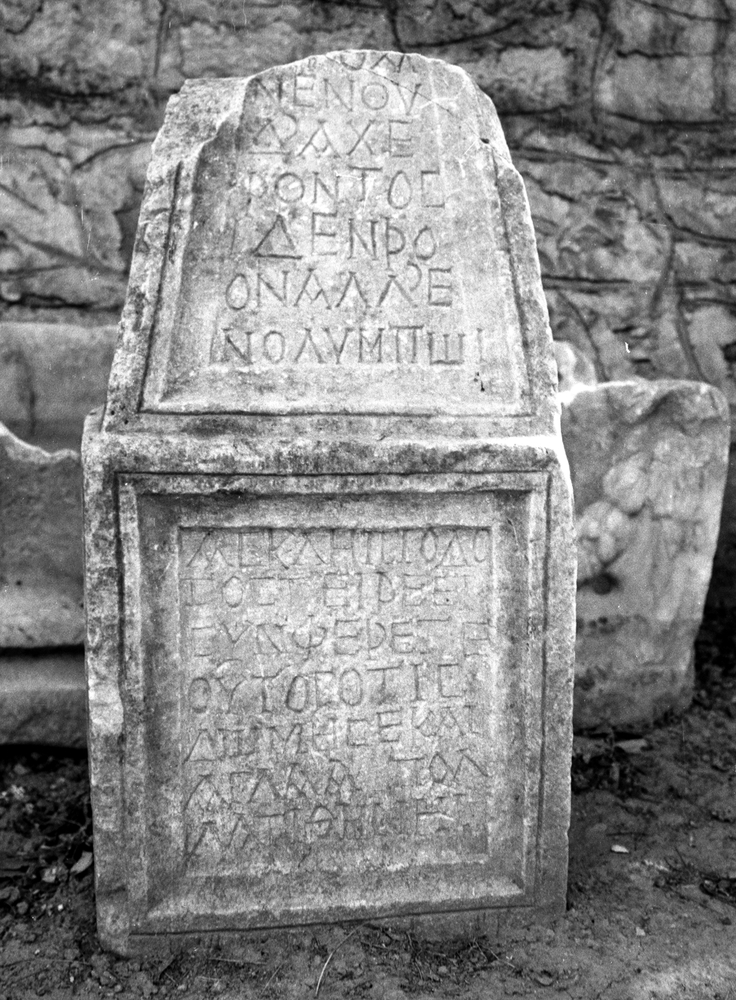
Fig. 1. Face (Mossman Roueché, 1980)
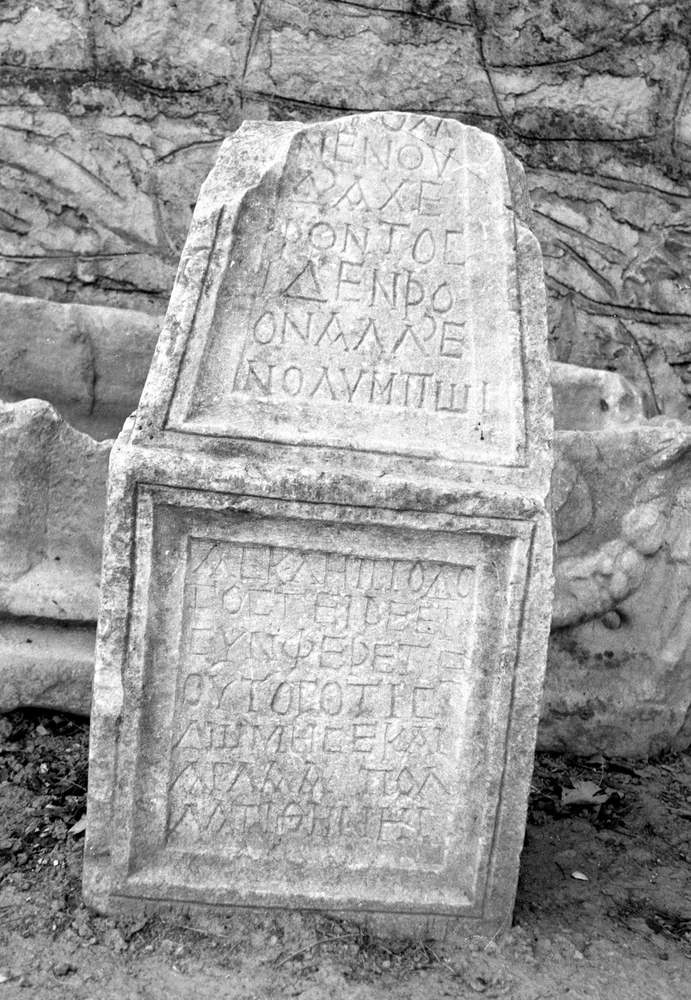
Fig. 2. Face (Mossman Roueché, 1980)
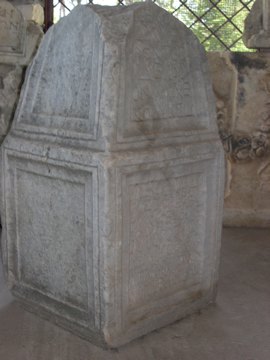
Fig. 3. Left side (Mossman Roueché, 2004)
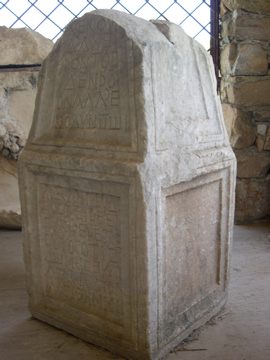
Fig. 4. Right side (Roueché, 2004)
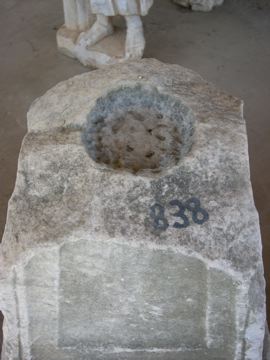
Fig. 5. Top (Mossman Roueché, 2004)