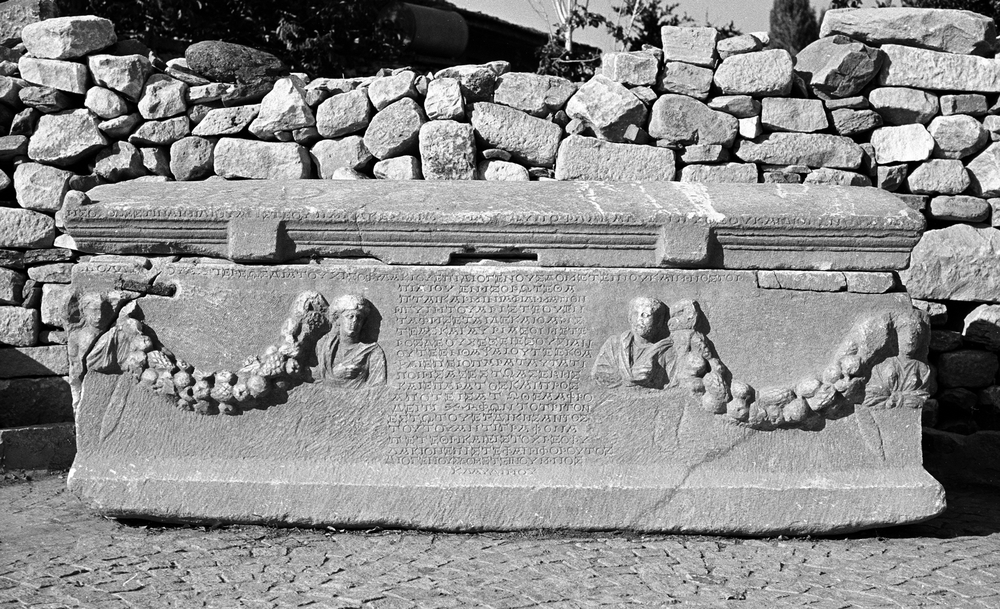
Description:
White marble
sarcophagus complete with lid and an iron clamp repairing an ancient break; total (w: 2.38 × h: 0.96 × d: 0.91);
chest (w: 2.38 × h: 0.73), lid (w: 2.36 × h: 0.24).
Text: Line 1 is inscribed on the front moulding of the lid; line 2 along the upper front edge of the sarcophagus, but leaving a
substantial area blank at the right-hand end, where the sarcophagus is damaged; lines 3-19 in the area between the two busts,
from which an earlier inscription has been erased; line 20 on the flange below.
Letters: Reasonably good examples of the second-to-fourth-century style, a little uneven in height, 0.015-0.025. Star for denarius.
Slanting stroke before the figure in line 14, after it in line 18.
Date: Late third century CE (hairstyles, nomenclature, lettering)
Findspot: Aphrodisias:
Necropolis, West area: excavated during repair work on the road from the site to the village of new Geyre.
Found with 13.602 and 13.603
Original location: Necropolis
Last recorded location: Museum (Inv. no. 5624)
Interpretive
ἡ σορ̣ός ἐστιν Αἰμιλίου Ἀρ̣ιστέου ((stop)) παρακεχωρημένη αὐτῷ ὑπὸ Φλαβ(ίων) Ἀντ̣ων(ίων) Πυθέου καὶ Διογένους υἱῶν
Ἀπολλω[ν]ίου ἀρχιερέως διὰ τοῦ χρεοφυλακίου ἐπὶ Διογένους Δομετείνου καὶ μηνὸς Γορ-
πιαίου ( vac. 1) ἐν ᾗ σορῷ τεθά-
πται Καρμινία Φιλημάτιον
5 ἡ γυνὴ τοῦ Ἀριστέου ἐν-
ταφήσεται δὲ καὶ ὁ Ἀρισ-
τέας καὶ Αὐρ(ηλία) Ἰασόνη ἕτε-
ρος δὲ οὐχ ἕξει ἐξουσίαν
οὔτε ἐνθάψαι οὔτε ἐκθά-
10ψαι ἐπεὶ ὁ παρὰ ταῦτά τι
ποιήσας ἔστω ἀσεβὴς
καὶ ἐπάρατος καὶ προσ-
αποτεισάτω θεᾷ Ἀφρο-
δείτῃ (δηνάρια) ͵βΦ ὧν τὸ τρίτον
15 ἔστω τοῦ ἐγδικήσαντος
τούτου ἀντίγραφον ἀ-
πετέθη καὶ εἰς τὸ χρεοφυ-
λάκιον ἐπὶ στεφανηφόρου το ζ
Διογένους Δομετείνου μηνὸς
20 ( vac. 8) Κλαυδιήου ( vac. 5)
Diplomatic
ΗΣΟ.ΟΣΕΣΤΙΝΑΙΜΙΛΙΟΥΑ.ΙΣΤΕΟΥ • ΠΑΡΑΚΕΧΩΡΗΜΕΝΗΑΥΤΩΥΠΟΦΛΑΒΑΝ.ΩΝΠΥΘΕΟΥΚΑΙΔΙΟΓΕΝΟΥΣΥΙΩΝ
ΑΠΟΛΛΩ[.]ΙΟΥΑΡΧΙΕΡΕΩΣΔΙΑΤΟΥΧΡΕΟΦΥΛΑΚΙΟΥΕΠΙΔΙΟΓΕΝΟΥΣΔΟΜΕΤΕΙΝΟΥΚΑΙΜΗΝΟΣΓΟΡ
ΠΙΑΙΟΥ ΕΝΗΣΟΡΩΤΕΘΑ
ΠΤΑΙΚΑΡΜΙΝΙΑΦΙΛΗΜΑΤΙΟΝ
5ΗΓΥΝΗΤΟΥΑΡΙΣΤΕΟΥΕΝ
ΤΑΦΗΣΕΤΑΙΔΕΚΑΙΟΑΡΙΣ
ΤΕΑΣΚΑΙΑΥΡΙΑΣΟΝΗΕΤΕ
ΡΟΣΔΕΟΥΧΕΞΕΙΕΞΟΥΣΙΑΝ
ΟΥΤΕΕΝΘΑΨΑΙΟΥΤΕΕΚΘΑ
10ΨΑΙΕΠΕΙΟΠΑΡΑΤΑΥΤΑΤΙ
ΠΟΙΗΣΑΣΕΣΤΩΑΣΕΒΗΣ
ΚΑΙΕΠΑΡΑΤΟΣΚΑΙΠΡΟΣ
ΑΠΟΤΕΙΣΑΤΩΘΕΑΑΦΡΟ
ΔΕΙΤΗ 𐆖 ͵ΒΦΩΝΤΟΤΡΙΤΟΝ
15ΕΣΤΩΤΟΥΕΓΔΙΚΗΣΑΝΤΟΣ
ΤΟΥΤΟΥΑΝΤΙΓΡΑΦΟΝΑ
ΠΕΤΕΘΗΚΑΙΕΙΣΤΟΧΡΕΟΦΥ
ΛΑΚΙΟΝΕΠΙΣΤΕΦΑΝΗΦΟΡΟΥΤΟΖ
ΔΙΟΓΕΝΟΥΣΔΟΜΕΤΕΙΝΟΥΜΗΝΟΣ
20 ΚΛΑΥΔΙΗΟΥ
English translation
Translation source: Jones and Smith, 1994
The sarcophagus belongs to Aemilius Aristeas, conceded to him by Flavius Antonius Pytheas and Flavius Antonius Diogenes, sons
of Apollonios the high-priest, through the registry office in (the year of) Diogenes Dometeinos, and in the month Gorpiaios.
In this sarcophagus has been buried Carminia Philemation, the wife of Aristeas, and there will be buried also Aristeas and
Aur(elia) Iasone. No-one else shall have the right either to inter or to disinter, and whoever contravenes these (dispositions)
is to be impious and accursed, and in addition he is to pay to the goddess Aphrodite 2500 denarii, of which one third will
belong to the successful prosecutor. A copy of this (text) was deposited in the registry-office in the (year of) Dometeinos
Diogenes, stephanephoros for the seventh time, in the month Claudieios.
English translation
Translation source: Reynolds, 2007
The sarcophagus is the property of Aemilius Aristeas, ceded to him by Flavius Antonius Pytheas and Flavius Antonius Diogenes,
sons of Apollonios the high-priest, a transaction registered in the civic archive in the year of Diogenes Dometinos, month
Gorpiaios. In this sarcophagus Carminia Philemation wife of Aristeas has been buried, and Aristeas and Aurelia Iasone will
be buried; but no-one else shall have the right to place (scil. a body) in it or to remove (scil. a body) from it, since whoever acts in any way contrary to these provisions is to be (considered) sacrilegious and accursed
and furthermore is to pay to the goddess Aphrodite 2,500 denarii, of which one third is to belong to the prosecutor. A copy
of this (text) was also deposited in the civic archive in the seventh stephanephorate of Diogenes Dometinos, in the month
Claudieios.
Bibliography
Recorded: Aphrodisias Museum team in 1989/1990, whence New York University expedition Sarcophagus 11
Publication: Jones and Smith, 1994 461-72, whence BE 1995.514 , SEG 44.866 , AE 1994.1705; Reynolds, 2007 6 ; IAph2007 13.604.