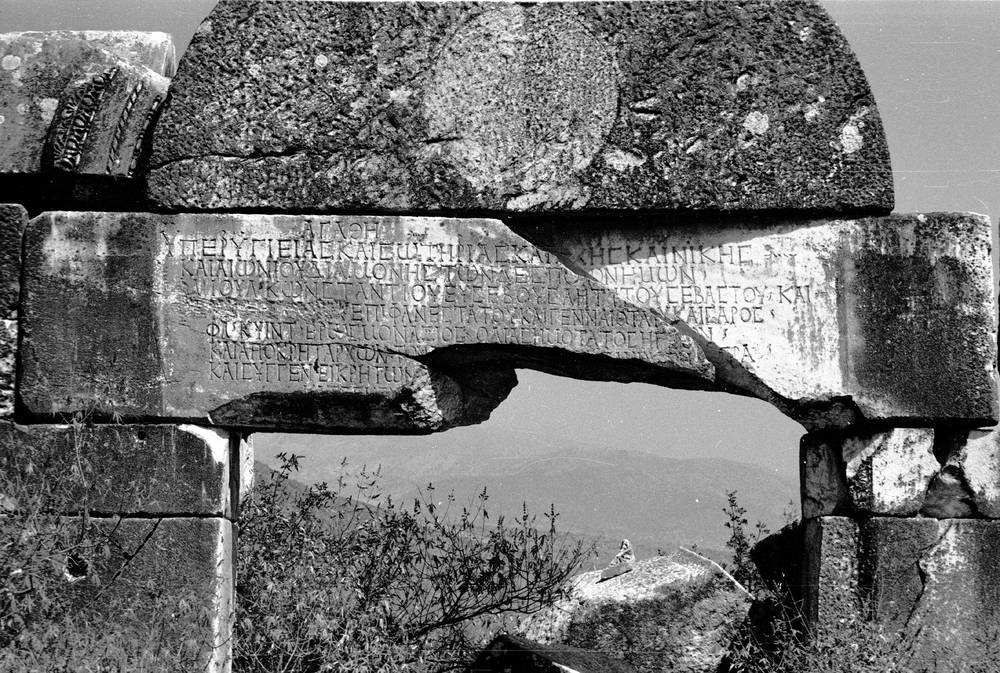
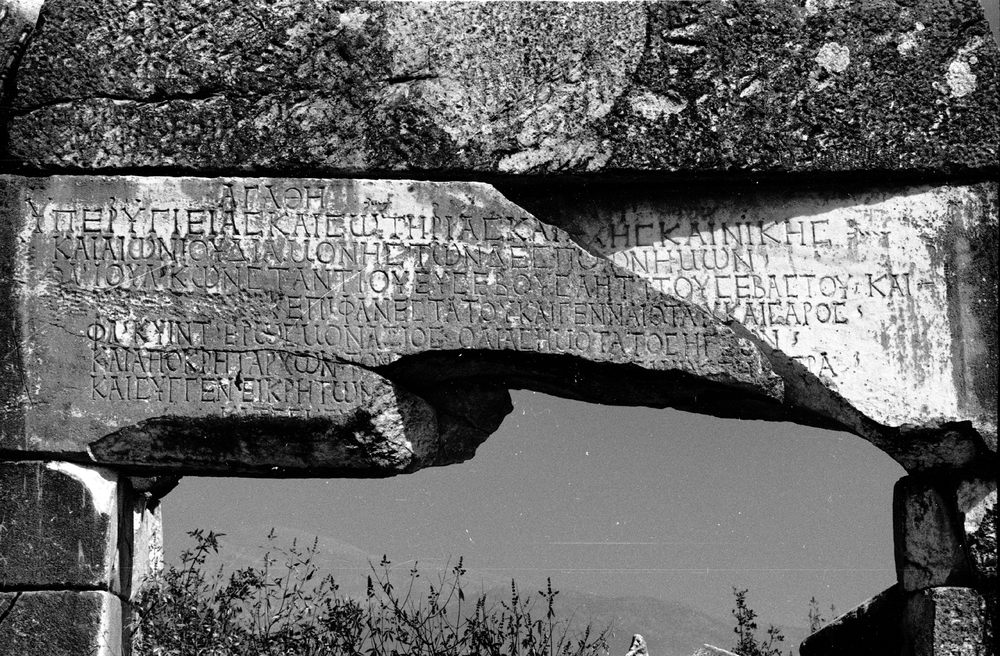
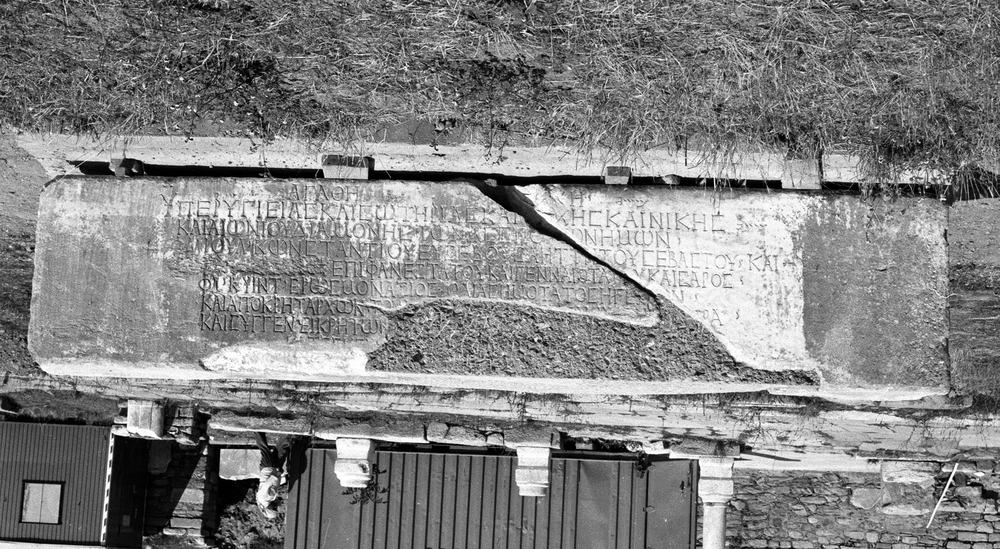
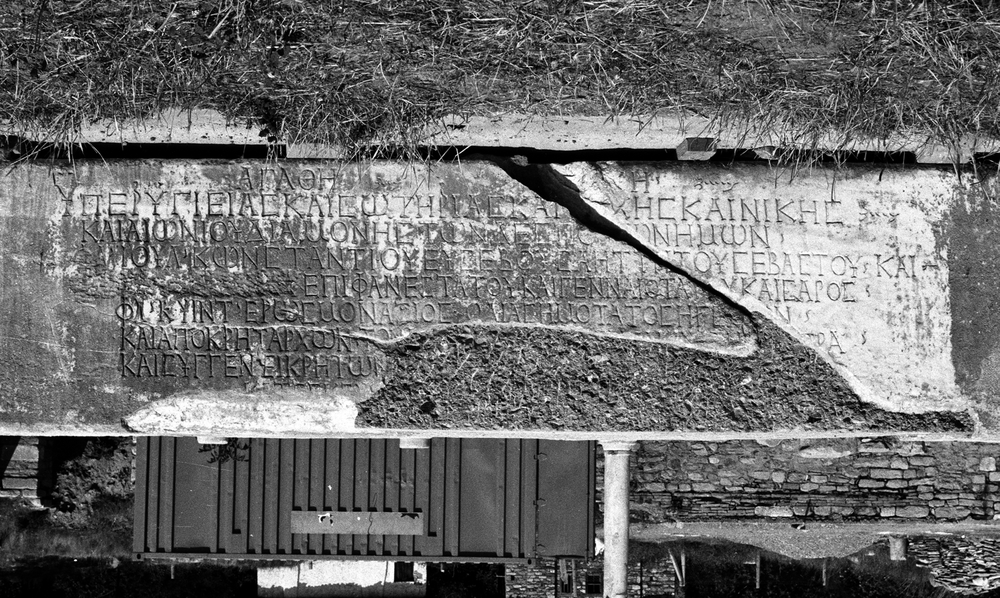
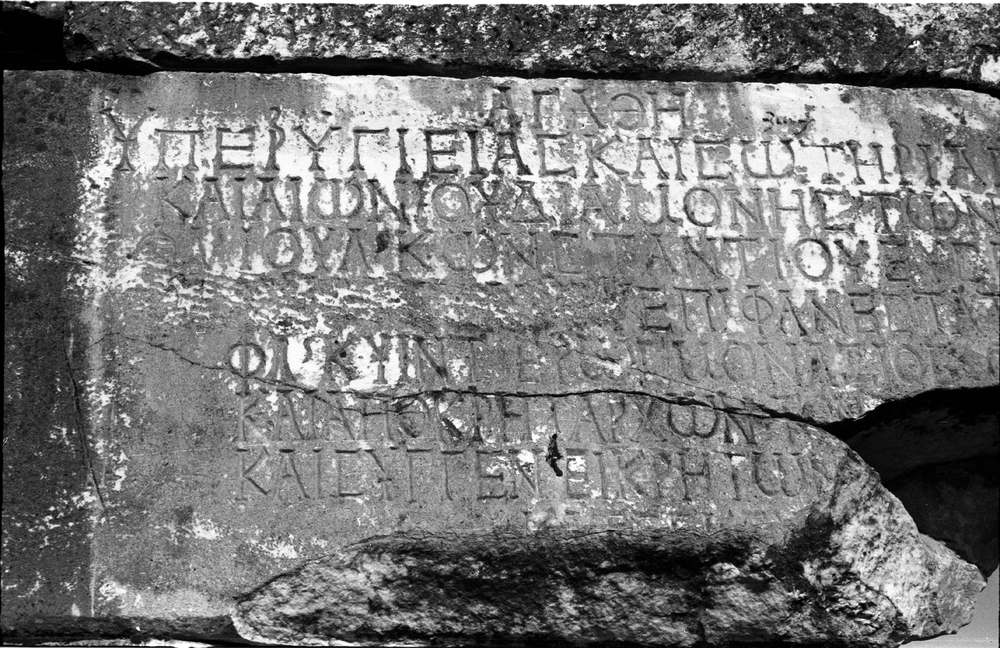
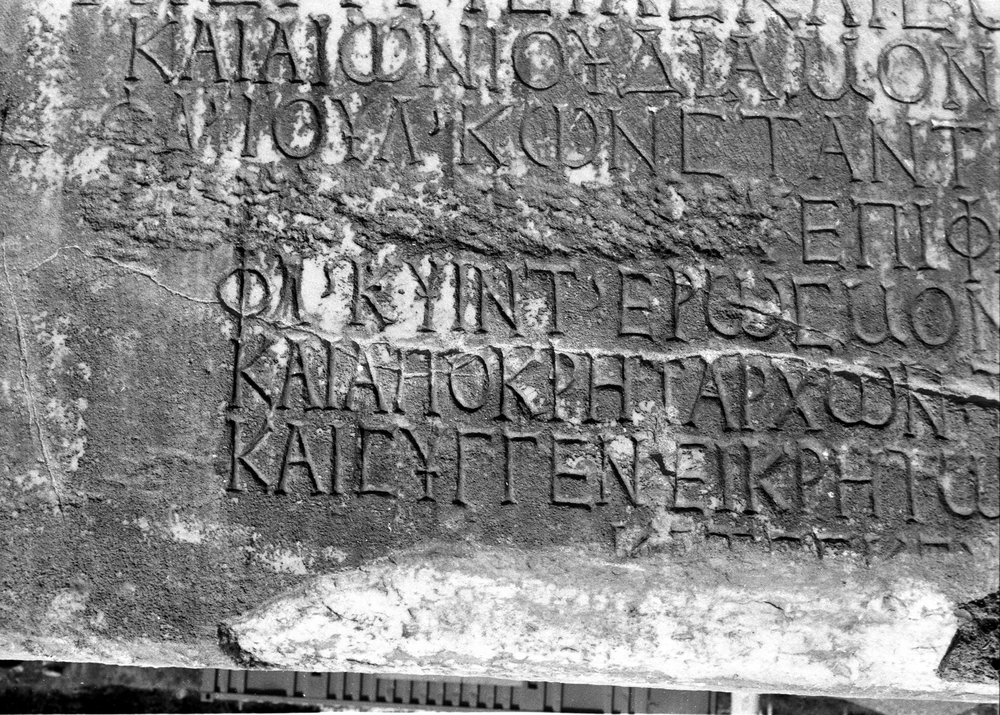
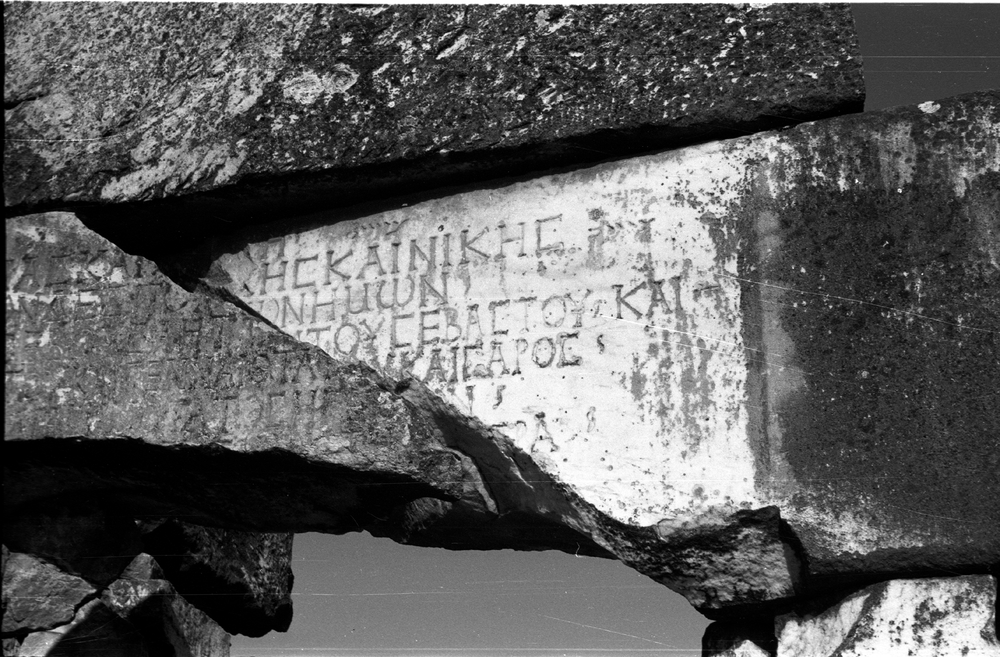
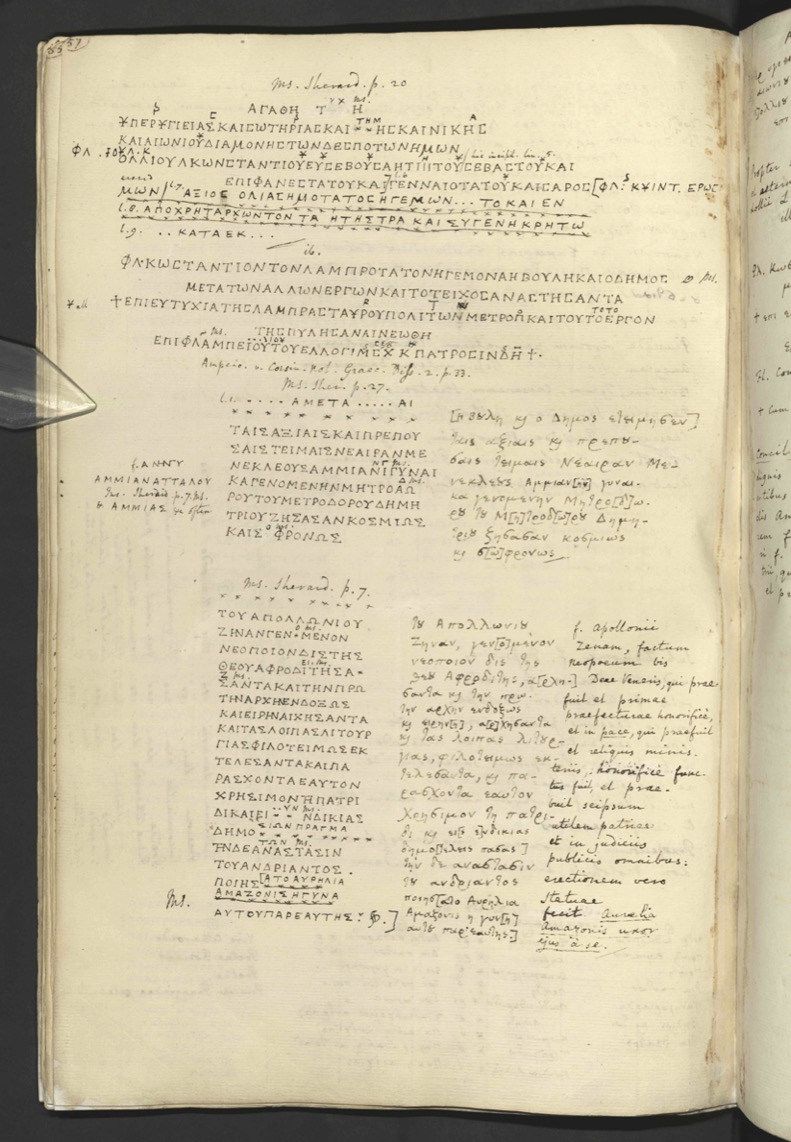
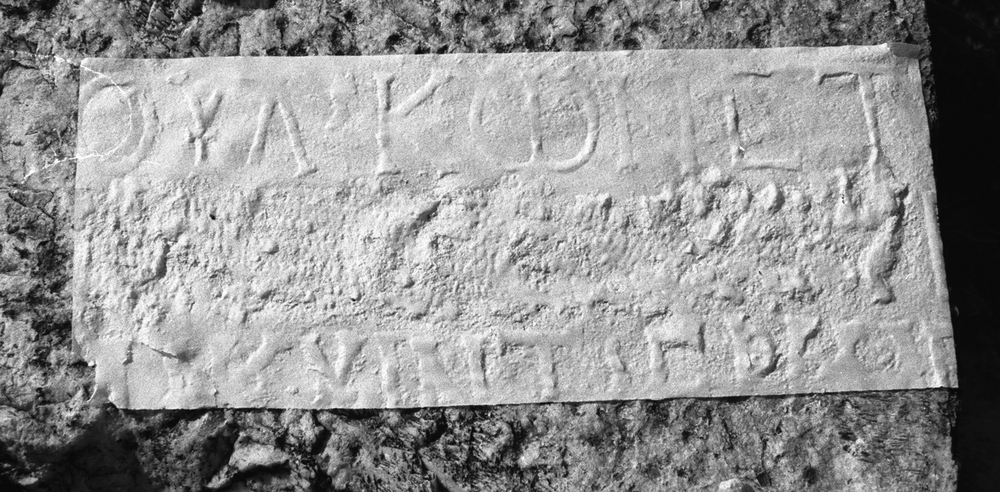
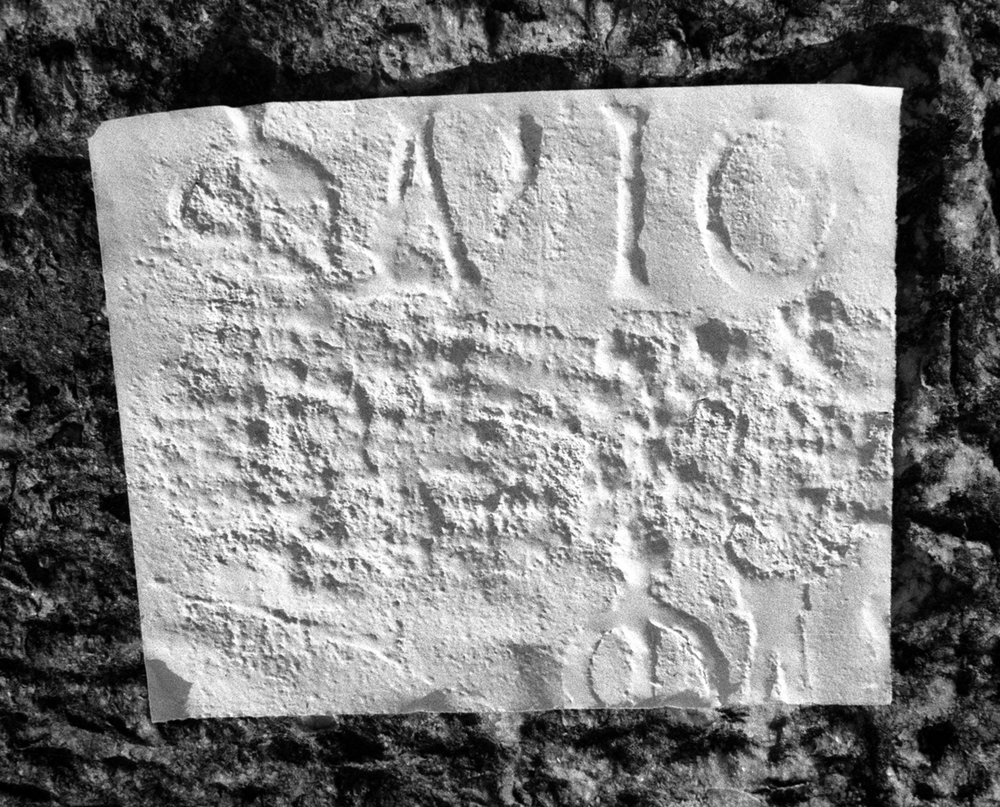
Description: A large white marble
lintel block (w: 4.20 × h: 0.87 × d: 0.50) broken in two diagonally across the face (as it probably was when Sherard saw it,
and certainly when Bailie did) and broken away at the bottom (where no earlier visitor could read any more than we could).
Text:
Inscribed on the face.
Letters: Letters: 0.075; elongated and decorated; square sigma and epsilon; diacritical dots over Υ in line 2 (twice); scroll for abbreviation marks and for stops.
Date: 355-360 CE, dependent on dating of Caesar.
Findspot: Aphrodisias:
Walls, West Gate:
found by us in the same position, and in virtually the same condition, as by the earlier visitors, cut on the large lintel
over the west gate in the city wall, on the outer (west) face.
The gate itself is decorated with a considerable amount of re-used relief sculpture.
Original location:
Walls, West Gate
Last recorded location: Findspot (1991).
Interpretive
( vac. ) Ἀγαθῇ ((scroll)) Τύχῃ ((scroll))
ὑπὲρ ὑγιείαϲ καὶ ϲωτηρίαϲ καὶ τ[ύ]χηϲ καὶ νίκηϲ ((scroll))
καὶ αἰωνίου διαμονῆϲ τῶν δεϲποτ̣ῶν ἡμῶν ((stop))
Φλ(αουίου) Ἰουλ(ίου) Κωνϲταντίου Εὐϲεβοῦϲ Ἀηττ̣ή̣του Ϲεβαϲτοῦ ((stop)) καὶ ((dash))
5 ⟦[Φλ(αουίου) Κλ(αυδίου) Ἰουλια]ν̣ο̣ῦ̣⟧ ἐπιφανεϲτάτου καὶ γενναιοτάτ̣[ο]υ Καίϲαροϲ((stop))
Φλ(άουιοϲ) Κυιντ(ίλιοϲ) Ἔρωϲ Μονάξιοϲ ((stop)) ὁ διαϲημότατοϲ ἡγεμ̣ὼ̣ν̣ ((stop))
καὶ ἀπὸ Κρητάρχων τὸν Π̣ [c. 8 ἐκ θ]ε̣μ̣ε̣λ̣ί̣ων̣ τῇ λ[αμ] π̣ρᾷ ((stop))
καὶ ϲυγγενεῖ Κρητῶν [μητροπόλει τῶν Ἀφροδειϲιέων ((stop)) ]
( vac. ) κα̣τε̣ϲ̣κε̣ύ̣ [αϲεν c. 12] ( vac. )
Diplomatic
ΑΓΑΘΗ ΤΥΧΗ
ΥΠΕΡΥΓΙΕΙΑϹΚΑΙϹΩΤΗΡΙΑϹΚΑΙΤ[.]ΧΗϹΚΑΙΝΙΚΗϹ
ΚΑΙΑΙΩΝΙΟΥΔΙΑΜΟΝΗϹΤΩΝΔΕϹΠΟ.ΩΝΗΜΩΝ •
ΦΛΙΟΥΛ ΚΩΝϹΤΑΝΤΙΟΥΕΥϹΕΒΟΥϹΑΗΤ..ΤΟΥϹΕΒΑϹΤΟΥ • ΚΑΙ ―
5⟦[..........]...⟧ΕΠΙΦΑΝΕϹΤΑΤΟΥΚΑΙΓΕΝΝΑΙΟΤΑ.[.]ΥΚΑΙϹΑΡΟϹ •
ΦΛ ΚΥΙΝΤ ΕΡΩϹΜΟΝΑΞΙΟϹ • ΟΔΙΑϹΗΜΟΤΑΤΟϹΗΓΕ... •
ΚΑΙΑΠΟΚΡΗΤΑΡΧΩΝΤΟΝ.[········...].....Ω.ΤΗΛ[..].ΡΑ •
ΚΑΙϹΥΓΓΕΝΕΙΚΡΗΤΩΝ[..........................]
Κ.Τ..Κ..[....············]
Apparatus
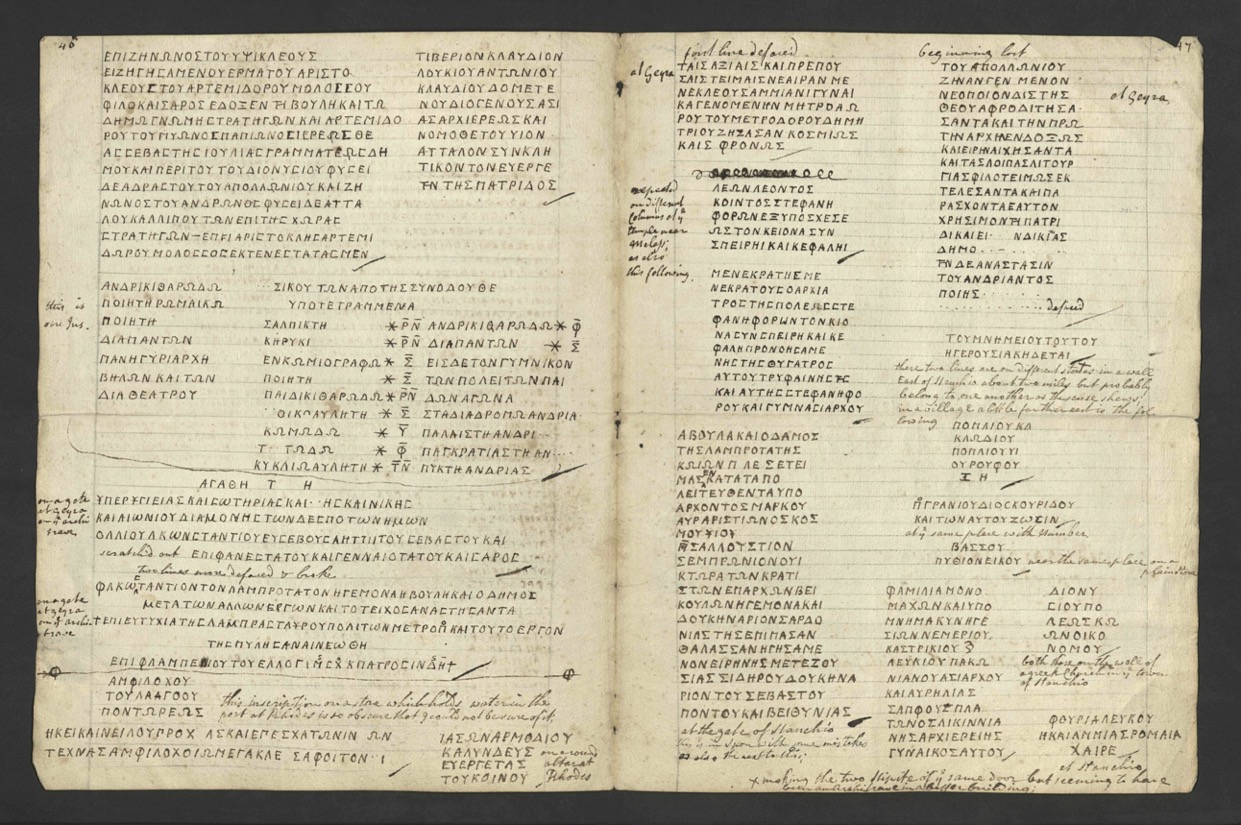
2: ΤΗΜΗϹ Sherard, 1705; ΤΙΜΗϹ Texier, 1835, Fellows, 1840; Τ+ΧΗϹ Waddington, 1850 but the tau was not copied by any later witnesses, or by us
5: No earlier visitors copied anything in this rasura; we have (with some difficulty) examined it closely, and taken a squeeze.
6: After ἡγεμών Sherard read το, seen by no other witnesses, but reproduced as τε by Cormack.
7: At the end . . . ]ΝΤΗΛ[ . . ]ΠΡΑ was read by most witnesses, but misleadingly set out in CIG, whence it was misunderstood
by Cormack (see Robert, loc.cit., 162). The NYU team took a squeeze of this line. After τόν there is a trace of a cross-bar.
The restoration [ἐκ θ]ε̣μ̣ε̣λ̣ί̣ων, from the traces which we discerned, is that of Robert; the phrase appears again in the
closely contemporary 8.405.
English translation
Translation source: ALA 2004
With Good Fortune. For the health and safety and fortune and victory and eternal endurance of our masters, Flavius Julius
Constantius, pious unvanquished Augustus, and ⟦Flavius Claudius Iulianus(?) ⟧. the most renowned and most noble Caesar, Flavius
Quintilius Eros Monaxios, perfectissimus praeses and former Cretarch, built [the gate?] from the foundations for the splendid [metropolis of the Aphrodisians(?) ], kin to
the Cretans [---]
English translation
Translation source: Bailie, 1843
Propitious (be) Fortune.For the health and safety and honour and victory and everlasting establishment of our lords, Flavius
Julius Constantius, the pious, Imperator, the Augustus: and of . . . . . the most illustrious and most noble Caesar: Flavius
Quintus Eros Monaxius, the most distinguished Hegemon, and of the number of the Cretarchs, hath, for the illustrious (Metropolis
of the Tauropolitans), and one related to the Cretans, (erected this portal) . . .
English translation
Translation source: Fellows, 1841
May fortune be favourable! For the good health, and the safety, and the honours, and the victory, and perpetual welfare of
our lords: Flavius Julius Constantius, the Pious, the Never-Vanquished, Augustus and [name erased] the most excellent and
noble Caesar, Fl. Quintius Eros Monaxius [?], the most distinguished Governor, and one of the Cretarchae, has erected it on
his own expense . . . . . . for the splendid Metropolis of the Tauropolitans, the relations of the Cretans
Bibliography
Recorded: This inscription, which confronted every traveller who arrived at Aphrodisias before the construction of the new road to
Tavas in the late 1960s, is one of the most frequently published from the site. Sherard, 1705 9; Richter, 1816; Wood, 1750 14, loose page 46 (first 5 lines); Fellows, 1840; Bailie, 1842 ; Waddington, 1850 ; Gaudin, 1904 180 Calder, 1934; Jacopi, 1937-38 New York University expedition, recorded and restored
Publication: From von Richter, Francke, 1830 73 ; from Sherard and von Richter CIG II.2, 1835 2744 ; Texier, 1839 159 ; Fellows, 1841 18 , whence CIG II.3, 1843 p. 1109; Bailie, 1843 p.35-36 , Bailie, 1846 46, a new and inaccurate distribution of the lines, which he presented with pride as an improvement on the text of CIG ;
Le Bas and Waddington, 1870 1626 ; Reinach, 1906 137 (mention) ; Jacopi, 1940 p. 170; MAMA 8 426 , on which Robert, Hellenica XIII 158-167 , whence Robert, Bulletin Épigraphique 1966.393 , Robert, Bulletin Épigraphique 1968.507 ; Roueché, ALA 19 whence McCabe, PHI, 1996 607 , ALA 2004 19 , IAph2007 12.1001.