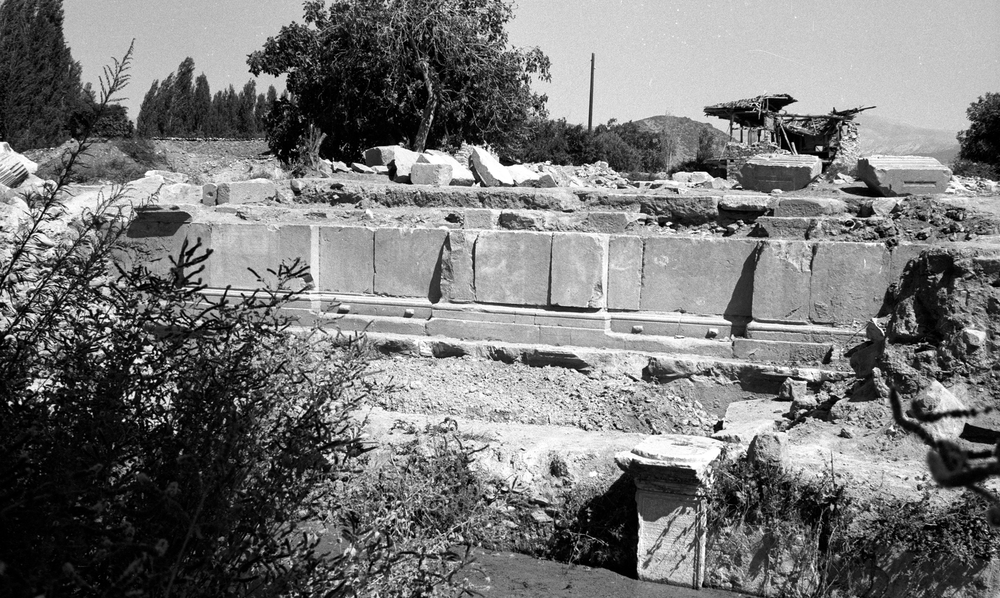
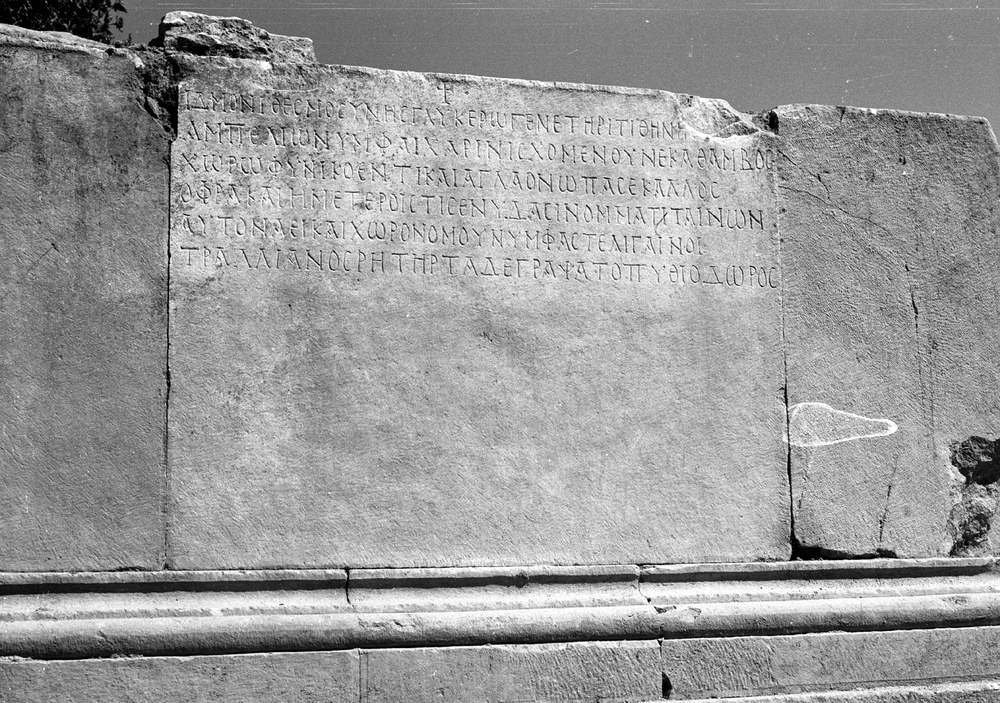
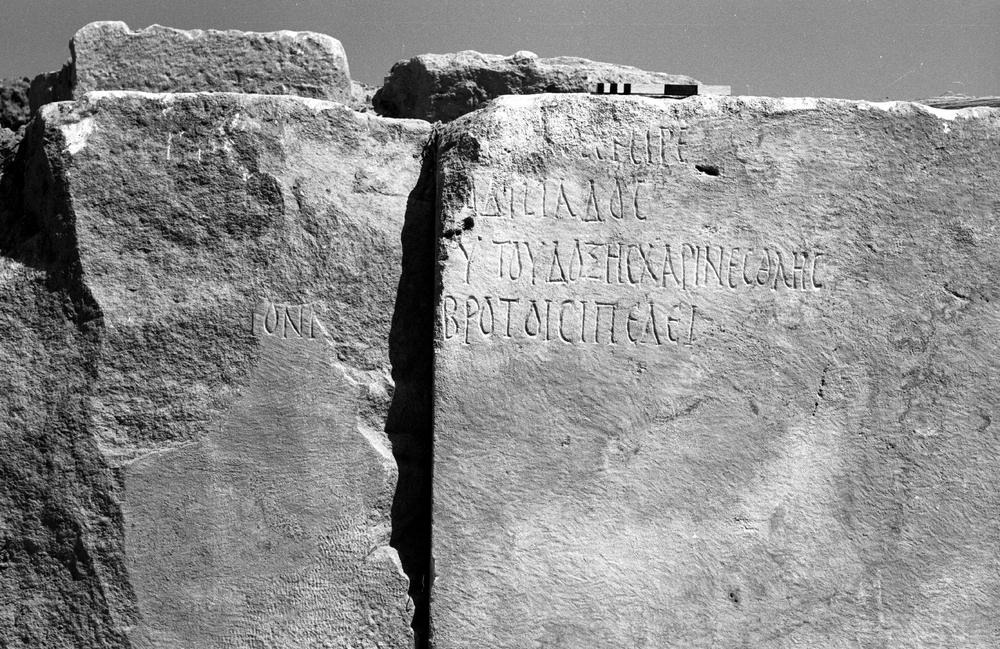
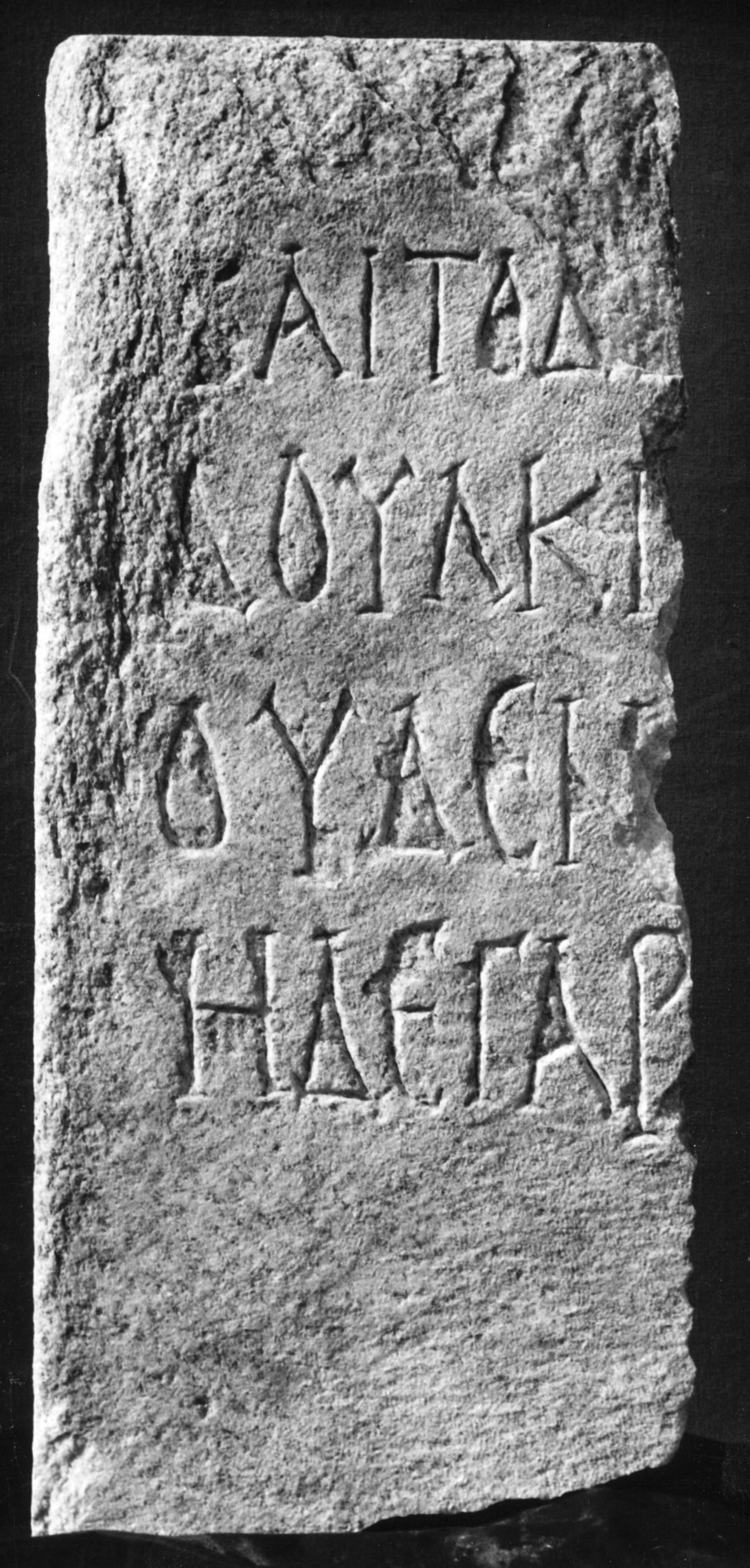
Description: Façade blocks
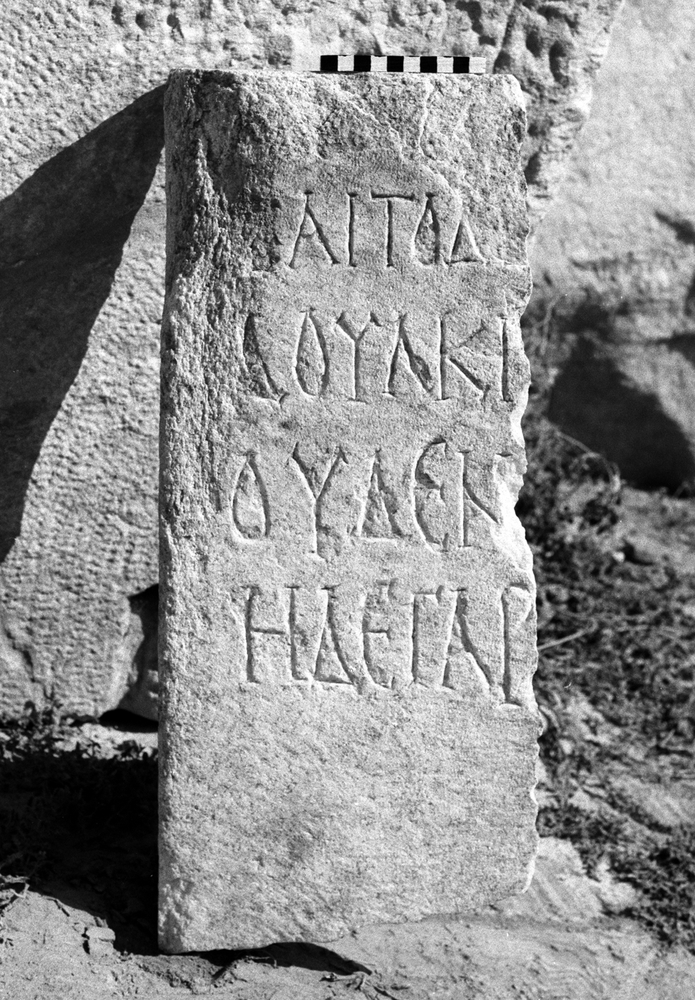
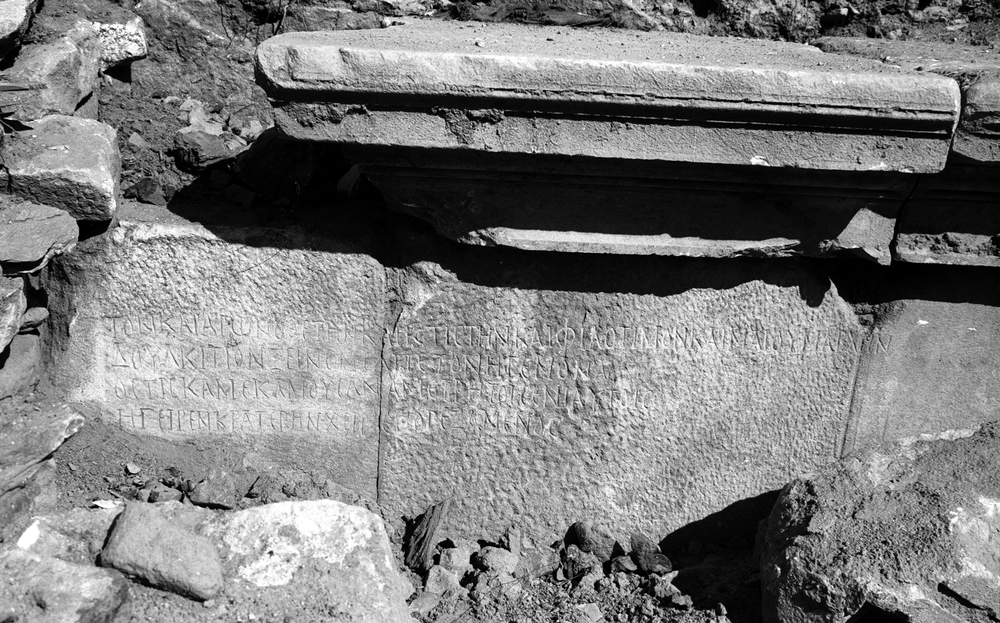
Text: i., ii. and iii are all cut, clearly set out as a group, on the façade, on the highest remaining course of blocks,
which was capped above by a moulded course. i. is cut on the northernmost of a series of projecting bastions; ii. is on the
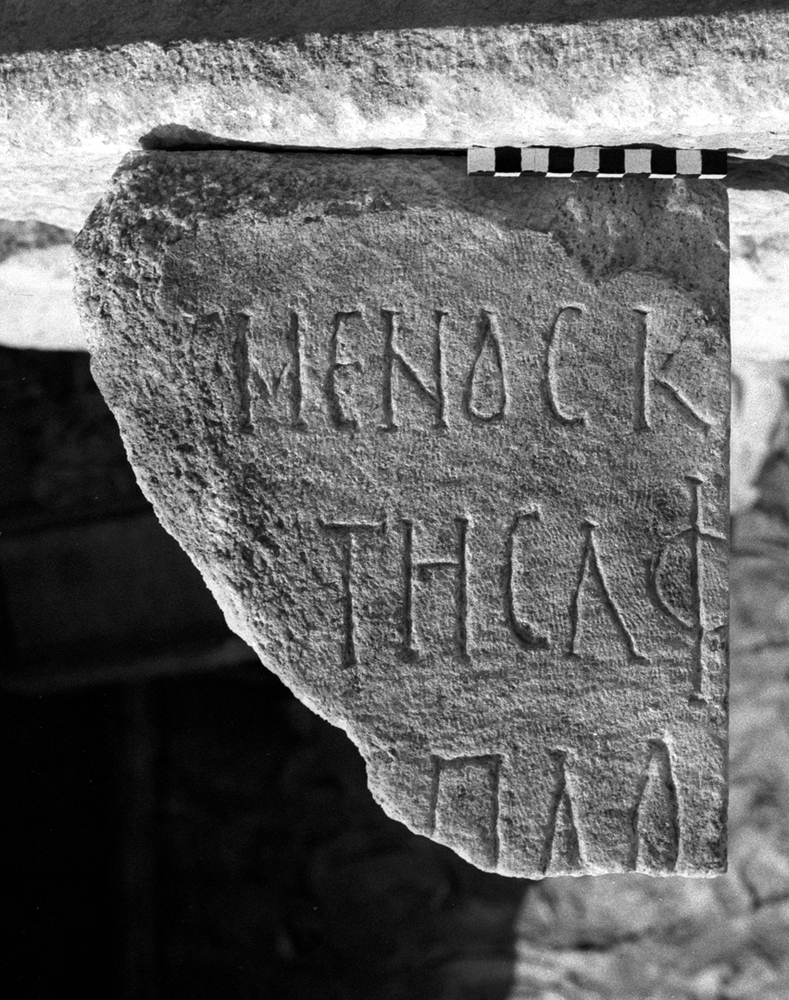
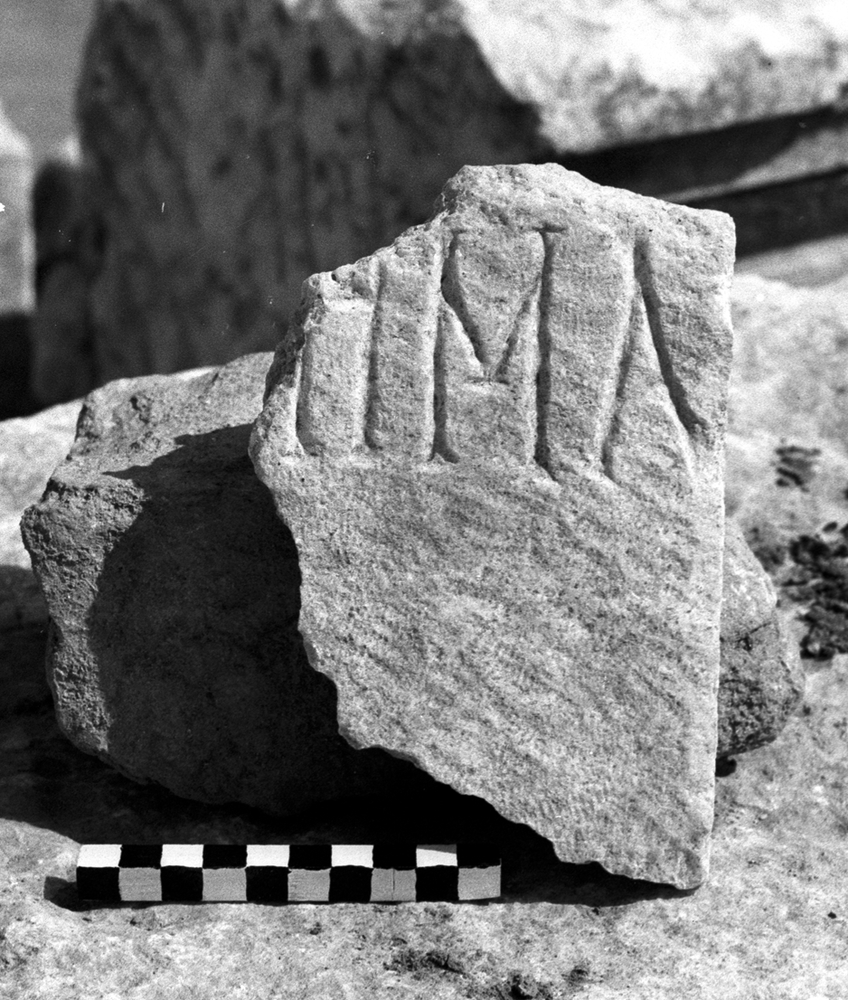
next bastion to the south, whose surface is largely lost; three loose fragments were found in 1983. The third bastion shows
no sign of any inscription; iii. is cut on the fourth. i. and ii. are on a smooth face, but iii. is cut partly on a rough
surface.
Letters: The lettering of all three is elongated, elegant and lunate, but the scripts are all slightly different. i: av. 0.04; ii:
0.055-0.06, with traces of red paint in letters; iii: 0.04-0.05, phi 0.09, with traces of red paint in letters.
Date: Mid fifth century. (titulature)
Findspot: Aphrodisias:
Place of Palms/South Agora, Agora Gate/Propylon:
on the façade, and three further loose fragments fallen from it; .
Original location: Place of Palms/South Agora, Agora Gate/Propylon
Last recorded location: Findspot
Interpretive
i
((Cross))
ἴδμονι θεϲμοϲύνηϲ γλυκερῷ γενετῆρι τιθήνηϲ |
Ἀμπελίῳ Νύμφαι χάριν ἴϲχομεν οὕνεκα θάμβοϲ |
χώρῳ φυνικόεντι καὶ ἀγλαὸν ὤπαϲε κάλλοϲ |
ὄφρα καὶ ἡμετέροιϲ τιϲ ἐν ὕδαϲιν ὄμμα τιταίνων |
5(5) αὐτὸν ἀεὶ καὶ χῶρον ὁμοῦ Νύμφαϲ τε λιγαίνοι. |
Τραλλιανὸϲ ῥητὴρ τάδ' ἐγράψατο Πυθιόδωροϲ
ii
καὶ τόδε [Νυμφάων τ]έμενοϲ Κ[αρεϲϲι?]ν̣ ἔγειρε |
Δουλκί[τιοϲ? κτίϲτη?]ϲ τῆϲ ⸢Ἀ⸣φ[ρ]ο̣διϲιάδοϲ |
οὐδὲν [φειϲάμενοϲ] πλούτου δόξηϲ χάριν ἐϲθλῆϲ· |
ἥδε γὰρ [ἀίδ]ι̣ον μ[ν]ῆμα βροτοῖϲιν πέλει.
iii
τὸν καὶ ἀγωνοθέτην καὶ κτίϲτην καὶ φιλότιμον καὶ Μαιουμάρχην |
Δουλκίτιον, ξεῖνε, μέλπε τὸν ἡγεμόνα |
ὅϲτιϲ κἀμὲ καμοῦϲαν ἀμετρήτοιϲ ἐνιαυτοῖϲ |
ἤγειρεν κρατερὴν χεῖρ' ἐπορεξάμενοϲ.
Diplomatic
i
†
ΙΔΜΟΝΙΘΕϹΜΟϹΥΝΗϹΓΛΥΚΕΡΩΓΕΝΕΤΗΡΙΤΙΘΗΝΗϹ |
ΑΜΠΕΛΙΩΝΥΜΦΑΙΧΑΡΙΝΙϹΧΟΜΕΝΟΥΝΕΚΑΘΑΜΒΟϹ |
ΧΩΡΩΦΥΝΙΚΟΕΝΤΙΚΑΙΑΓΛΑΟΝΩΠΑϹΕΚΑΛΛΟϹ |
ΟΦΡΑΚΑΙΗΜΕΤΕΡΟΙϹΤΙϹΕΝΥΔΑϹΙΝΟΜΜΑΤΙΤΑΙΝΩΝ |
5(5) ΑΥΤΟΝΑΕΙΚΑΙΧΩΡΟΝΟΜΟΥΝΥΜΦΑϹΤΕΛΙΓΑΙΝΟΙ |
ΤΡΑΛΛΙΑΝΟϹΡΗΤΗΡΤΑΔΕΓΡΑΨΑΤΟΠΥΘΙΟΔΩΡΟϹ
ii
ΚΑΙΤΟΔΕ[........]ΕΜΕΝΟϹΚ[......].ΕΓΕΙΡΕ |
ΔΟΥΛΚΙ[..........]ϹΤΗϹΛΦ[.].ΔΙϹΙΑΔΟϹ |
ΟΥΔΕΝ[..........]ΠΛΟΥΤΟΥΔΟΞΗϹΧΑΡΙΝΕϹΘΛΗϹ |
ΗΔΕΓΑΡ[...].ΟΝΜ[.]ΗΜΑΒΡΟΤΟΙϹΙΝΠΕΛΕΙ
iii
ΤΟΝΚΑΙΑΓΩΝΟΘΕΤΗΝΚΑΙΚΤΙϹΤΗΝΚΑΙΦΙΛΟΤΙΜΟΝΚΑΙΜΑΙΟΥΜΑΡΧΗΝ |
ΔΟΥΛΚΙΤΙΟΝΞΕΙΝΕΜΕΛΠΕΤΟΝΗΓΕΜΟΝΑ |
ΟϹΤΙϹΚΑΜΕΚΑΜΟΥϹΑΝΑΜΕΤΡΗΤΟΙϹΕΝΙΑΥΤΟΙϹ |
ΗΓΕΙΡΕΝΚΡΑΤΕΡΗΝΧΕΙΡΕΠΟΡΕΞΑΜΕΝΟϹ
English translation
Translation source: Chaniotis, 2024
(i): To Ampelios, learned in law, sweet father of his nurse, we Nymphs are grateful; for he gave wonder and splendid beauty to
(this) place of palms, so that anyone who, standing among our waters, turns his glance around, may always sing the praise
of him, and of the place, and of the Nymphs as well Pythiodoros, the orator from Tralles, wrote this.
(ii): Doulkitios, [builder] of Aphrodisias, raised up also this precinct [of the Nymphs, for the Karians?]; not at all sparing
with wealth for the sake of noble fame; for fame is what remains an eternal memorial for the mortals.
(iii): Stranger, sing the praise of Doulkitios, governor, also, president of contests, builder, lover of honour and Maioumarch.
Stretching out his mighty hand, he raised me too, who had suffered for innumerable years.
English translation
Translation source: ALA 2004
(i): To Ampelios, learned in law, sweet father of his motherland, we Nymphs are grateful, because he gave wonder and splendid
beauty to (scil. this) place of palms, so that anyone who, among our waters, turns his glance around, may always sing the praise both of him,
and of the place, and of the Nymphs as well Pythiodoros, the speaker from Tralles, wrote this.
(ii): Doulkitios, [founder?] of Aphrodisias, raised up this [work] also [---]; he [was unsparing] of wealth for the sake of good reputation, which is [a permanent?] memorial for mortals.
(iii): Stranger, sing of Doulkitios, the governor, giver of games and founder and lover of honour and Maioumarch, who, stretching
out his strong hand, raised me too, who had suffered for unnumbered years.
French translation
Translation source: Puech, 2002
(i): À ce grand connaisseur du droit, père de sa tendre mère nourricière, Ampélios, nous, les Nymphes, rendons grâce pour le
charme saisissant et l'éclatante splendeur qu'il a donnés à cette palmeraie, afin que toujours, en contemplant, parmi no flots,
le spectacle, on chante d'une même voix sa louange, celle du lieu et celle des Nymphes aussi. C'est un orateur de Tralles,
Pythiodôros, qui a composé ces vers.
German translation
Translation source: Merkelbach and Stauber, 1998
(i): Wir Nymphen wissen Dank dem Kenner der Gesetze und lieber Vater seine Amme Ampelius, weil er diesem von Palmen umgegeben
Ort Staunen und herrliche Schönheit gegeben hat, damit einer, der sein Auge auf das Wasser richtet, immer ihn und den Platz
und die Nymphen hell besinge.
Diese Verse hat geschrieben der Rhetor Pythiodoros aus Tralles.
(ii): Auch dieses Bauwerk hat Dulkitios erweckt, der (Neu-)Gründer von Aphrodisias; um des guten Ruhmes willen hat er seinen Reichtum
nicht geschont, denn dieser ist für die Menschen ein ewiges Denkmal.
(iii): Fremde, besinge sen Statthalter (i.e. praeses) Dulcitius, den Festspielleiter und Gründer und spender und Leiter des Maiumâs-Festes,
der auch mich (i.e. das Brunnenhaus), welches seit unzählbaren Jahren krank lag, wider errichtet hat, indem er seine starke
Hand ausstreckte
Bibliography
Recorded: New York University expedition, 80.28, 80.29 and 80.53
Publication: i-iii: Roueché, ALA 38, 39, 40 and plates x and xi, whence AE 1990.961, 1990.962, McCabe, PHI, 1996 714, 704, 717 , Merkelbach and Stauber, 1998 02/09/03, 02/09/08, 02/09/07 , Puech, 2002, 233 (i); Roueché, PPA 65 (iii) , whence PHI PPAphr 65; ALA 2004 38, 39, 40; IAph2007 4.202; Chaniotis, 2024 10, 11, 12.