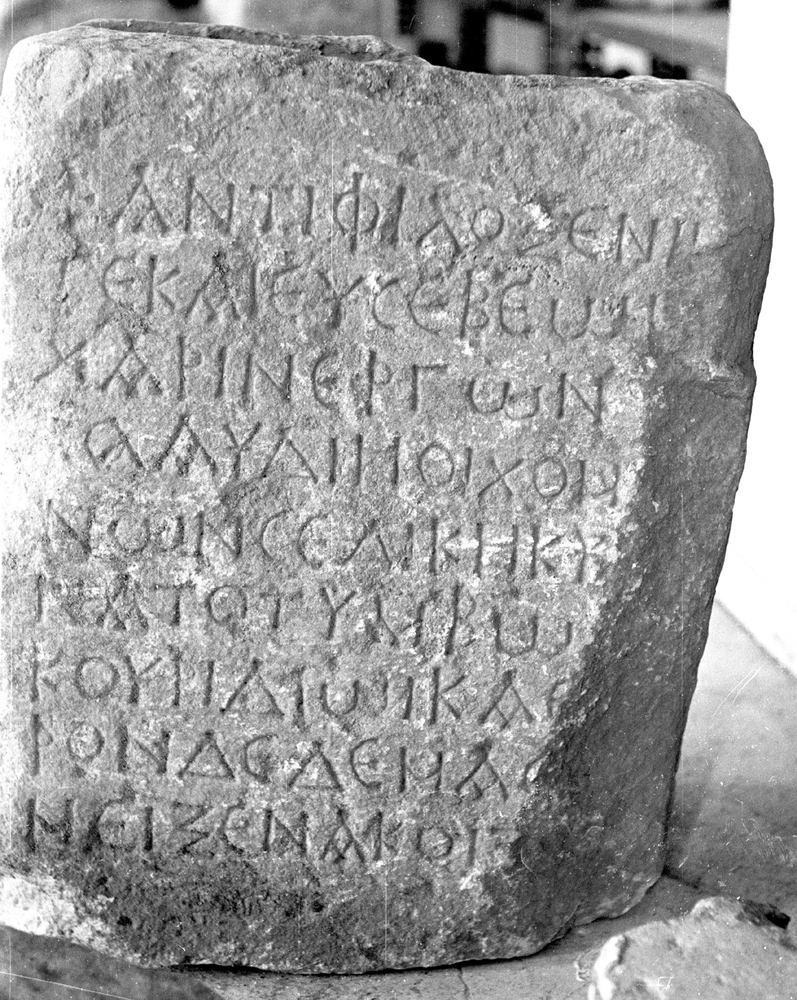
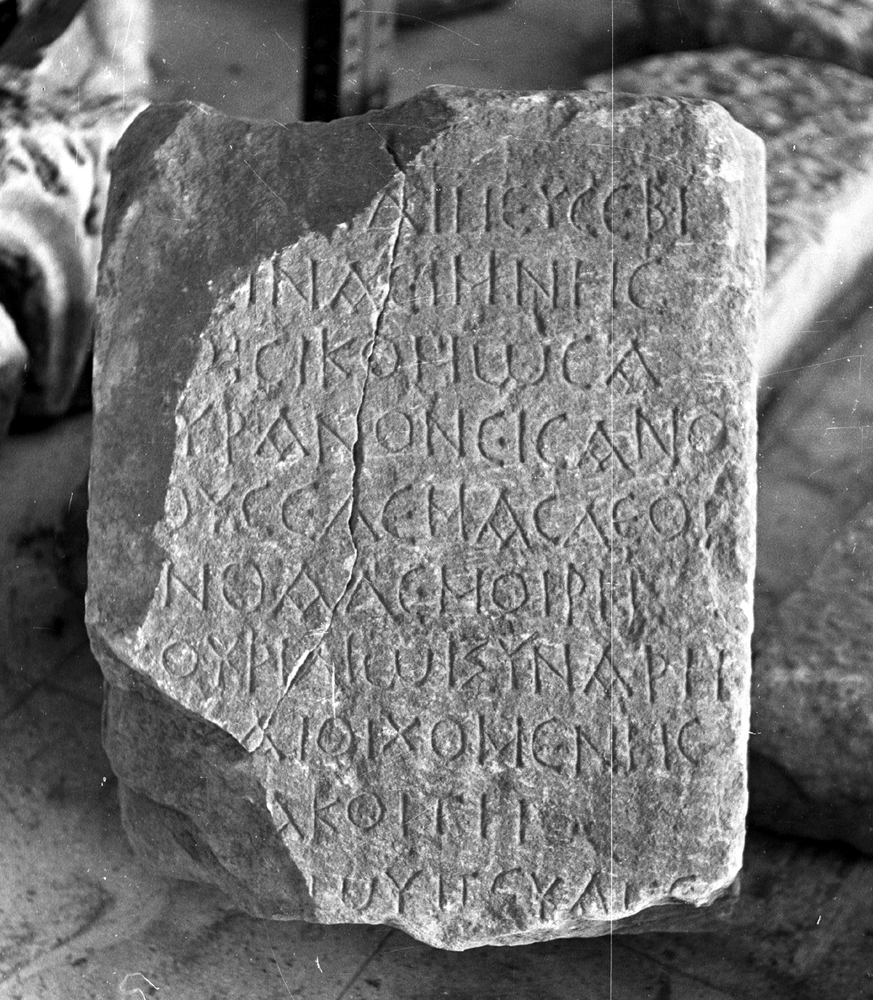
Description: A plain white marble
masonry block without moulding (w: 0.355 × h: 0.46 × d: 0.19).
Face a broken at right side; b broken on left side
and below.
Text:
Inscribed on two opposite faces.
Letters: 0.025-0.035; clear, lunate.
Date: Fourth-sixth century. (content, metre)
Findspot: Aphrodisias: Stray
Original location: Unknown.
Last recorded location: Museum.
Interpretive
a
((Cross)) ἀντὶ φιλοξενίη̣[ϲ] | τε καὶ εὐϲεβέων̣ | χάριν ἔργων |
Κ̣λαυδίη οἰχομ[έ-]|(5)νων ϲε Δίκη κυ[δή-]|νατο τύμβῳ |
κουριδίωι καθ̣[α-]|ρὸν δὲ δέμαϲ [ϲυμ-]|μεῖξεν ἀκοίτ̣[ῃ]
| ( vac. 1 line)
b
[Κλα]υδίη εὐϲεβί|[αιϲ]ιν ἀειμνήϲ|[τ]οιϲι κομῶϲα |
[ο]ὐρανὸν εἰϲανό|(5)[ρ]ουϲε, δέμαϲ δέ οἱ | [ἐ]νθάδε Μοίρη |
κουριδίωι ξυνάρη|[ρε κ]αὶ οἰχομένηϲ | [ϲὺν] ἀκοίτῃ |
(10) [τύμβ]ῳ ὑπ’εὐαγε|[------]
Diplomatic
a
† ΑΝΤΙΦΙΛΟΞΕΝΙ.[.] | ΤΕΚΑΙΕΥϹΕΒΕΩ. | ΧΑΡΙΝΕΡΓΩΝ |
.ΛΑΥΔΙΗΟΙΧΟΜ[.-] |(5)ΝΩΝϹΕΔΙΚΗΚΥ[..-] |ΝΑΤΟΤΥΜΒΩ |
ΚΟΥΡΙΔΙΩΙΚΑ.[.-] |ΡΟΝΔΕΔΕΜΑϹ[...-] |ΜΕΙΞΕΝΑΚΟΙ.[.]
| vacat
b
[...]ΥΔΙΗΕΥϹΕΒΙ |[...]ΙΝΑΕΙΜΝΗϹ|[.]ΟΙϹΙΚΟΜΩϹΑ |
[.]ΥΡΑΝΟΝΕΙϹΑΝΟ |(5)[.]ΟΥϹΕΔΕΜΑϹΔΕΟΙ | [.]ΝΘΑΔΕΜΟΙΡΗ |
ΚΟΥΡΙΔΙΩΙΞΥΝΑΡΗ |[...]ΑΙΟΙΧΟΜΕΝΗϹ | [...]ΑΚΟΙΤΗ |
(10) [....]ΩΥΠΕΥΑΓΕ |[------]
Apparatus
a.5-6: κυ[δή]νατο is far from certain; although the verb is used in epigrams in this kind of construction, I know of no parallel for its use
in the middle voice.
b.10: [τύμβ]ῳ, while tempting, is not a certain restoration.
English translation
Translation source: ALA 2004
(a): In repayment for hospitality, and in thanks for pious works, Claudia, Justice has honoured you with (scil. the) tomb of the dead, and has wedded your pure body (scil. with it as a) lawful husband.
(b): Claudia, who abounded in acts of piety which will ever be remembered, has rushed up to heaven, but Fate here below has joined
her body, even after death, with a wedded husband, a tomb(?), by the pure(?) . . .
German translation
Translation source: Merkelbach and Stauber, 1998
Justitia selbst hat dich, Claudia, im Grab der Dahingescheidenen ehrenvoll beigesetzt, als Dank für deine Gastfreundschaft
und für deine frommen Werke, und hat deine Gestalt bei deinem Ehemann beigesetzt.
Claudia, die in frommen Werken, welche man immer erinneren wird, blühte, ist zum Himmel empor aufgebrochen, aber die Schicksalsgöttin
hat hier die Gestalt der Verschiedenen mit ihrem Gatten im Grab zusammengeführt . . .
Bibliography
Recorded: New York University expedition brought by village children in 1970, 70.210
Publication: Roueché, ALA 153a and b and plate xxxvi (a only), whence McCabe, PHI, 1996 734, 735 , Merkelbach and Stauber, 1998 02/09/28 , ALA 2004 153, IAph2007 15.347.