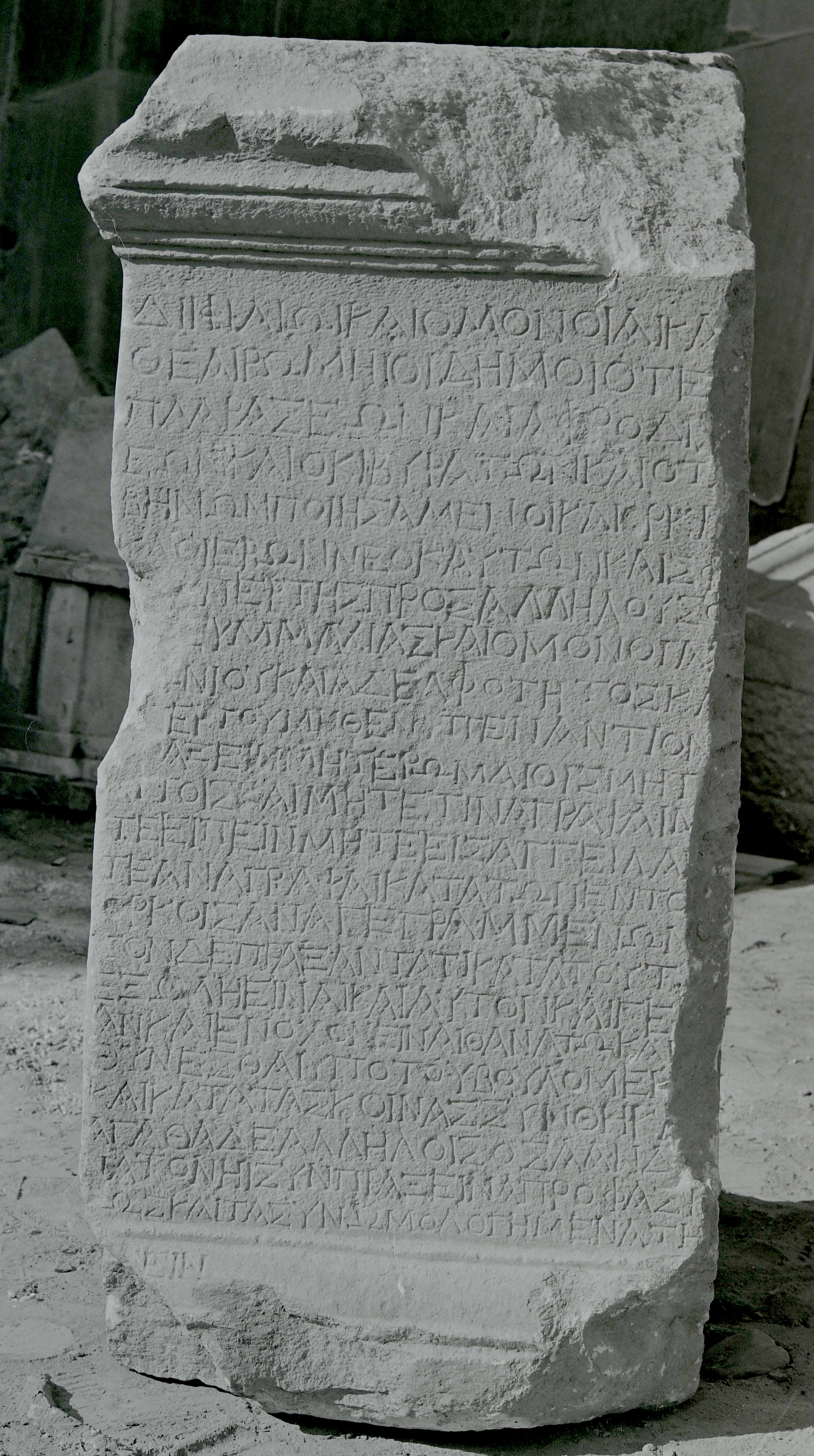
Description: White marble altar (w: 0.55 × h: 1.09 × d: 0.44) moulded at top and bottom of the front face, both mouldings badly damaged,
the face chipped all along the right edge and approximately in the centre of the left.
Text:
Inscribed on the face; the last line cut on the lower moulding.
Letters: av. 0.025, imperfectly aligned.
Date: Probably second century BCE (lettering)
Findspot: Aphrodisias:
Theatre, re-used in the north parodos.
Original location: Unknown
Last recorded location: Museum
Interpretive
Διῒ Φιλίωι καὶ Ὁμονοίαι κα[ὶ]
Θεᾶι Ῥώμηι οἱ δῆμοι ὁ τε [( vac. 1)]
Πλαρασέων καὶ Ἀφροδισ̣[ι-]
έων καὶ ὁ Κιβυρατῶν καὶ ὁ Τα̣-
5βηνῶν ποιησάμενοι καὶ ὅρκι[α]
καθ' ἱερῶν νεοκαύτων καὶ σφ[ά-]
[για] ὑ̣πὲρ τῆς πρὸς ἀλλήλους φ[ύσ-]
[ει] συμμαχίας καὶ ὁμονοίας
[αἰ]ωνίου καὶ ἀδελφότητος κα̣[ὶ]
10[ὑ]π̣ὲρ τοῦ μηθὲν ὑ̣π̣εναντίον
[π]ράξειν μήτε Ῥωμαίοις μήτ[ε]
α̣ὑ̣τοῖς καὶ μήτε τινὰ γ̣ράψαι μ̣[ή-]
τε εἰπεῖν, μήτε εἰσαγγεῖλα[ι μή-]
τε ἀναγράψαι κατὰ τῶν ἐν το[ῖς]
15ὅρκοις ἀναγεγραμμένων [( vac. 2)?]
τὸν δὲ πράξαντά τι κατὰ τούτ[ων]
ἐξώλη εἶναι, καὶ αὐτόν, καὶ γε[νε-]
άν, καὶ ἔνοχον εἶναι θανάτῳ, καὶ [εὐ-]
θύνεσθαι ὑπὸ τοῦ βουλομέν[ου]
20καὶ κατὰ τὰς κοινὰς συνθήκα̣[ς]
ἀγαθὰ δὲ ἀλλήλοις ὅσα ἂν δ[υ-]
νατὸν ἦι συνπράξειν ἀπροφασί[σ-]
τως καὶ τὰ συνωμολογημένα τη[ρ-]
[ή]σ̣ειν ( vac. 15)
Diplomatic
ΔΙΙΦΙΛΙΩΙΚΑΙΟΜΟΝΟΙΑΙΚΑ[.]
ΘΕΑΙΡΩΜΗΙΟΙΔΗΜΟΙΟΤΕ[.]
ΠΛΑΡΑΣΕΩΝΚΑΙΑΦΡΟΔΙ.[.-]
ΕΩΝΚΑΙΟΚΙΒΥΡΑΤΩΝΚΑΙΟΤ.
5ΒΗΝΩΝΠΟΙΗΣΑΜΕΝΟΙΚΑΙΟΡΚΙ[.]
ΚΑΘΙΕΡΩΝΝΕΟΚΑΥΤΩΝΚΑΙΣΦ[.-]
[...].ΠΕΡΤΗΣΠΡΟΣΑΛΛΗΛΟΥΣΦ[..-]
[..]ΣΥΜΜΑΧΙΑΣΚΑΙΟΜΟΝΟΙΑΣ
[..]ΩΝΙΟΥΚΑΙΑΔΕΛΦΟΤΗΤΟΣΚ.[.]
10[.].ΕΡΤΟΥΜΗΘΕΝ..ΕΝΑΝΤΙΟΝ
[.]ΡΑΞΕΙΝΜΗΤΕΡΩΜΑΙΟΙΣΜΗΤ[.]
..ΤΟΙΣΚΑΙΜΗΤΕΤΙΝΑ.ΡΑΨΑΙ.[.-]
ΤΕΕΙΠΕΙΝΜΗΤΕΕΙΣΑΓΓΕΙΛΑ[...-]
ΤΕΑΝΑΓΡΑΨΑΙΚΑΤΑΤΩΝΕΝΤΟ[..]
15ΟΡΚΟΙΣΑΝΑΓΕΓΡΑΜΜΕΝΩΝ[..]
ΤΟΝΔΕΠΡΑΞΑΝΤΑΤΙΚΑΤΑΤΟΥΤ[..]
ΕΞΩΛΗΕΙΝΑΙΚΑΙΑΥΤΟΝΚΑΙΓΕ[..-]
ΑΝΚΑΙΕΝΟΧΟΝΕΙΝΑΙΘΑΝΑΤΩΚΑΙ[..-]
ΘΥΝΕΣΘΑΙΥΠΟΤΟΥΒΟΥΛΟΜΕΝ[..]
20ΚΑΙΚΑΤΑΤΑΣΚΟΙΝΑΣΣΥΝΘΗΚ.[.]
ΑΓΑΘΑΔΕΑΛΛΗΛΟΙΣΟΣΑΑΝΔ[.-]
ΝΑΤΟΝΗΙΣΥΝΠΡΑΞΕΙΝΑΠΡΟΦΑΣΙ[.-]
ΤΩΣΚΑΙΤΑΣΥΝΩΜΟΛΟΓΗΜΕΝΑΤΗ[.-]
[.].ΕΙΝ
Apparatus
2: οἵ τε Reynolds, 1982, IAph2007
6-7: σφάγια seems inevitable here; the accusative case is imposed by the repetition of καὶ in this sentence
7: ΛΛ appear to have been cut twice, the first attempt being partially erased
7-8: φ[ύ] | [σει] suggested by L. Robert
10: Υ is partially damaged and the subsequent Π written as if the cutter saw ΤΓ, but ὑπεναντίον in such contexts is so common that there can be no doubt that it was intended
12: for Γ the cutter originally wrote Τ
English translation
Translation source: Reynolds, 1982
To Zeus Philios, Concord, and Dea Roma; (scil. dedicated by) the Peoples of Plarasa/Aphrodisias, of Kibyra, and of Tabae who have taken oaths over newly-burnt offerings
and made blood-offerings for their natural alliance, eternal concord, and brotherhood with each other; and in order that they
shall take no action in opposition either to the Romans or to each other and that no one shall draft, advocate, introduce
a proposal, or record anything contrary to what has been written in the sworn agreements; and that anyone who does anything
in contravention of these shall be utterly destroyed, himself and his family, liable to a capital penalty and open to prosecution
by anyone who wishes and in accordance with their common agreements, and that they shall jointly promote each other's advantage
in every possible way, unreservedly; and that they shall observe what has been agreed.
Bibliography
Recorded: New York University expedition 69.237
Publication: Mellor, 1975 49 (description), whence Robert, Bulletin Épigraphique 1977.76 (mention); Reynolds, 1980 p. 70; Reynolds, 1982 1 , whence McCabe, PHI, 1996 179 , IAph2007 8.210.