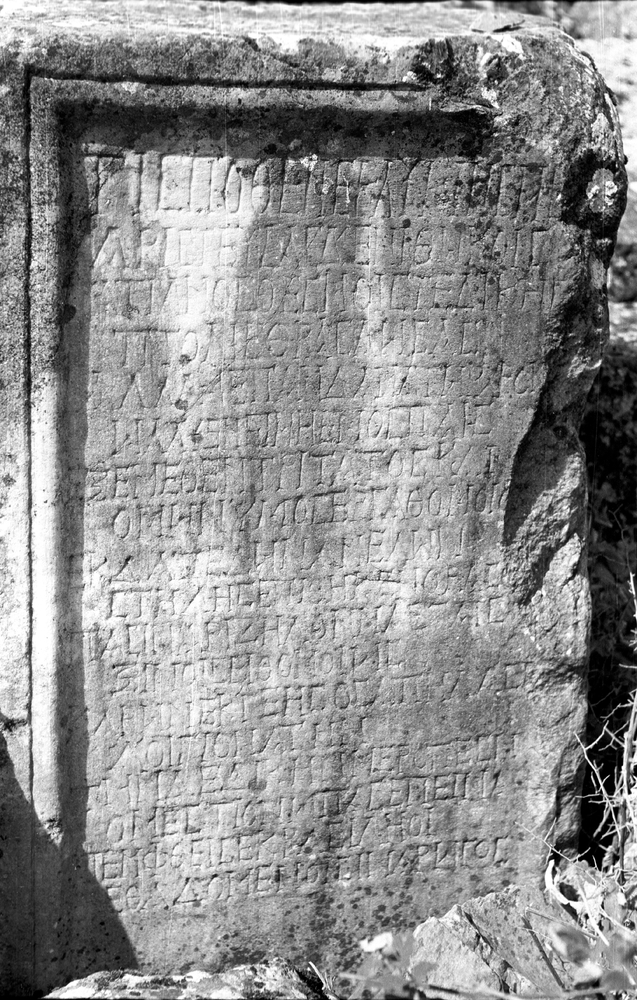
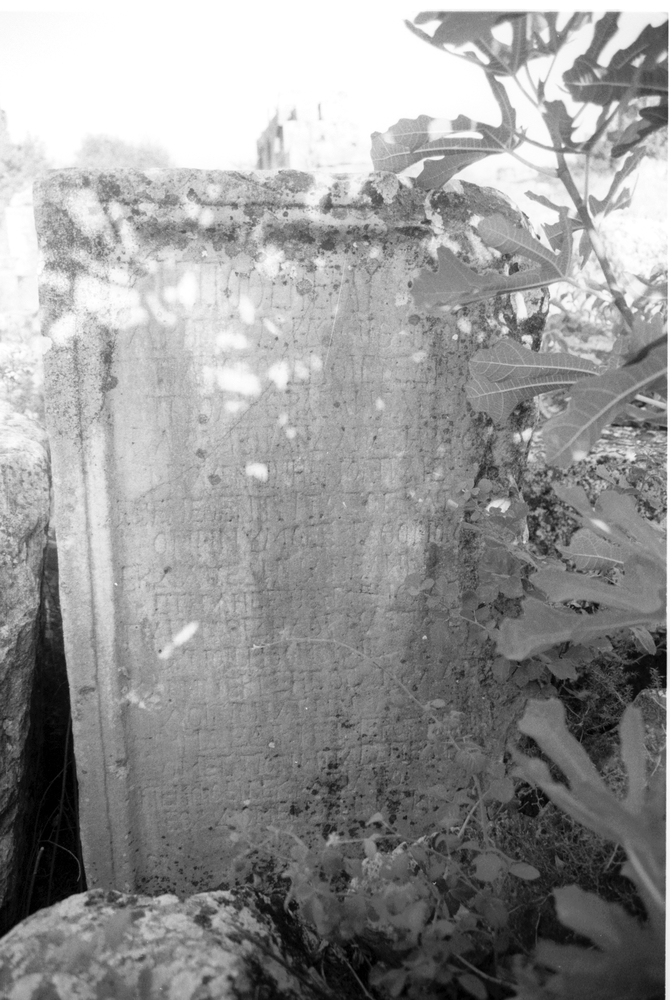
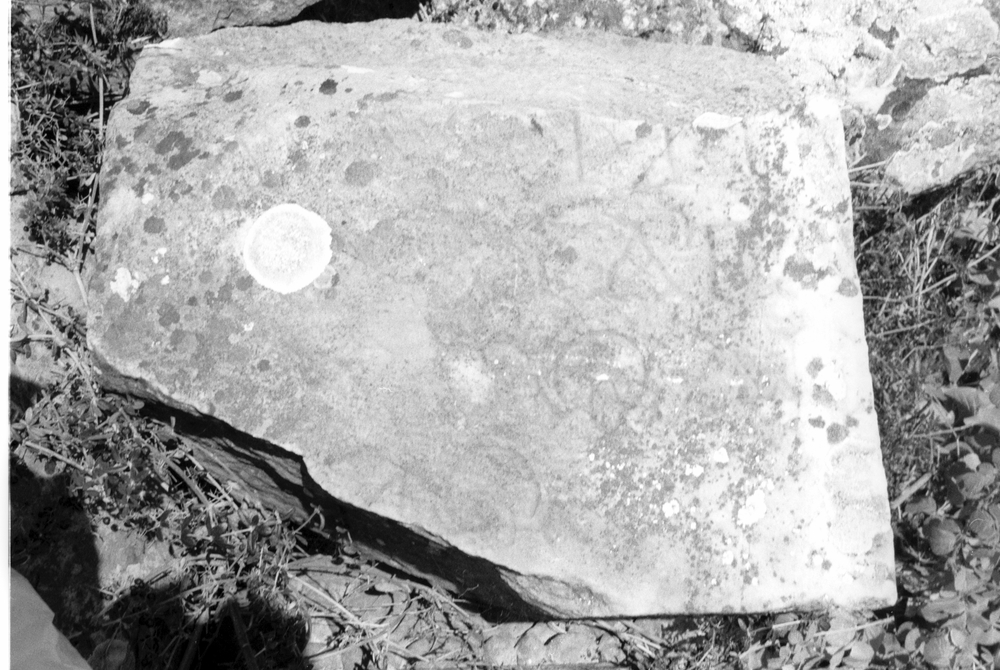
Description: A white marble rectangular
statue base shaft (w: 1.18 × h: 0.60 × d: 0.48) with panels within moulded edges on three sides.
Text:
Inscribed on the central panel; last letter in line 15 cut on right moulding.
Letters: Line 1, 0.045, lines 2 ff., av. 0.03; elongated, irregular.
Date: First half of the fifth century CE (prosopography)
Findspot: Aphrodisias:
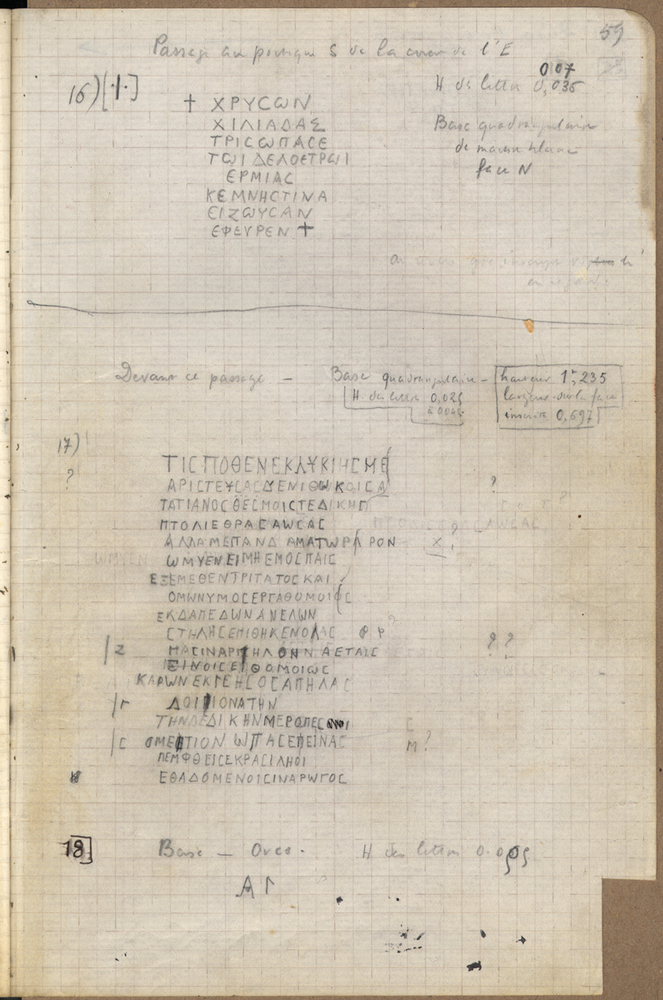
Hadrianic Baths, East court/Palaestra, South portico: 'devant ce passage' (Boulanger, referring to the previous entry,
5.204: 'Passage au portique s(ud) de la cour de l'E(st) ').
Original location: Hadrianic Baths, East court/Palaestra, South portico
Last recorded location: Findspot: slightly north of the southern colonnade (1994).
Interpretive
τίϲ; πόθεν; ἐκ Λυκίηϲ μέ[ν], | ἀριϲτεύϲαϲ δ' ἐνὶ θώκοιϲ |
Τατιανὸϲ θεϲμοῖϲ τε δίκηϲ | πτολίεθρα σαώϲαϲ. ( vac. 3) |
(5) ἀλλά με πανδαμάτωρ χρόν[οϲ] | ὤλλυεν, εἰ μὴ ἐμὸϲ παῖϲ |
ἐξ ἐμέθεν̣ τρίτατοϲ καὶ | ὁμώνυμοϲ ἔργα θ' ὅμοιο[ϲ] |
5ἐκ δαπέδων ἀνελὼν | (10) ϲτήληϲ ἔπι θῆκεν ὁρᾶϲθ̣[αι] |
πᾶϲιν ἀριζηλ̣ον ναέταιϲ | ξίνοιϲει θ'ὁμοίωϲ ( vac. 3) |
Καρῶν ἐκ γέηϲ ὃϲ ἀπήλαϲε | λοίγιον ἄτην ( vac. 3) |
(15) τὴν δὲ δίκην μερόπεϲιν | ὁμέϲτιον ὤπαϲ’ἐπεῖνα(ι) |
πεμφθεὶϲ ἐκ βαϲιλῆοϲ | ἔθ' ἁδομένοιϲιν ἀρωγόϲ.
Diplomatic
ΤΙϹΠΟΘΕΝΕΚΛΥΚΙΗϹΜΕ[.] | ΑΡΙϹΤΕΥϹΑϹΔΕΝΙΘΩΚΟΙϹ |
ΤΑΤΙΑΝΟϹΘΕϹΜΟΙϹΤΕΔΙΚΗϹ | ΠΤΟΛΙΕΘΡΑΣΑΩϹΑϹ |
(5) ΑΛΛΑΜΕΠΑΝΔΑΜΑΤΩΡΧΡΟΝ[..] | ΩΛΛΥΕΝΕΙΜΗΕΜΟϹΠΑΙϹ |
ΕΞΕΜΕΘΕ.ΤΡΙΤΑΤΟϹΚΑΙ | ΟΜΩΝΥΜΟϹΕΡΓΑΘΟΜΟΙΟ[.] |
5ΕΚΔΑΠΕΔΩΝΑΝΕΛΩΝ | (10) ϹΤΗΛΗϹΕΠΙΘΗΚΕΝΟΡΑϹ.[..] |
ΠΑϹΙΝΑΡΙΖΗ.ΟΝΝΑΕΤΑΙϹ | ΞΙΝΟΙϹΕΙΘΟΜΟΙΩϹ |
ΚΑΡΩΝΕΚΓΕΗϹΟϹΑΠΗΛΑϹΕ | ΛΟΙΓΙΟΝΑΤΗΝ |
(15) ΤΗΝΔΕΔΙΚΗΝΜΕΡΟΠΕϹΙΝ | ΟΜΕϹΤΙΟΝΩΠΑϹΕΠΕΙΝΑ(ι) |
ΠΕΜΦΘΕΙϹΕΚΒΑϹΙΛΗΟϹ | ΕΘΑΔΟΜΕΝΟΙϹΙΝΑΡΩΓΟϹ
Apparatus
4: ξαώσας (misprint) ALA 2004, IAph2007
7: Ν corrected from Μ.
10: στήλης ἐπίθηκεν Robert, Hellenica IV, Roueché, ALA; στήλαις ἐπέθηκεν Livrea, 1997; στήλης ἔπι θῆκεν Peek, 1954, Feissel, 1991, ALA 2004 || ὁρᾶσ[θαι] Robert, Hellenica IV
15: μερόπεσ<σ>ιν Peek, 1954
16: ὤπασε πείνᾳ Robert, Hellenica IV, Livrea, 1997; ὤπασ' ἐπεῖναι Peek, 1954, Merkelbach and Stauber, 1998; πο̣ινᾷ Merkelbach, 1970 ; we see a faint upright as the last letter in the line; ὤπασ' ἐπεῖνα̣ι (misprint) ALA 2004, IAph2007
18: ἐε̣λ̣δομένοισον Peek, 1954, Merkelbach, 1970, Feissel, Bulletin Épigraphique; ἔθ' ἁδομένοισιν Roueché, ALA, Merkelbach and Stauber, 1998, IAph2007
English translation
Translation source: IAph2007
Who is this? From where? (scil. I am) Tatianos from Lycia, who held the highest officies, and by just laws saved cities. But all-conquering time would have
destroyed me if my child, of the third generation, who has the same name and similar achievements, had not lifted me up from
the ground and set me on a monument, to be seen and admired by all, local inhabitants and strangers alike. (scil. It is) he who drove deadly ruin from the land of the Carians, and gave justice to dwell among men, when he had been sent
from the emperor as a defender for the people, who still rejoice.
German translation
Translation source: Merkelbach and Stauber, 1998
Wer ist dieser? Und woher? Aus Lykien, Tatianos, der sich auf dem Richterstuhl ausgezeichnet und die Städte durch seine Rechtsprechung
gerettet hat. Aber die allesbezwingende Zeit hätte mich (das Standbild) vernichtet, wehnn nicht mein Urenkel gleichen Namens,
auch an Taten mit gleich, mich vom Boden aufgehoben und sichtbar auf die Säule gesetzt hätte, sodass ich für alle Bewohner
und gleichermassen für die Fremden beneidenswert bin. (mein Urenkel) der dem verderblichen Schaden (der Rechtlosigkeit) aus
dem Land der Karer vertrieben und es erreicht hat, das Iustitia für die Menschen eine Hausgenossin wurde, als er vom Kaiser
ihnen, die sich daran erfreuten, als Helfer geschickt wurde.
Bibliography
Recorded: Mendel, 1905; Boulanger, notebooks A, 59, no. 17, whence B, 9, no. 10; J. and L. Robert, 1946 Notebook 40 (1946); New York University expedition
Publication: Robert, Hellenica IV 47-53, and plate vii, from Boulanger and his own copy , whence Robert, Bulletin Épigraphique 1949.178 , AE 1949.219 ; Peek, 1954, whence SEG 15.661 , Merkelbach, 1970 , whence Robert, Bulletin Épigraphique 1971.616 ; Roueché, ALA 37 and plate x, whence McCabe, PHI, 1996 725 , LSA 193, Feissel, 1991 , Livrea, 1997, on which Feissel, Bulletin Épigraphique 1998.646 , Merkelbach and Stauber, 1998 02/09/24 , SEG 47.1555 ; ALA 2004 37; Smith, 2007 B 42 (description); IAph2007 5.204.